


Ready to start planning your dream elopement in Italy?
By Camilla M — Venice Elopement Photographer & Experience Designer
I want to start with something honest: I have photographed elopements in Venice in February fog so thick you could barely see three metres ahead, in July heat that could melt stones, in October when the light becomes something I can only describe as impossible — and in every single one of those sessions, I have watched couples stop mid-walk, look at each other, and quietly understand that they made exactly the right choice.
Venice does something to people. It slows them down. It makes them present. It strips away the noise of a hundred guests and the anxiety of a seating chart and replaces it with just — this. Two people. A city that has been the backdrop for love stories for a thousand years. And a day that belongs entirely to them.
I’m Camilla. I’m Italian, I’m based in Venice, and I have been photographing elopements here for years. This guide is everything I know about eloping in Venice — written the way I’d explain it to a couple sitting across from me on a video call, not the way a travel website would describe it. Real information, real opinions, no filler.
If you’re thinking about a Venice elopement, read this from start to finish. It will save you months of research and probably prevent a few planning mistakes.
1. Why Venice — and why it works especially well for elopements
I get asked often why couples choose Venice over somewhere easier to navigate, somewhere less crowded, somewhere with a beach or a vineyard or a sweeping countryside view. The answer is almost always the same: Venice has something those places don’t. It has weight.
The city is built across 121 small islands, threaded together by canals and 435 bridges. It has been slowly sinking since the day it was founded, and it is still standing, more than a thousand years later. Every stone, every bridge, every canal carries that contradiction — ambition and decay, beauty and impermanence, existing in the same place at the same time. When you walk through it with the person you’re choosing to spend your life with, that contradiction is there whether you’re thinking about it or not. It enters the photographs without being asked.
There’s something specific about what an elopement does to Venice, or what Venice does to an elopement. This is a city that was never built for crowds — it was built for small parties moving through narrow calli, for two people who have to walk close together because the street won’t allow otherwise, for tiny bridges where you have to stop and wait your turn, for courtyards hidden behind heavy doors that open onto complete silence. The larger your group, the more Venice resists you. With just the two of you, it gives itself up completely.
I’ve photographed couples who flew in specifically for the elopement and couples who folded it into a longer Italy honeymoon, stopping here for a day or two on their way somewhere else. I’ve photographed newlyweds who’d already married legally at home and were here purely for the symbolic ceremony, couples exchanging vows by the water for the first and only time, and couples who eloped completely — no other event, no other celebration, nobody else in on it at all. What connects all of them in the images afterward is a kind of quiet disbelief. Venice makes it very hard to take a bad photograph when the light is right and two people are actually present with each other, rather than performing for a camera.
And then there’s the thing that makes the whole day easier than almost anywhere else I work: nothing here moves on wheels. No cars, no motorbikes, no traffic to plan around, no parking to worry about. Your entire elopement day happens at the pace of feet and water — which turns out to be one of the best gifts a wedding day can give two people who are trying, for once, not to rush anything. I’ll get into exactly how that works in the next section, because it changes more about your planning than people expect.
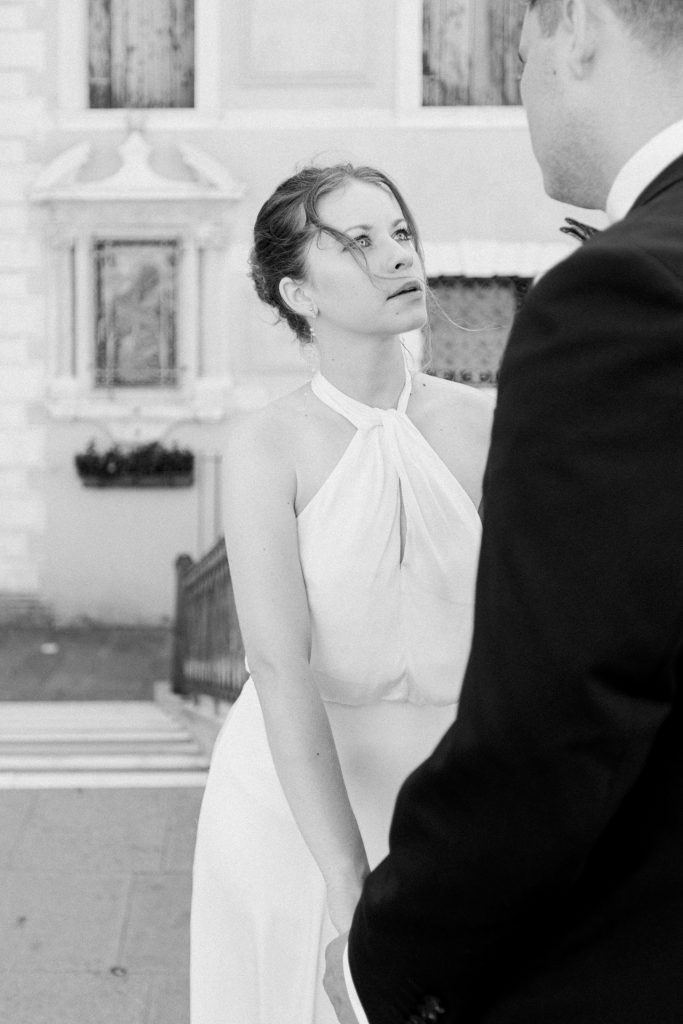
Summer sunrise elopement in Venice, through the quiet streets of San Marco before the city wakes up.
2. Understanding Venice — the sestieri and the lagoon
Venice is small enough to cross on foot, start to finish, in under an hour. And yet it doesn’t feel like one place. It feels like six.
The historic city is divided into six sestieri — literally “sixths” — a division older than most nations: San Marco, Castello, Cannaregio, San Polo, Santa Croce, and Dorsoduro. Each has its own personality, its own relationship with tourists, its own quality of light, and — this is the part that actually matters for your elopement — its own emotional register. San Marco is monumental and theatrical. Cannaregio is where Venetians actually live. Dorsoduro is artistic and sun-warmed. San Polo is ancient and a little mysterious. Santa Croce is the quiet one nobody photographs. Castello is grand and spacious, with room to breathe.
None of them are far from each other. A brisk walk gets you from the edge of San Marco to the heart of Dorsoduro in about fifteen minutes, or from Cannaregio to the Rialto in ten. This is the single biggest difference between planning here and planning somewhere like Lake Como or the Dolomites, where I’m working with drives of twenty minutes to two hours between locations. In Venice, the constraint isn’t distance. It’s mood, light, and the tide of the day — how a place that’s completely empty at 6am becomes unrecognisable by 10.
Beyond the six sestieri, the lagoon holds a second layer of possibility: islands that are technically part of Venice but feel like leaving it entirely. San Giorgio Maggiore, five minutes across the water, gives you Venice as a skyline rather than a street. Giudecca is wider, quieter, industrial-turned-luxurious. Burano is candy-coloured and joyful. Torcello is nearly empty, ancient, and a little melancholy. None of them are reachable on foot — every one means a boat — which is exactly why they change the character of a day rather than just the scenery.
Here’s the honest shorthand, before I go into real depth on each in section 6:
| If you’re drawn to… | Look toward… |
|---|---|
| Grand, iconic, unmistakably Venice | San Marco |
| A city that feels real and inhabited | Cannaregio |
| Warmth, art, and golden-hour light | Dorsoduro |
| History without the crowds | San Polo |
| Total quiet, off any map | Santa Croce |
| Scale, space, and the Biennale | Castello |
| Colour, distance, a day on the water | The lagoon islands |
Most Venice elopements I design don’t stay in one sestiere. They move — a sunrise in one, a ceremony in another, golden hour somewhere else entirely — and because nothing here is more than a short walk or a five-minute boat ride away, that movement never costs you the day the way it would somewhere built around long drives. The question I’m actually asking when we plan yours isn’t “which neighbourhood.” It’s “in what order, and at what hour, does this city show you its best self.”


A special day in Venice including a water taxi ride, strolling around the city and a unique dinner reservation on the canal.
3. How You Actually Move Around Venice
Every other place I photograph in Italy begins with a car. In the Dolomites it’s the car and the cable cars, and on Lake Como it’s the car and the boat. Venice begins at the exact point where the car stops. The road runs out at Piazzale Roma, on the western edge of the city, and at the Tronchetto parking island beside it. From there on, everything moves on foot or on water.
That sounds like a complication, and it’s actually the opposite. There’s no traffic to plan around, nowhere to park, and no drives eating into the light. The city has three speeds: walking, the public water bus, and a private boat. A good day depends on knowing which one to use and when. Here’s how all of it works, from the moment you land until the last frame of the day.
Getting to Venice
By air. Most couples fly into Venice Marco Polo (VCE), which sits on the mainland across the lagoon. From there you have four ways into the city. The right one depends mostly on how much luggage you have and where your hotel door is.
| Option | Where it takes you | Time | Cost (2026) |
|---|---|---|---|
| Aerobus (ACTV line 5 or ATVO coach) | Piazzale Roma | ~20–25 min | from €10 per person |
| Land taxi | Piazzale Roma | ~15–20 min | €40 fixed fare |
| Alilaguna water bus | Stops across the city: Rialto, San Marco, Zattere, Giudecca and more | roughly 60–90 min, depending on line and stop | €18 per person, including one large bag and one hand luggage (€4 per extra bag) |
| Private water taxi | Your hotel’s water entrance, if it has one | ~25–30 min | typically €140–€160 per boat; confirm when booking |
Alilaguna is the most beautiful slow arrival, and the two main lines are very different journeys. The Orange Line sails straight up the Grand Canal, stopping at Guglie, San Stae, Rialto, Sant’Angelo, Ca’ Rezzonico and Santa Maria del Giglio, which is the stop for the Gritti. The Blue Line takes the long way round via Murano and the Lido, then continues to San Zaccaria, San Marco, the Zattere, Giudecca and the station. The boat dock is a 7–10 minute walk from arrivals along a covered walkway, so allow time for it if you’re carrying bags.
A private water taxi is a treat, but it’s also the one boat I’d build into the budget before any other, after the one on your wedding day. It takes you from the runway to your door in under half an hour, with the whole lagoon opening up in front of you on the way in.
Via Treviso (TSF). Some budget airlines fly into Treviso instead, about 40 km inland, so check which “Venice” is on your ticket. Airport coaches run to Piazzale Roma (ATVO) or to the Tronchetto (Barzi) in roughly 40 to 70 minutes, depending on the operator.
By train. Book to Venezia Santa Lucia, not Venezia Mestre. Mestre is on the mainland, and most fast trains stop there first. When you walk out of Santa Lucia, the Grand Canal is right in front of you. High-speed trains take about two and a quarter hours from Milan, around two from Florence, and just under four from Rome. If you’re pairing Venice with Lake Como or Tuscany, the train is almost always easier than driving.
By car. The road ends at the multi-storey garages at Piazzale Roma and the Tronchetto. Book a space in advance in high season, or return your rental car on arrival, since several rental companies have desks at Piazzale Roma. Driving makes the most sense when Venice is one half of a bigger trip. Cortina, in the Dolomites, is about two hours from Venice airport.
The last few hundred metres
Most arrival stress in Venice doesn’t come from the flight. It comes from the final stretch between the boat or bus stop and your hotel door, which usually involves bridges with steps and your heaviest suitcase.
A few things make it painless. First, not every door takes a boat. A water taxi can only drop you where there’s a landing it’s allowed to use, so ask your hotel whether it has one before you book a door-to-door transfer. Second, porters exist. The Cooperativa Trasbagagli works from Piazzale Roma, the Tronchetto and the airport, and will carry your luggage to your hotel while you walk in unburdened. Many hotels will also help arrange this if you ask ahead. Third, travel with your wedding outfits as hand luggage. Carry the dress or suit in a garment bag and let the heavy cases go with the porter.
The Venice Access Fee: why it still concerns you
On peak days, Venice charges day visitors an access fee. As overnight guests you won’t pay it. On fee days, though, you still need to show a free exemption code, and any guests visiting just for the day may need to pay.
- When: In 2026 the fee applied on 60 selected days between 3 April and 26 July, mostly weekends, holidays and long weekends, from 8:30 to 16:00. Outside those days and hours, nothing is required at all.
- For the two of you: If you’re staying overnight anywhere in the Municipality of Venice, you’re exempt. That includes the historic centre, the islands and Mestre. You still need a free exemption voucher with a QR code, which you can get on the official site, cda.ve.it, and many hotels send instructions before you arrive.
- The sunrise detail: Arriving before 8:30 on a fee day doesn’t exempt you from registering. Keep your QR code with you until 16:00.
- For your guests: A guest coming just for the day on a fee day pays €5 if they book at least four days ahead, or €10 after that. Attending a wedding doesn’t count as an exemption. Children under 14 and residents of the Veneto region don’t pay.
- Where it applies: The fee covers the historic city, including Giudecca and San Giorgio Maggiore. In 2026, Murano, Burano, Torcello and the Lido were excluded.
- 2027: The calendar hasn’t been confirmed yet. I check it against your date as part of planning.
Anyone who can’t show a valid code during a check can be fined €25–€150. The fee is easy to deal with, but it’s also easy to forget, which is why it sits on my planning checklist and not yours.
On foot: the backbone of every Venice elopement
Most of your day will be walked, and that’s a gift. Venice is small and dense, and it rewards slowness more than any city I know. Here are the distances that come up most often, at an unhurried pace without stops:
| From → To | On foot |
|---|---|
| Santa Lucia (Train station) → Rialto | ~20–25 min |
| Santa Lucia (Train station) → Piazza San Marco | ~30–40 min |
| Rialto → Piazza San Marco | ~10 min |
| Accademia Bridge → Piazza San Marco | ~10–15 min |
| Accademia Bridge → Zattere waterfront | ~5–10 min |
| Piazza San Marco → Fondamente Nove (boats to Burano) | ~20 min |
| Piazza San Marco → the Arsenale gates | ~15 min |
Those times assume an empty city. At eleven on a May morning, the walk from the station to Rialto can take twice as long, while the same walk at six takes almost nothing. That difference shapes every timeline I build. Phone maps also struggle in the narrowest calli, where the signal bounces off stone. The yellow signs painted on corners, reading Per Rialto and Per S. Marco, are more reliable than GPS. I plan routes in wedding clothes by counting bridges rather than metres, because some bridges have many more steps than others, and there’s almost always a flatter way round.
One local rule changes one small thing about your day. Venice asks visitors to keep moving on bridges and not to sit, eat or drink on monuments, church steps, bridges, wells or quaysides, especially around San Marco. Fines run from €25 to €500. So the champagne toast happens on a boat, a hotel terrace or at a café table, never on the steps of a bridge. Those settings are prettier anyway.
The vaporetto
The vaporetto is Venice’s public water bus, run by ACTV. It’s the city’s real transport network, used by everyone from schoolchildren to fishmongers. Fares for 2026:
- Single ticket: €9.50, valid for 75 minutes, with changes allowed
- Passes: €25 for 24 hours, €35 for 48 hours, €45 for 72 hours, €65 for 7 days, each counted from the moment you first validate
- Contactless: you can tap a bank card at the gate for a single ticket
- Children: under 6 travel free
- Not included: airport routes and Alilaguna need separate tickets
Validate your ticket every time you board, including when you change boats.
The lines you’re most likely to use:
- Line 1 is the slow Grand Canal boat, stopping everywhere. It takes about 35–45 minutes from the station to San Marco.
- Line 2 is the faster route, about 25–30 minutes on the same trip.
- Line 12 leaves from Fondamente Nove for Murano and Burano, about 45 minutes to Burano.
- Line 9 is a five-minute shuttle between Burano and Torcello.
- A night line runs through the small hours.
I love the vaporetto. Line 1 at dusk, sitting at the open back of the boat, is one of the great cheap pleasures in Europe. It’s perfect the day before your elopement, for getting your bearings and seeing the Grand Canal for the first time, and the day after. On the day itself I rarely use it. It runs to its own timetable, it’s often full, and a train of silk on a crowded pontoon is nobody’s idea of fun. When we need water on your wedding day, it’s a private boat.
For couples with limited mobility, the vaporetto is often the most practical way around the city. Wheelchair users and holders of the EU Disability Card pay €1.50 per journey. I cover accessibility properly in section 11.
The traghetto
The traghetto is a two-oared gondola that ferries people across the Grand Canal where there’s no bridge nearby. A crossing costs visitors €2 and takes a couple of minutes, and Venetians ride it standing up. It’s the cheapest gondola moment in the city, and on an elopement day it can make a lovely spontaneous one. Crossings and hours change, though, so I never build a timeline around one.
Private boats: water taxis and gondolas
Water taxis are priced per boat, not per person, and carry up to around ten passengers. The biggest operator, the Consorzio Motoscafi Venezia, runs more than a hundred of them.
- Airport transfers typically cost €140–€160.
- Short hops within the city, such as Piazzale Roma to San Marco, generally start from about €60–€80.
- Surcharges can apply for night journeys, extra luggage and waiting time, so agree the total before you board.
- Book ahead in peak season, because good boats can be fully booked several days in advance.
Gondolas have an official 2026 tariff of €90 for a 30-minute daytime ride and €110 in the evening. The price is per boat, for up to five people, and payment is usually in cash. That’s the standard public ride, though. A gondola for your elopement is arranged differently and priced differently: a specific route through the small canals, timed to the light, sometimes before the stations open, with a gondolier who understands what a photographer needs from him. Everything about building boats into your day, including ceremonies on the water, is in section 9.
Tides, regattas and the city’s own calendar
Tides. Acqua alta, the seasonal high water, happens mostly from autumn through winter. Since 2020, the MOSE barriers have been raised at the lagoon inlets whenever a tide of around 110 cm is forecast, so the severe floods that once defined Venetian winters are far rarer than they were. Smaller tides can still put water in Piazza San Marco, one of the lowest points in the city. When a tide of 110 cm or more is coming, sirens sound three to four hours ahead, raised walkways called passerelle go up along the main routes, and the vaporetti keep running. The city’s official Hi!Tide Venice app gives forecasts two days ahead. I watch the tide forecast in the days before your elopement and reorder the route if I need to. On a high-water morning, San Marco simply moves later in the day. I cover the seasons in full in section 5.
Dates that change how the city moves:
- Carnival (February) fills every street and hotel.
- The Vogalonga (Pentecost Sunday, in late May or June) hands the canals along its route to thousands of rowers.
- The Redentore (the third weekend of July) brings a Saturday-night fireworks display over the basin and a temporary bridge of boats to Giudecca.
- The Regata Storica (the first Sunday of September) gives the Grand Canal over to the races.
- The Film Festival on the Lido (late August into September) fills hotels and water taxis across the lagoon.
Any of these can be wonderful to weave into a day, or worth avoiding. Either way, I check your date against them before anything is booked.
How it all comes together on the day
Put together, a Venice elopement almost always has the same shape. Walking is the backbone, and one or two boats are the punctuation: a gondola through the small canals, a water taxi across the basin as the light turns gold. My part is everything around that. I book the boats, time the gondolier, check the tide and the access-fee calendar for your date, and arrange a porter if you need one. That way the only thing you’re carrying on the day is the bouquet.


The slowest and quietest way to mave around in Venice is the gondola
4. Symbolic vs. Legal Ceremony: What You Actually Need to Know
In most of Italy, choosing a legal ceremony means choosing a room in a town hall. Venice is the exception. Here the town hall’s wedding rooms are inside a Renaissance palazzo on the Grand Canal, with the Rialto Bridge in the window. So in Venice, symbolic versus legal isn’t a choice between meaning and paperwork. You’re choosing between two beautiful versions of the same day: one freer, one official.
The symbolic ceremony: what most of my couples choose
A symbolic ceremony isn’t registered in Italy. You take care of the legal step at home, either before you travel so you arrive already married, or after you return. Then in Venice you exchange vows wherever and however you like. You might have a celebrant, a friend reading something they’ve written, or no one but the two of you.
Most of my couples choose this route because it gives back the two things Venice rewards most, which are timing and place. There are no office hours and no booking windows. Your vows can meet the first light in an empty campo, or happen on a private terrace above the Grand Canal, in a hotel garden, or on the water. They can also happen beneath a Tiepolo ceiling in a rented scuola. You simply choose wherever the day feels most like yours. I go through all of these in section 6.
The Venetian detail most guides skip. Venice’s public spaces are yours to stand in. A few quiet words between two people on a fondamenta or in a sleeping campo don’t need anyone’s permission. What changes things is setting up. Chairs, an arch, a musician, or anything else that occupies public ground turns a private moment into an event that needs a permit, and in a city this crowded it’s rarely worth it. That’s why symbolic ceremonies here tend to take one of two shapes. The first is nothing at all: just the two of you somewhere beautiful, at an hour when the city still belongs to you. The second is private ground, such as a terrace, a garden, a boat or a rented hall, where you can have the flowers, the chairs and the music. Both are lovely, and I’ll help you choose.
The legal ceremony: yes, and in a palazzo
Foreign couples can marry legally in Venice. The ceremony is performed by an official of the city and is legally binding. It can only take place in a location the municipality has authorised, but there are more of these than most couples realise:
| Where | What it’s like | Municipal fee for non-EU couples (2026) |
|---|---|---|
| Palazzo Cavalli, San Marco | The city’s main wedding rooms, looking across the Grand Canal toward the Rialto | from €1,700 (see below) |
| Ca’ Vendramin Calergi, Sala Cuoi d’Oro | A gilded-leather hall inside the Grand Canal palazzo that houses the city casino | €5,000, all-inclusive (setup extra) |
| Ca’ Loredan, Sala del Consiglio | The city council chamber, beside the Rialto | €3,500 on top of the base fee |
| Ca’ Farsetti, Sala degli Stucchi | The town hall’s stucco hall | €9,000 on top of the base fee |
| Palazzo Persico, Malamocco (Lido) | A small Gothic palazzo in an old fishing village on the Lido | €1,000 on top of the base fee |
| Authorised private venues | The list approved in 2024 includes Ca’ Sagredo, the Scuola Grande di San Giovanni Evangelista, the Scuola Grande della Misericordia, Palazzo Marin, the Hilton Molino Stucky and the island of San Servolo | €10,000, all-inclusive, plus the venue’s own charges |
The base fee at Palazzo Cavalli depends on when you marry. For non-EU citizens, it’s €1,700 during office hours (Monday to Saturday, 8:45 to 13:00). Outside office hours it’s €2,100 on a weekday, €2,400 on the day before a public holiday, and €3,600 on Sundays and public holidays. EU citizens pay less, from €700 to €1,700. An official interpreter, if you need one, adds €300. The full schedule is on the Comune di Venezia’s costs page.
One consequence of those numbers fits Venice’s light perfectly. The least expensive slot is a morning ceremony during office hours, and that’s exactly the shape of a great Venice elopement day. You’d have sunrise portraits in an empty city, vows at Palazzo Cavalli mid-morning with the Grand Canal below you, and then the rest of the day free.
What the legal route actually involves
- Documents from home. You’ll need to prove you’re free to marry, and the exact form depends on your nationality (the Comune’s official list is here):
- US and Australian couples need a sworn declaration made at their consulate in Italy, which is then legalised at the Prefettura. They also need an affidavit sworn at an Italian consulate back home. Because part of this happens in Italy, plan to arrive with a few working days in hand.
- British couples need a Certificate of No Impediment from their register office, apostilled and translated into Italian, plus a bilingual declaration made before a notary, also apostilled.
- Couples from Germany, Austria, Switzerland, Spain, the Netherlands, Portugal and Luxembourg, among others, need a certificate of legal capacity to marry under the 1980 Munich Convention.
- Everyone else needs a certificate of no impediment, or its equivalent, from their home authorities or their embassy in Italy.
- Booking the date with the city’s marriage office.
- On the day, you’ll need two adult witnesses with valid ID, and an interpreter if either of you doesn’t speak Italian.
- Afterwards, the city issues your marriage certificate within two working days. Depending on your country, it may need an apostille before your home authorities will accept it.
Give yourselves at least six months, and ideally a year. The legal side is specialist work, so I don’t handle it myself. Instead, I introduce couples to a trusted local planner who does nothing else, and I design everything around the ceremony: the route, the light and the rest of your day. For a wider look at the rules across the country, see my guide to marriage requirements for foreigners in Italy.
Or both
Some couples choose both. They have a short legal ceremony at Palazzo Cavalli in the morning, with just the two witnesses. Later in the day, somewhere that means something to them, they hold a symbolic ceremony in their own words. The first makes it official. The second is the one they’ll describe to their grandchildren.
For same-sex couples
Everything in this guide is written for you too. A symbolic ceremony has no restrictions of any kind: any couple can say their vows anywhere in this city, in exactly the way they want. For legal recognition, Italy has offered civil unions (unione civile) to same-sex couples since 2016. In Venice, civil unions are celebrated in the same rooms and at the same fees as marriages, and the municipality lists them side by side. How an Italian civil union is treated back home depends on your own country’s law. For that reason, many couples take the legal step at home and make Venice the place where they say the words that matter. Either way, I would love to be the one photographing it.
Religious ceremonies
These are possible too. A Catholic wedding is arranged through your home parish together with the Patriarchate of Venice. Venice also has an Anglican church, St George’s, in Campo San Vio in Dorsoduro. Every faith has its own requirements and lead times, and not every religious ceremony carries legal weight in Italy on its own, so start the conversation early.
Which route is right for you
If what matters most is freedom of time and place, choose a symbolic ceremony. You get the hour, the setting and the words entirely on your terms. If legal recognition in Italy matters to you, or if marrying in a palazzo on the Grand Canal is itself part of the dream, the legal route is well worth the extra time. Book a morning slot and start early. Whichever you choose, the rest of the day is designed the same way: around the two of you, and around the light.
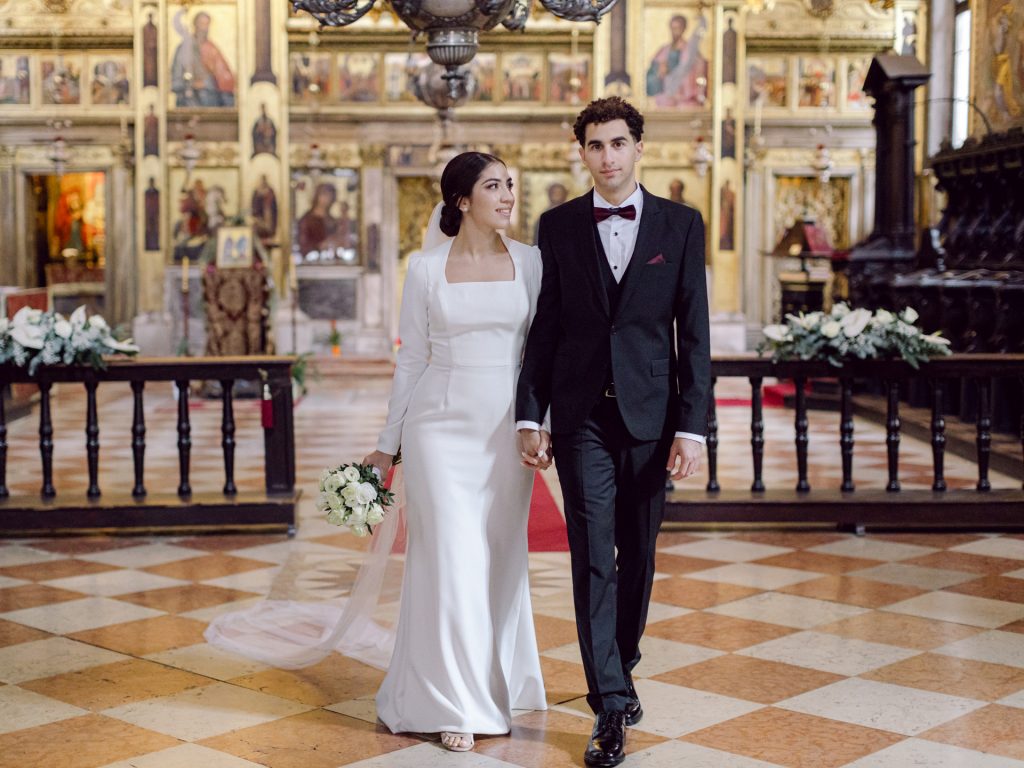
Getting married in Venice at the Greek Orthodox Church, San Giorgio dei Greci.
5. The Best Time of Year to Elope in Venice
I’ve photographed Venice in February fog, in July heat and in the long gold of October, and I’ve never found a season it does badly. The seasons feel like different cities, though, and each one asks for its own kind of day. Here’s what I actually think about each, followed by the light and the dates everything else is planned around.
Spring (March to May)
Spring is the most reliably beautiful season to elope in Venice. The light is soft without the hard glare of summer, and the temperature lets you wear a dress or a suit comfortably from morning until night. Window boxes and island gardens start to bloom. By late April the evenings stretch out, and the light turns gold and seems to hang there.
If I had to choose one stretch of the year purely on photographic grounds, it would be April into early May. The light is dependable and the city’s mood is gentle. There’s also a warmth and softness in the air that’s hard to find in any other month.
Spring is also when the crowds return, especially over Easter (28 March in 2027) and the Italian holidays of 25 April and 1 May. The city publishes its own map of its busiest days, too. In 2026, the day-visitor access fee from section 3 applied on 60 days between April and July, mostly weekends. That list doubles as a guide to when the day-trippers come. The good news is that Venice’s congestion sits almost entirely along a few well-worn routes. Ten minutes from San Marco, you’re in a different city.
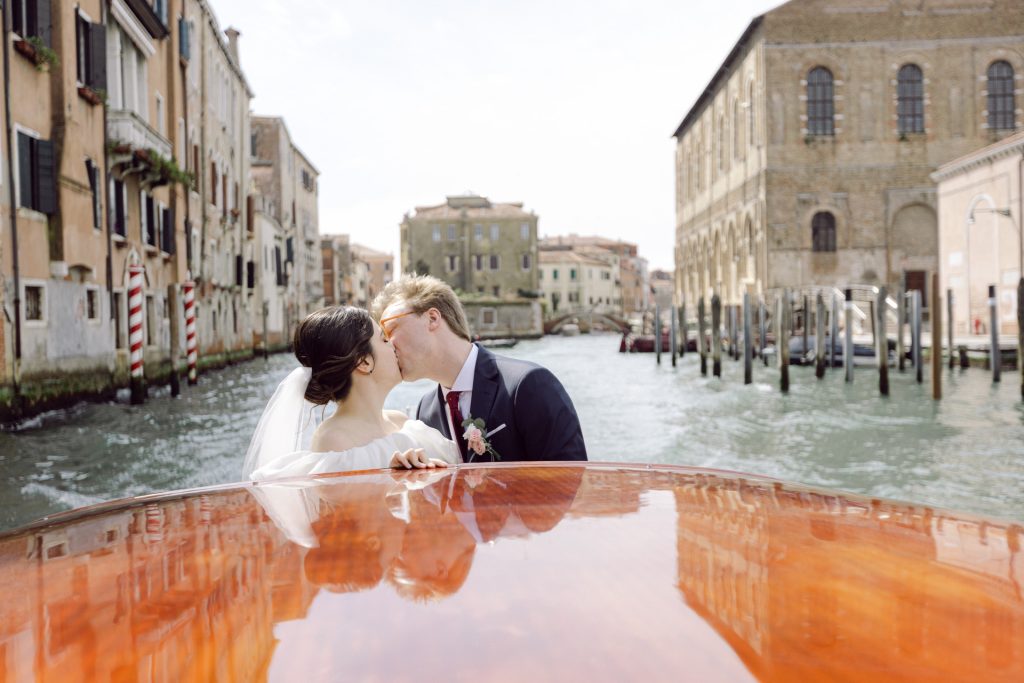
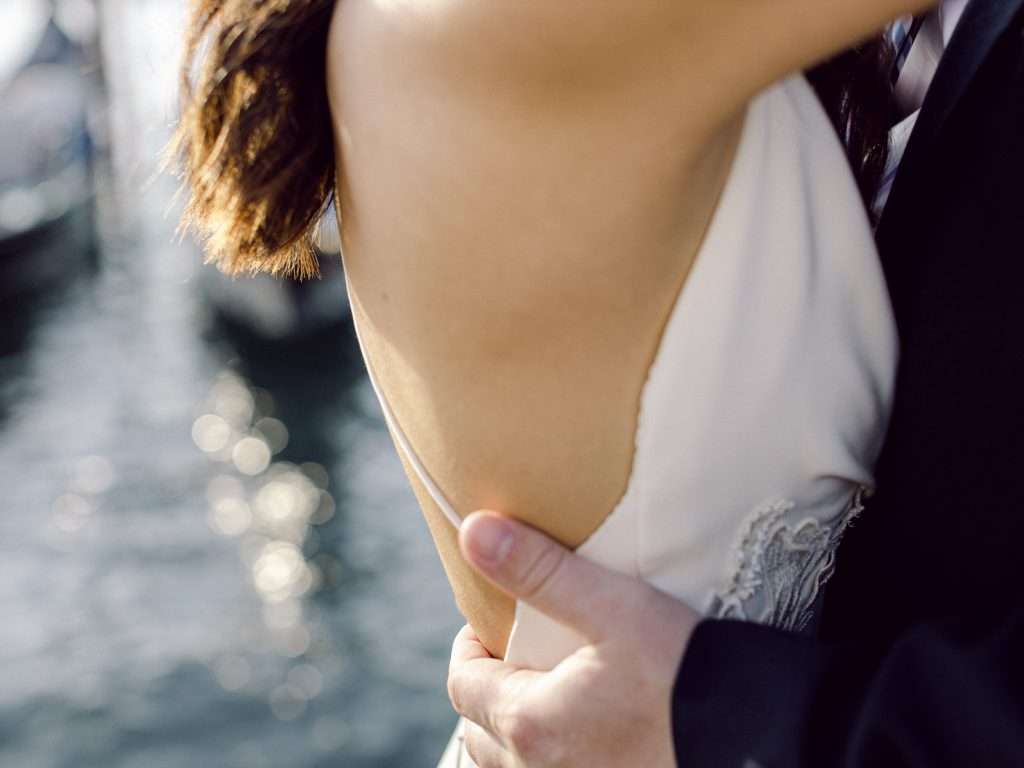

The quality of the light in Venice during Spring is incredible.
Summer (June to August)
Summer is the season that asks the most of the plan. The city is at its busiest, midday highs sit in the high twenties with real humidity, and by noon in July the stone is radiating heat. None of that is a reason to avoid summer. It just changes the shape of the day.
Summer in Venice belongs to sunrise. Some of my favourite images I’ve ever made started at 5:30am, before the vaporetti filled up and before the heat arrived. At that hour the city is pale pink and gold and completely still. Piazza San Marco is empty, and the canals are so still they look like mirrors. The whole city feels like it’s yours alone.
Patrycja and Tomasz, from Poland, built their Venice elopement into a European honeymoon and did exactly this. They started at sunrise in Piazza San Marco, wandered the quietest calli of the San Marco sestiere, and finished with a private gondola through the smaller canals. Their story is here.
For a July or August date, commit to the early start. The city portion is done by mid-morning, and the rest of the day moves to where summer is at its best: a shaded terrace, a long lunch, or a boat on the open lagoon, where there’s always a breeze.

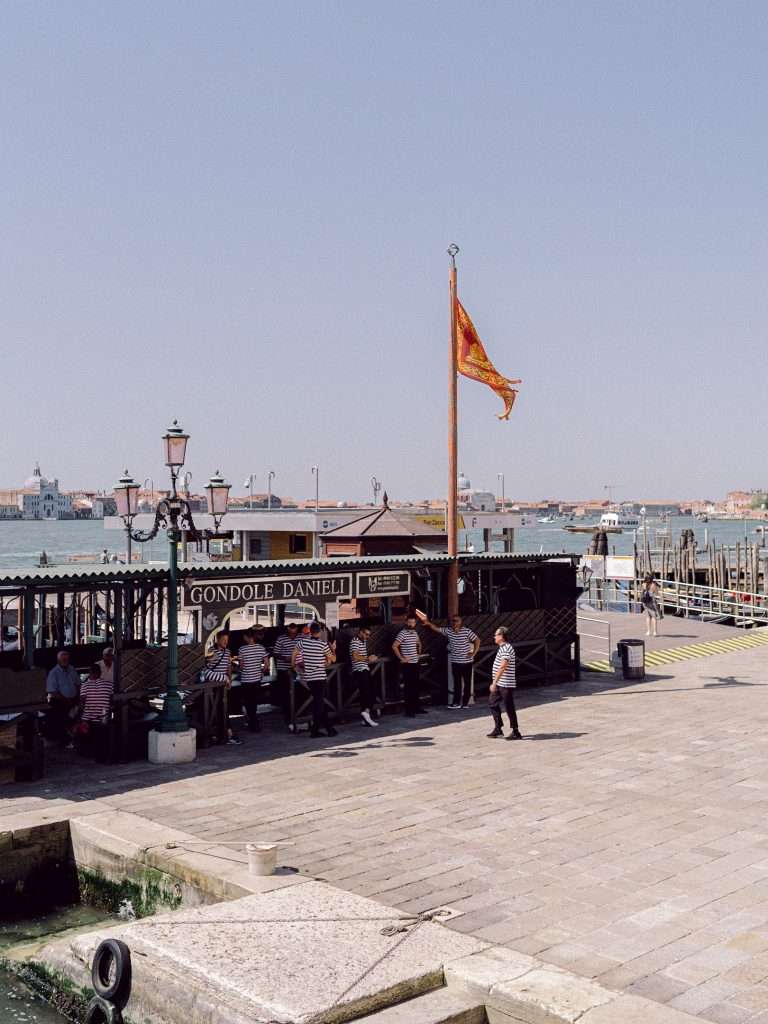

Summer elopements have consistent sunshine and it is essential to wake up early to enjoy the sunrise.
Autumn (September to November)
October is, in my opinion, the single best month to elope in Venice. The crowds thin noticeably from mid-September. The light changes in a way that’s hard to describe until you’ve stood in it. It becomes softer and warmer, and it seems to come from everywhere at once. The temperature is kind, and the city feels most like itself again, with its own rhythm and its own life. Couples who marry here in October often tell me they feel they discovered something the summer crowds miss entirely.
September is a close third on my list. It’s still warm, and the light is just beginning its autumn turn. The first half of the month is still busy, with the Film Festival on the Lido and the Regata Storica on the Grand Canal.
November is quieter, mistier and more intimate, and it brings the chance of acqua alta. I won’t pretend that isn’t a consideration. But a flooded piazza reflecting everything, with the city calmly managing its relationship with the sea, has given me some of the most extraordinary Venice images I’ve ever made. Section 3 explains how the tides and the flood barriers work. November also has one day I’d plan a whole trip around: the Festa della Madonna della Salute on 21 November, when a temporary bridge of boats crosses the Grand Canal to the Salute and Venetians walk over it to light a candle.


November can be either very foggy, or very sunny, as it was the case with this intimate wedding.
Winter (December to February)
If you want Venice to yourselves, come in winter. The city is emptier than at any other time of year. Mist sits on the canals in the morning, and the light turns cool and silvery. The palazzos look more imposing, and the whole city feels like a film set between takes.
Then there’s Carnival, which runs from 23 January to 9 February in 2027. For two and a half weeks, the city fills with masks and costumes, and every corner looks like a scene from a period drama. For theatrical couples who love maximalism and a little glorious absurdity, a Carnival elopement is unforgettable. Giorgia and Alessandro eloped during Carnival, and their gallery shows exactly what I mean. Treat Carnival like peak season, though: hotels fill and prices climb, so plan early.
Winter asks for warmth, meaning layers under the dress and a beautiful coat or wrap between locations. It also asks for honesty: tell me when you’re cold, and I’ll adjust. Daytime highs sit in the single digits Celsius, and the wind finds its way down the narrow calli and across the water. Dress for it and plan for it, and winter gives you a Venice most people never see.
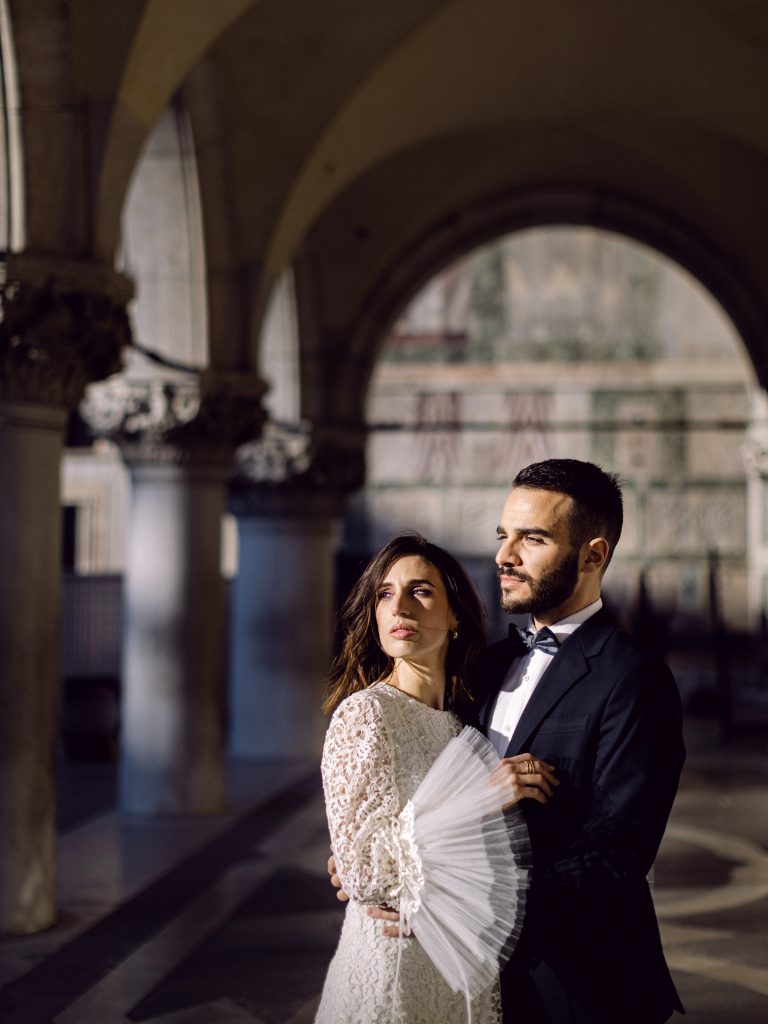
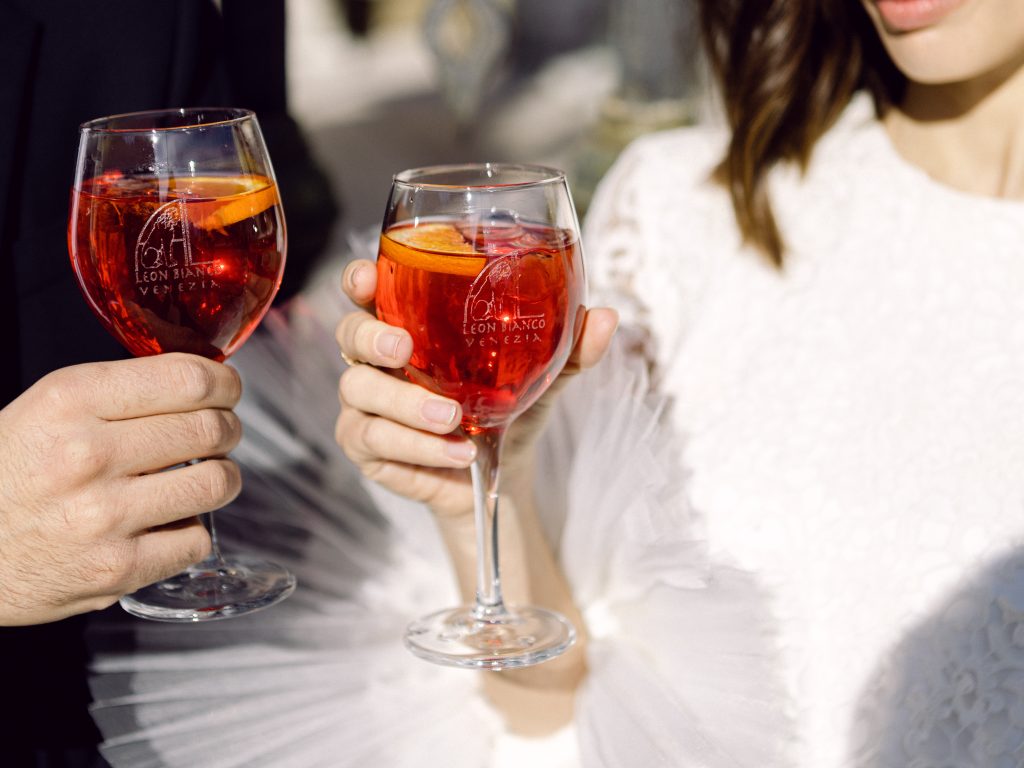
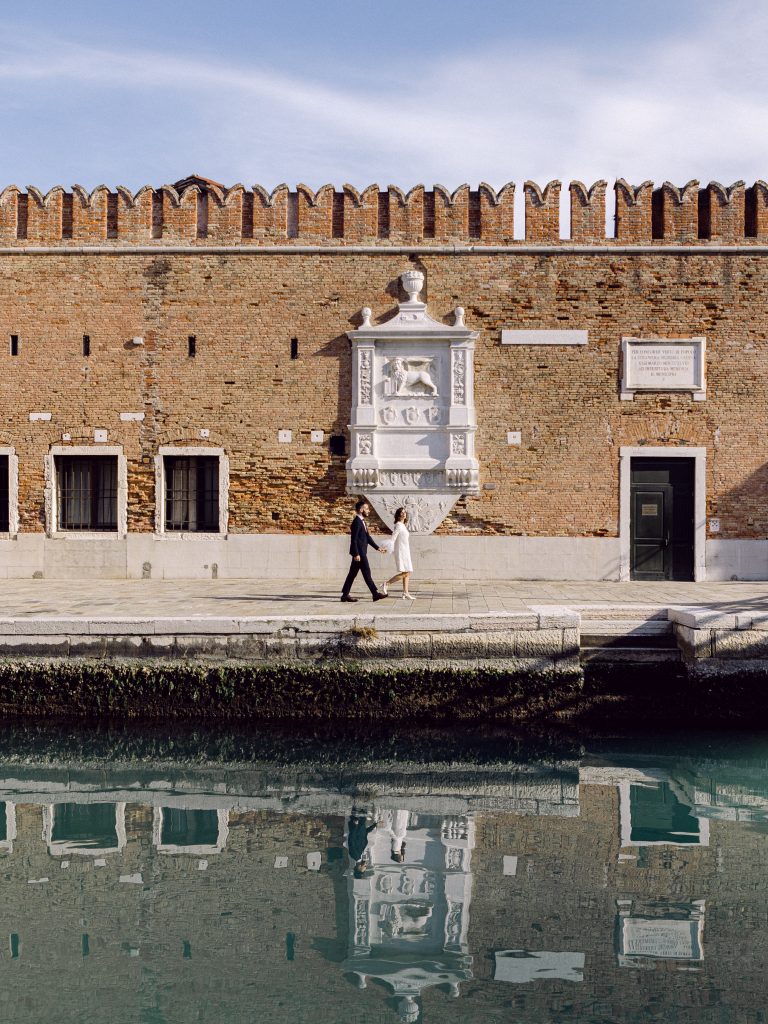
A winter elopement in the middle of Carnival in Venice
Venice’s light, hour by hour
In Venice, timing matters more than almost anywhere else I work. The same location at 7am and at 10am doesn’t just look different. It becomes a completely different photograph.
First light and sunrise are the finest light of the day, almost without exception. It’s soft and diffuse, often peach or pale gold, with mist on the water and perfect reflections. San Marco, the Rialto and the bridges are all at their best in this window, and they’re also at their emptiest.
The two or three hours after sunrise are still excellent. The light is higher and more direct but still warm, which is lovely for the waterfront, for open campos and for time on the water.
Midday brings the hardest light of the day, so the day moves to where the light is still kind. That means shaded calli, frescoed interiors, a boat under a canopy, or lunch at a canal-side table. None of this is a pause. Some of the most honest images of any Venice day happen here, when the two of you have stopped performing for anyone and are just sitting together over lunch.
Late afternoon and golden hour are the second great window. In spring and autumn the low sun comes in from the west and turns stone and water a warm amber, and in October that warm light stretches across the whole late afternoon.
Blue hour, just after sunset, is the most underrated light in Venice. It lasts only thirty to forty minutes. The sky deepens to indigo, the lamps come on along the fondamenta, and the canals become perfect mirrors. Some of the most atmospheric images I make anywhere happen here.
Sunrise, sunset and blue hour through the year
These times are calculated for the centre of Venice on the 15th of each month. They shift by a minute or two from year to year, and the tall buildings mean direct sun reaches the narrow streets later than the clock suggests. I plan every location around the light on the ground, not just the time on paper.
| Month | First light | Sunrise | Sunset | Blue hour ends | Sunrise to sunset |
|---|---|---|---|---|---|
| January | 07:13 | 07:47 | 16:53 | 17:26 | ~9h |
| February | 06:42 | 07:13 | 17:37 | 18:08 | ~10½h |
| March | 05:54 | 06:24 | 18:15 | 18:45 | ~12h |
| April | 05:54 | 06:26 | 19:56 | 20:27 | ~13½h |
| May | 05:05 | 05:41 | 20:33 | 21:09 | ~15h |
| June | 04:43 | 05:21 | 21:00 | 21:39 | ~15½h |
| July | 04:59 | 05:36 | 20:56 | 21:33 | ~15¼h |
| August | 05:38 | 06:11 | 20:18 | 20:51 | ~14h |
| September | 06:18 | 06:48 | 19:22 | 19:52 | ~12½h |
| October | 06:56 | 07:26 | 18:25 | 18:56 | ~11h |
| November | 06:36 | 07:09 | 16:40 | 17:13 | ~9½h |
| December | 07:08 | 07:43 | 16:27 | 17:02 | ~8¾h |
The last column matters more than any other number in this guide, because it decides which collection fits your date. From late September to mid-March, sunrise and sunset are less than twelve hours apart, so a single Full Day can hold both. In mid-October, a Full Day runs almost exactly from first light to the end of blue hour. From April to early September, the two ends of the day are thirteen to more than fifteen hours apart. That’s why summer couples choose one end of the day for a Half or Full Day, or split the story across the Custom 2-Day Experience, which can also take you out of the city for a second day in the Veneto or the Dolomites. Section 10 shows what each of those days looks like.
Dates worth knowing
- Carnival: 23 January – 9 February 2027
- Easter: 28 March 2027, one of the busiest weekends of spring
- Italian public holidays: 25 April, 1 May and 2 June all fill the city
- Biennale Architettura: 8 May – 21 November 2027. Section 6 covers how to fold it into your day.
- Redentore: the third weekend of July, with fireworks over the basin on the Saturday night
- Ferragosto: 15 August, the peak of Italy’s summer holidays
- Regata Storica and the Film Festival: early September
- Festa della Salute: 21 November
Section 3 explains how these events change the way the city moves. Some are worth building a day around and some are worth avoiding, and I check your date against all of them before anything is booked.
Venice at a glance
| When | What you get | What to plan around |
|---|---|---|
| October | The softest gold light, thinning crowds, comfortable days, and a Full Day that holds sunrise to sunset | Occasional rain; high water becomes possible late in the month |
| April – early May | Soft spring light, long evenings, flowers on the islands | Easter and the spring holidays are busy |
| September | Warm days, with the light just starting to turn | A busy first half, with the Film Festival and the Regata |
| November – January | Mist, empty calli, silver light, and the Festa della Salute | Cold, short days, and the high-water season |
| Carnival (late Jan – early Feb) | Masks, theatre, a whole city in costume | Crowds and prices spike, so book early |
| Late May – June | The longest, most luminous evenings of the year | Early starts for the empty city; heat building |
| July – August | Pale-gold sunrises and the open lagoon | The city portion is sunrise only; heat, humidity and crowds |
Tell me what you’re dreaming of, whether that’s mist or masks, gold or silver, a long summer evening or an empty winter morning. I’ll tell you which month, and which hour, gives you exactly that.
6. The Best Locations in Venice for Your Elopement
Before the places themselves, one thing matters more than any single location. In Venice, the same spot at 6am and at 10am gives you two completely different photographs. A list of landmarks produces the same pictures every couple takes: the same bridges, the same angles, the same crowd in the background. The places below aren’t a checklist. Think of them as a palette. What we actually use on your day depends on your season, your hour, the light, and who the two of you are.
Section 2 introduced the six sestieri. Here’s what each one offers an elopement specifically.
For the full, spot-by-spot version, read my complete guide to Venice elopement locations, which covers private terraces, rentable historic rooms and ceremony spaces. For every photo location in the city, see my photographer’s guide to the best photo spots in Venice.
San Marco: monumental, and transformed by timing
No neighbourhood in the world packs this much extraordinary architecture into so small a space. Most of my Venice elopements begin here. Partly that’s practical, because nobody gets lost on the way to the most famous square in Italy. Mostly it’s because I know every corner of it: which ones look extraordinary, which ones disappoint, and which ones only work at a particular hour.
The Basilica facade catches the low eastern sun in the first light, and its mosaics glow gold. The Gothic arcades of the Doge’s Palace frame a couple the way a set designer would. The Canonica Bridge, small and quiet just behind the Basilica, gives me some of the most intimate images I make anywhere in the city. The Bridge of Sighs is usually shown from one angle, but I photograph it in three different ways. Along the Riva degli Schiavoni, the gondolas line the water and San Giorgio Maggiore floats across the basin behind them.
Caffè Florian deserves a mention of its own. It was founded in 1720 and was once a gathering place for Venetian poets and painters. Its gilded, mirrored rooms are among the most beautiful interiors in the city. It opens at 9, so ending a sunrise session here with a coffee adds a layer of old Venetian elegance nothing else can.
The honest caveat is that San Marco only works at sunrise, or in the last light of a winter afternoon. At 6am the square belongs to you. By 10am, in any season except deep winter, it belongs to everyone.
Don’t miss: Piazza San Marco at sunrise · Caffè Florian · the Canonica Bridge · the Bridge of Sighs · the Doge’s Palace arcades · the Riva degli Schiavoni · the quiet calli behind the Basilica
Best for: first-time visitors who want images that could only ever be Venice
Best light: first light and sunrise, or the last light of a winter afternoon


Sunrise elopements in Venice, photographed before the day’s crowds arrived.
Cannaregio: the Venice where Venetians live
Cannaregio is where most of the city’s residents actually live. People shop here, children walk to school, and there are bars where an espresso still costs about a euro and nobody photographs it. For an elopement, it offers something San Marco can’t. You’re in Venice rather than at Venice, and the images have a documentary quality, like evidence of a life being lived rather than a performance.
The Fondamenta della Misericordia is one of my favourite places in the whole city. It’s a long canalside walk of low houses, bars and neighbourhood life. It’s a local favourite and far quieter than the famous routes. At dawn it’s completely still. In the evening it fills with Venetians having an aperitivo, and both versions are beautiful.
The Jewish Ghetto, founded in 1516, was the world’s first ghetto; the word itself comes from here. Its buildings are unusually tall, because the community had to build upward rather than outward. The campo is wide and quiet, and the whole place carries a weight you feel even before you know the history. The Cannaregio Canal, second only to the Grand Canal in width, gives open views and long reflections from its bridges.
Don’t miss: the Fondamenta della Misericordia · the Ghetto and its campo · the Cannaregio Canal bridges · the quiet calli toward the northern lagoon
Best for: couples who want Venice to feel lived-in, layered and real
Best light: any hour. It’s magical in the morning and alive in the evening.


Dorsoduro: the artists’ quarter, with the best light in the city
If I had to pick one sestiere for elopement work, it would be Dorsoduro. It has wide waterfront space and some of the city’s loveliest small campi, and the late-afternoon light keeps drawing me back.
The Zattere is a long, south-facing promenade on the Giudecca Canal. In the late afternoon, warm light rakes along the whole waterfront, and it’s quiet enough in the early morning and evening to work without interruption. Campo Santa Margherita is wide, irregular and much loved by Venetians. It’s the kind of square where a couple can sit at a café table, perhaps at the historic Caffè Rosso, and simply be still, which often produces the most honest images of the day. From the top of the wooden Accademia Bridge, the Grand Canal stretches toward the Salute. It’s one of the finest views in the city, especially late in the day.
Two quieter places make people ask “how did you find this?” The first is the Rio di San Trovaso and its squero, one of the last traditional gondola yards in Venice, weathered and quietly beautiful. The second is Punta della Dogana at the very tip of Dorsoduro, where the Grand Canal meets the Giudecca Canal. There, the Salute stands behind you, San Marco lies across the water, and the basin opens out in front of you.
Don’t miss: the Zattere · Campo Santa Margherita · the Accademia Bridge · the squero at San Trovaso · Punta della Dogana · Campo San Barnaba
Best for: warmth, space and golden hour. It’s my first choice for the second half of a long day.
Best light: afternoon into sunset. The Zattere at golden hour is extraordinary.


San Polo: the Rialto before it wakes
San Polo is the smallest sestiere and one of the oldest parts of the city. It holds the Frari, the Scuola Grande di San Rocco, the Rialto Bridge and the Rialto market. It’s a place of extremes: a packed tourist route and a completely empty medieval alley can sit fifty metres apart.
The Rialto Bridge is almost impossible to photograph at normal hours. In the first hour of light it becomes something else entirely. Without the crowds you finally see its scale, the eastern light runs straight down the Grand Canal onto its stone, and the reflections below are clean and sharp. If you want the Rialto in your images, we go at first light. There’s no other time.
The Rialto market in early morning is one of my favourite places for documentary images in all of Venice. You’ll see crates of lagoon artichokes, fishmongers setting out the catch, and the first light catching the colour. It’s busy and textured, and completely uninterested in being photographed. One thing to plan around: the fish market is closed on Sundays and Mondays, and the whole market is closed on Sundays.
Campo San Polo, second only to San Marco in size, is grand in an understated way. In the morning, before the neighbourhood wakes, the light across it is beautiful. The back streets between here and the Frari hide small bridges and sudden canal views I’ve learned one turn at a time.
Don’t miss: the Rialto Bridge at first light · the market (Tuesday to Saturday for the full scene) · Campo San Polo · the back streets toward the Frari
Best for: the iconic Rialto without the crowds, and the older, less polished side of Venice
Best light: first light for the Rialto. The back streets work at any hour.
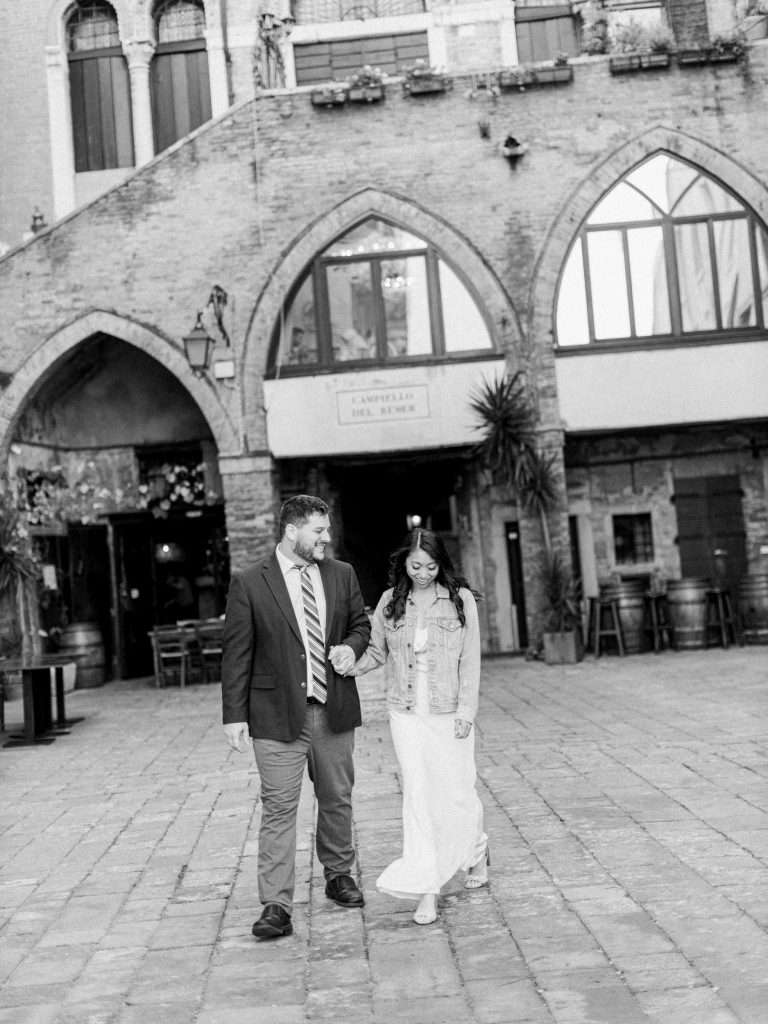

Santa Croce: quiet, local, and deeply beautiful
Santa Croce is the least visited sestiere on the main island, and that’s exactly its value. San Marco is theatrical and Dorsoduro is artistic, but Santa Croce is domestic. There’s washing strung between windows, children playing in small campi, and bars that close early because the neighbourhood goes to bed at a reasonable hour.
It gives you something I treasure: room to photograph without interruption. Rio Marin is a long, low canal with lovely early-morning reflections. Campo San Giacomo dell’Orio is irregular and ancient, with a beautiful church at its heart, and it catches pools of warm late-morning light.
Best for: couples who want to wander entirely off the map
Best light: early morning and late morning, when the sun first reaches the small campi

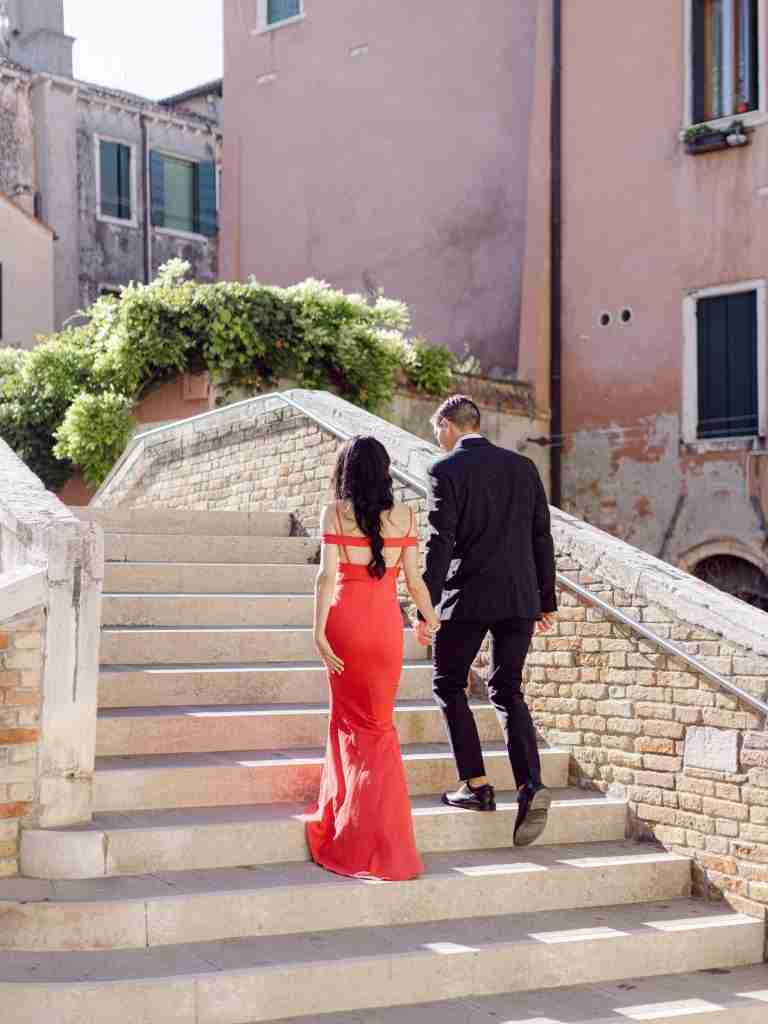
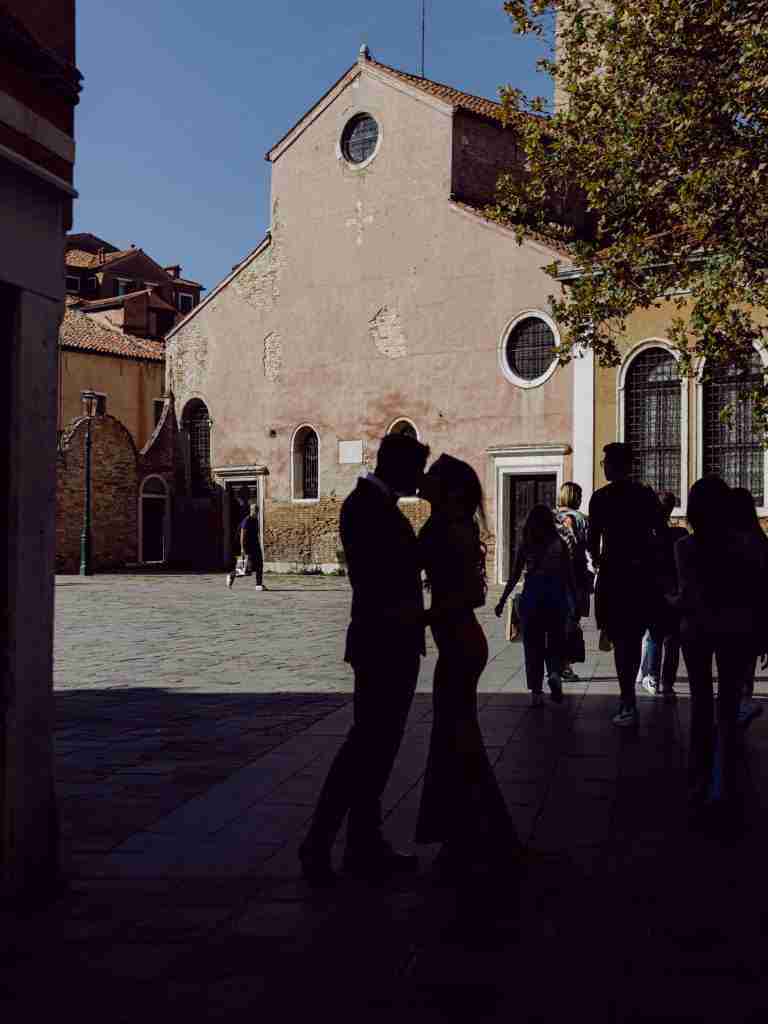
Castello: grand scale, the Arsenale and the Biennale
Castello is the largest sestiere. It stretches from behind San Marco to the eastern edge of the city and holds both some of Venice’s grandest architecture and some of its quietest corners, around Via Garibaldi and the long Riva dei Sette Martiri.
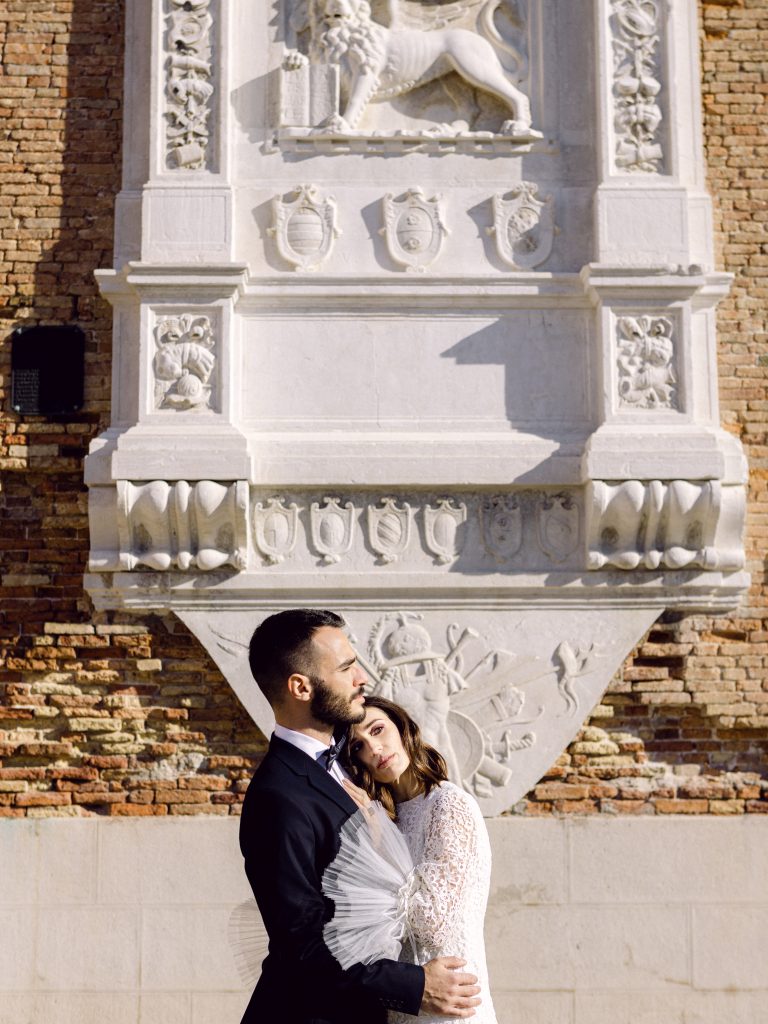
The Arsenale gates are the monumental entrance to the Republic’s old shipyard, guarded by stone lions. They’re one of the least photographed great landmarks in the city, and their scale gives your images a completely different register from the delicate Gothic of San Marco.
The Biennale: a different kind of elopement experience. Venice’s Biennale alternates each year: Art in even years and Architecture in odd years, both from spring to autumn. In 2027 the Biennale Architettura runs from 8 May to 21 November across the Giardini and the Arsenale, open 10am to 6pm and closed on Mondays. Venice also holds Film, Music, Theatre and Dance Biennales, with the Film Festival held on the Lido in late summer.
To be honest about the Giardini: they’re a pleasant park, not a remarkable photographic location. The special thing is spending part of your day inside the exhibition, moving through the pavilions together and letting the work become part of your experience. Photography rules change from pavilion to pavilion and from year to year, and some of the most striking spaces don’t allow it at all.
So my advice is to plan the Biennale as an experience, not a photo session. Fit it into a longer day, before or after the portraits, and dress elegantly rather than in full wedding clothes. For art- and architecture-loving couples, wandering the Arsenale with the person you’re marrying is a different kind of intimacy from a canal at sunrise, and for some couples it’s the more meaningful one.
Don’t miss: the Arsenale gates · Via Garibaldi · the Riva dei Sette Martiri · the Biennale (as an experience)
Best for: grand architecture without the crowds, and art-loving couples
Best light: morning along the waterfront, or any time inside the pavilions
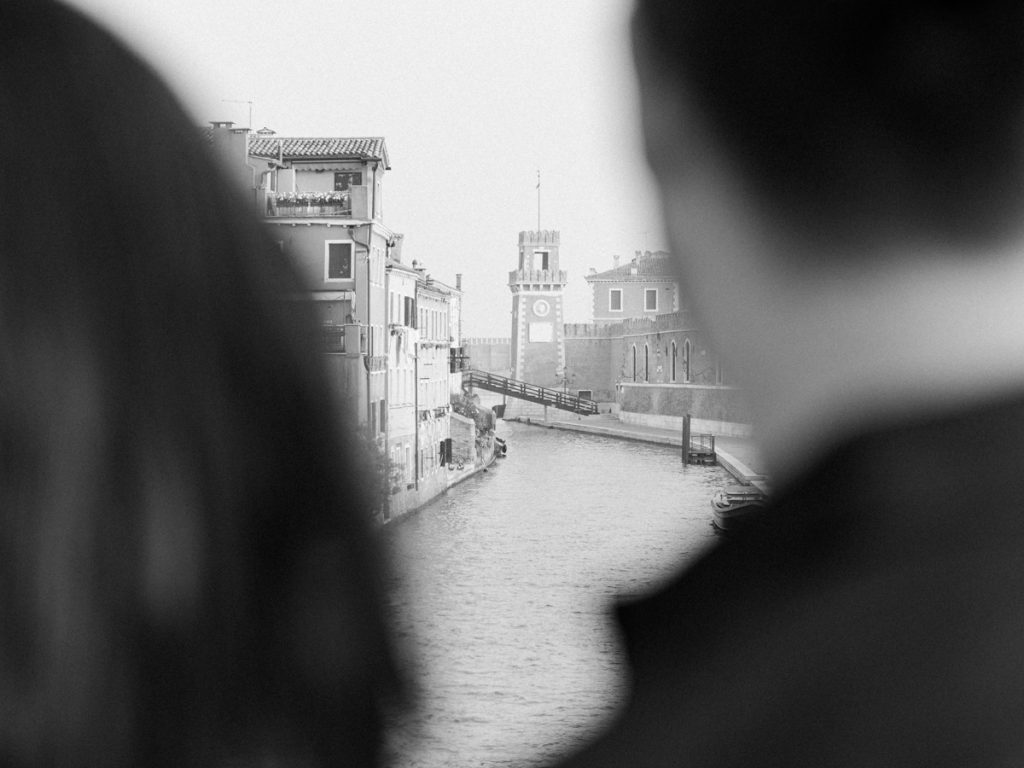
The lagoon islands: when you want to leave the city behind
Every island below means a boat, which is exactly why each one changes the whole character of a day rather than just the backdrop.
San Giorgio Maggiore is five minutes across the basin by water taxi. It gives you one of the most beautiful views in the world: Venice seen from outside, with the Doge’s Palace, the Campanile and the Salute laid out across the water. Palladio’s church is one of the great buildings of the Italian Renaissance, and its bell tower has a lift up to a panorama over the whole lagoon. This is the place for couples who want Venice as their horizon rather than their backdrop.
Giudecca is the long island across from the Zattere. It was once industrial and is now partly residential and partly luxury hotels. The streets are wider, the buildings lower, and the views open. The neo-Gothic Molino Stucky, a former flour mill that’s now a hotel, is one of the most unexpected buildings in the lagoon, and it’s also one of the private venues authorised for civil ceremonies (see section 4).
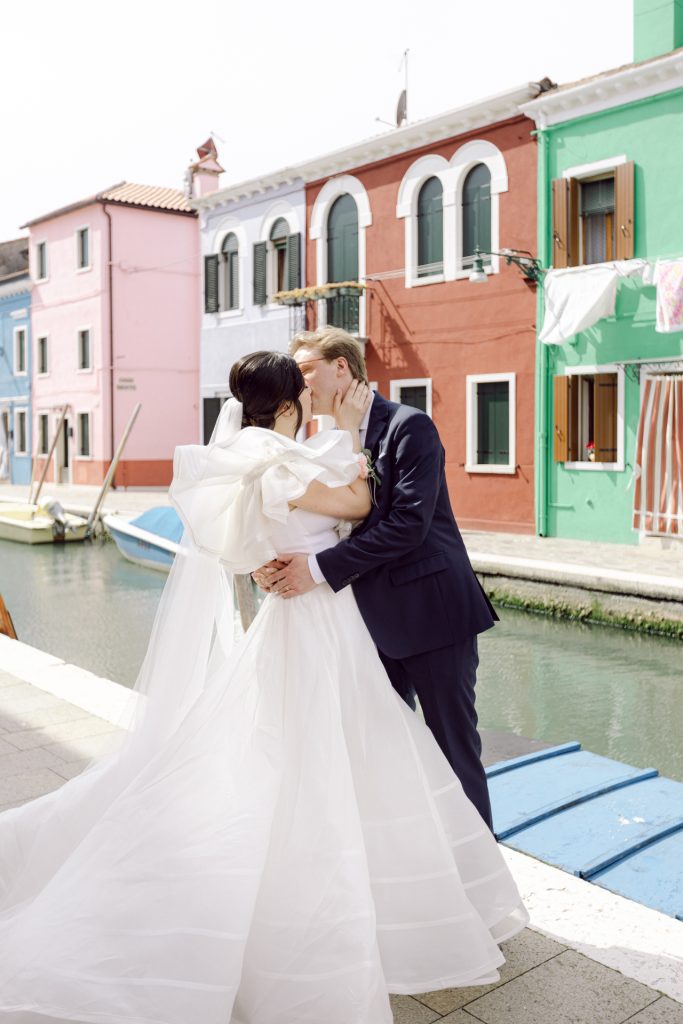
Burano is the island of painted houses: yellow, coral, turquoise and deep red, in combinations that shouldn’t work and somehow do. It’s joyful and graphic, about 45 minutes from Fondamente Nove on the line 12 vaporetto, and quicker by private boat. It’s best in mid-morning or late-afternoon light. I plan it as part of a long day or a second day, never squeezed in.
Torcello is where the lagoon’s story began. It was once more populous than Venice and is now almost empty: a cathedral founded in 639, a handful of houses, and reed beds and marsh all around. It’s a five-minute hop from Burano. For couples drawn to silence and melancholy, and to being truly alone, nowhere in the lagoon compares.

On the water: the Grand Canal and the small canals
Being on the water isn’t a location so much as a way of being in Venice, and it changes the photographs completely. At canal level, the palazzo facades rise straight out of the water beside you, and light bouncing off the surface lifts your faces from below in a way that only happens here.
A gondola through the small canals of San Polo, Cannaregio and Dorsoduro is Venice at its most intimate. The canals are so narrow the houses nearly touch, the only sound is the oar, and the reflections are perfect. A private water taxi is the way to reach San Giorgio, Giudecca and the islands, and to cross the basin at golden hour with San Giorgio behind you and Venice lit ahead. I try to build time on the water into every elopement of eight hours or more, because boat images are consistently among the most loved in any Venice gallery. Section 9 covers routes, pricing and ceremonies on the water.

Where to actually say your vows
Portrait locations and ceremony locations aren’t the same thing. For the vows themselves, Venice offers roughly six kinds of place:
- Nowhere at all: just the two of you in a quiet campo or on an empty fondamenta at an hour when the city is still asleep, with nothing set up. As section 4 explains, that’s the version that needs no permission.
- A private terrace or altana: the traditional wooden rooftop terraces above the city, or a palazzo terrace over the Grand Canal. Section 15 covers the rentals that have them.
- A historic room: the Scuola Grande dei Carmini in Dorsoduro hosts symbolic ceremonies in its Sala Capitolare, beneath a ceiling painted by Tiepolo between 1739 and 1749.
- A hotel garden or terrace: some of the city’s great hotels have exactly the right spaces. They’re covered in section 15.
- On the water: a ceremony in a gondola, drifting through a narrow canal. See section 9.
- A legal ceremony: Palazzo Cavalli and the other authorised venues are listed in section 4.
My Venice elopement locations guide goes through each of these in detail, including which spaces suit two people rather than a crowd.
Venice at a glance
| Sestiere | Feels like | Best light | Crowds |
|---|---|---|---|
| San Marco | Monumental, iconic | First light | Very heavy after 8:30 |
| Cannaregio | Lived-in, local | Any hour | Light, except the Strada Nova |
| Dorsoduro | Artistic, open, warm | Afternoon to sunset | Moderate |
| San Polo | Ancient, a little mysterious | First light (Rialto) | Heavy around the Rialto, empty behind it |
| Santa Croce | Quiet, domestic | Morning | Very light |
| Castello | Grand, spacious | Morning waterfront | Light beyond San Zaccaria |
| The islands | Another world entirely | Mid-morning to golden hour | Burano is busy midday; Torcello is almost empty |
How I choose locations for your day
I don’t have a standard route. I have years of knowledge about this city in every season, every hour and every kind of weather, and I use it to build your particular day. When we talk, I’m listening for things you might not realise matter. Do you love a bit of life around you, or prefer silence? Grand architecture, or intimate scale? Do you want images that are unmistakably Venice, or ones that could only be Venice, but in a less obvious way? Are you morning people, or your best selves at golden hour? Those answers, together with your date and the light on the day, shape your route. It will be different from every other couple’s, and that’s the whole point.
On the water — the Grand Canal and the smaller canals by boat
I want to separate this out because it is not a location in the same sense — it is a mode of being in Venice that completely changes the photographs.
The Grand Canal is the main artery of the city. On a public vaporetto, it is crowded and rushed. On a private water taxi, launch, or gondola — it is one of the most beautiful experiences Venice offers. The perspective from the water is entirely different from any land-based photography: the palazzo facades rise directly from the water, you are at canal level, the light bounces off the surface and illuminates faces from below in a way that only happens on water.
A private gondola through the smaller canals — the ones that cross San Polo, snake through Cannaregio, and cut through Dorsoduro — takes you through Venice at its most intimate. These are not the tourist gondola routes. They are the routes I’ve planned with gondoliers I trust, timed for the light, moving slowly enough to make images. The canals are so narrow that the buildings press in from both sides, and the reflections in the still water are perfect mirrors.
A private water taxi is the way to reach San Giorgio, Giudecca, and the outer islands, and to see the Grand Canal from a position of space and speed. For sunset returns across the basin — San Giorgio behind you, Venice lit from the west ahead of you — a private boat is the only way.
I always try to build some time on the water into Venice elopement sessions of eight hours or more. The images made from boats are consistently among the most beloved in any Venice gallery.
How I choose locations for your elopement specifically
I don’t have a standard route. I have years of knowledge about this city in every season, every hour and every kind of weather, and I use it to build your particular day. When we talk, I’m listening for things you might not realise matter. Do you love a bit of life around you, or prefer silence? Grand architecture, or intimate scale? Do you want images that are unmistakably Venice, or ones that could only be Venice, but in a less obvious way? Are you morning people, or your best selves at golden hour? Those answers, together with your date and the light on the day, shape your route. It will be different from every other couple’s, and that’s the whole point.
5. How to time your day around Venice’s light
Photography in Venice is, more than almost anywhere else I’ve worked, about timing. The difference between the same location at 7am and 10am is not aesthetic — it is categorical. These are functionally different photographs made in a different place.
Here is what I know about Venice’s light through the day:
Sunrise and the first hour after: The most beautiful light of the day, almost without exception. Soft, diffuse, often golden or peach, with mist and reflections. Piazza San Marco, the canals, the bridges — all of them are at their most photographic in this window. This is also the quietest hour. In peak season, this might mean starting at 5:30–6am. In autumn, sunrise is around 7am, which is more civilised.
Two to three hours after sunrise: Still excellent. The light is higher and more direct but still warm. Good for portraits in open locations, on the waterfront, on the water itself.
Midday and early afternoon: The harshest light of the day. Not ideal for outdoor portraits — the shadows are hard, the light is flat in some places and brutal in others. This is often when I recommend a break: a long lunch, the hotel room, a quiet hour. In summer, this is also when the heat is at its peak.
Late afternoon and golden hour: The second great light window of the day. In Venice, especially in autumn and spring, the late afternoon turns the stones and water a colour that I cannot describe without sounding like I’m overselling it — a warm amber gold that comes from low in the west and catches everything. This window can last two hours in October. It is extraordinary.
Blue hour (just after sunset): Underrated for Venice photography. The canal reflections are mirror-perfect, the streetlights come on and create warm pools of light, and the sky turns a deep blue that contrasts with the warm tones of the city. Short window — thirty to forty minutes — but exceptional.
For a four-hour session, I almost always recommend either: start at sunrise and finish mid-morning, or start two hours before sunset and finish in blue hour. For an eight or ten hour day, we do both — sunrise session, midday break, golden hour and blue hour to close.
7. Things to Do: Building a Full Venice Elopement Day
A long elopement day in Venice shouldn’t feel like one extended portrait session. It should feel like the best day the two of you have ever spent in this city, which just happens to include your wedding. Below is the menu I draw from when we design yours. It’s arranged by the hour each experience is at its best, because here the clock shapes everything.
At first light
Piazza San Marco before the city wakes. Section 6 explains why this comes first. It’s the one hour when the most famous square in Italy belongs to two people.
The Rialto market. Early in the morning, crates of lagoon produce stack up under the arcades, including tiny castraure artichokes from the islands in spring, and the fishmongers lay out the night’s catch beneath the Pescheria’s Gothic loggia. It’s alive, textured, and completely uninterested in you, which is exactly why the images feel so honest. The fish market runs from Tuesday to Saturday, and the whole market is closed on Sundays.
Coffee the Venetian way. Order un caffè standing at the bar with a pastry, the way the city does it every morning. For the gilded version, Caffè Florian on Piazza San Marco has been serving coffee since 1720 and opens at 9.
Learn to row like a Venetian. Voga alla veneta is the standing, forward-facing rowing style of the lagoon. Row Venice, a non-profit based in Cannaregio, teaches it in traditional handmade wooden boats. A private lesson for two costs around €100 per boat (check current rates). I’d suggest it for the day before or after rather than your wedding day itself, since it’s much more fun in clothes you don’t mind splashing.
Late morning into midday
When the light turns hard, the day moves indoors, into the shade or onto the water. None of this is filler. It’s often where the most relaxed, honest images of the day happen.
A cicchetti crawl. Drift from one bacaro to the next, standing at the counter with small plates and a little glass of local wine (un’ombra). It’s the most Venetian lunch there is. My favourite bacari are in section 8.
The Scala Contarini del Bovolo. This is a Renaissance spiral staircase hidden in a courtyard near Campo Manin, and it rises almost thirty metres to a view over the rooftops. Visits are timed and ticketed, about thirty minutes each, and it’s quietly spectacular.
Tiepolo or Tintoretto. At the Scuola Grande dei Carmini you can stand beneath Tiepolo’s painted ceiling in the Sala Capitolare. At the Scuola Grande di San Rocco, Tintoretto’s canvases cover the walls and ceilings of vast rooms. Both are unhurried, cool on a summer day, and extraordinary.
The Biennale. In 2027 it’s the Biennale Architettura, from 8 May to 21 November, closed on Mondays. Section 6 explains how to fold it into your day as an experience rather than a photo session.
A long lunch. It’s part of the day, not a pause in it. See section 8.
Afternoon: out onto the lagoon
San Giorgio Maggiore. It’s five minutes across the basin, and the view back to the Doge’s Palace and the Campanile is one of the finest in the world. From the top of the bell tower you can see the entire lagoon.
Burano, Mazzorbo and Torcello by private boat. Burano has its painted houses. Next to it, the quiet island of Mazzorbo has Venissa, a walled medieval vineyard and the only place in the world that grows the Dorona di Venezia grape. You reach it across a little wooden bridge from Burano. Five minutes further on, Torcello has its cathedral, founded in 639, surrounded by reeds and silence. Done well, it’s a whole unforgettable afternoon.
Sant’Erasmo. This flat, green island has been called Venice’s kitchen garden for centuries. It’s all artichoke fields and lagoon light, and almost no visitors come.
A swim at the Lido. Swimming in Venice’s canals is forbidden and fined. But the Lido’s Adriatic beaches are a short boat ride away, and a sunset swim in the sea on your wedding day is something you’ll remember forever.
A private gondola. This is the classic done properly: the small canals, the right hour, and a gondolier who knows why you’re there. Routes and pricing are in section 9.
Golden hour into night
Aperitivo on the water. A spritz (the Veneto’s own aperitivo) and a few cicchetti on a private boat as the palazzos turn gold. Or, for a local version, pull up a chair on the Fondamenta della Misericordia with the neighbourhood.
Sunset from above the city. The newly reopened Terrazza Danieli serves aperitivo on its rooftop as the light fades over San Giorgio (see section 8). You’ll still see the Fondaco dei Tedeschi terrace recommended in many guides, but it closed with its department store in May 2025 and is no longer open to the public.
Opera, room by room. At Musica a Palazzo, in the Gothic Palazzo Barbarigo Minotto on the Grand Canal, the singers perform each act of La Traviata, Rigoletto or The Barber of Seville in a different salon, and the audience moves through the palazzo with them. La Traviata had its premiere in Venice in 1853, which makes it the one to choose. It’s intimate, candlelit and unlike any other night at the opera, and it’s a lovely, dressed-up way to end your wedding day.
A night at La Fenice. Venice’s great opera house has hosted premieres by Verdi, Rossini and Stravinsky. Check the season calendar against your dates.
Blue hour on foot, or on the water. The lamps come on, the canals become mirrors, and the city grows quiet. The last images of the day are often the most atmospheric of all.
If your date falls on…
- Carnival (23 January – 9 February 2027): costume hire, masked portraits and, for the fully theatrical, a masked ball.
- The Redentore (third weekend of July): fireworks over the basin on Saturday night, watched from a boat. Boats book out months ahead.
- The Regata Storica (first Sunday of September): historic boats and a costumed procession on the Grand Canal. Watch from a canal-side terrace.
- The Festa della Salute (21 November): the votive bridge of boats across the Grand Canal, and candles lit in the Salute.
What I’d leave off the list
The Fondaco rooftop terrace is closed, as explained above. A standard gondola from the busiest stations at midday means crowded canals and harsh light. You won’t get the ride you’re imagining. The Rialto Bridge or Piazza San Marco between mid-morning and late afternoon in season means the same crowds you came to Venice to escape. We simply go at the right hour.
How much fits into a day
- The Mini (4 hours): one experience, plus your ceremony and portraits
- The Half Day (8 hours): two or three experiences, including time on the water
- The Full Day (12 hours): four or five, with none of them rushed
- The Custom 2-Day Experience: the city on one day, and on the other the lagoon, or somewhere else entirely. Your second day can take you beyond Venice: to the Prosecco hills, to Verona, to a Palladian villa on the Brenta, or up into the Dolomites.
I always leave slack in the timeline, but never gaps in the coverage. The lunch that runs long, the detour down a canal that wasn’t on the plan, the extra half hour on Torcello because neither of you wants to leave: that’s where your day stops being a schedule and becomes a memory.

8. Where to Eat: Bacari, Trattorie and Tables with a View
In Venice, food is part of the story of your day, not a break from it. A glass of wine standing at a bar after your vows, a long lunch in a canal-side trattoria, a candlelit dinner as the last blue light leaves the lagoon: these are some of the most honest moments I photograph. Here’s how I think about eating on an elopement day, with the places I’d send you to.
For the full list, with every restaurant’s setting, view, neighbourhood and price, read my guide to the most romantic restaurants in Venice.
What you’ll actually eat
Venetian cooking is lagoon cooking: fish and shellfish from the morning market, vegetables from the island gardens, and recipes shaped by centuries of trade with the East.
Look for:
- baccalà mantecato: salt cod whipped until it’s silky, served on grilled polenta
- sarde in saor: sweet-and-sour sardines with onions, pine nuts and raisins, a sailor’s dish built to last a voyage
- bigoli in salsa: thick wholewheat pasta with anchovies and slow-cooked onion
- risotto al nero di seppia: cuttlefish-ink risotto
- fegato alla veneziana: calf’s liver with onions
In spring look for castraure, the tiny first artichokes from Sant’Erasmo. In spring and autumn, look for moeche, the lagoon’s soft-shell crabs, which are only available for a few weeks each season.
To drink, order a spritz (the Veneto’s own aperitivo), a glass of Prosecco from the hills just north of the city, or a crisp Soave. At the bar, ask for un’ombra, a small glass of wine. The name means “shade,” and legend says it comes from the wine sellers who once followed the shadow of the Campanile across Piazza San Marco to keep their barrels cool.
Bacari and cicchetti: standing up, the Venetian way
A bacaro is a Venetian wine bar, and cicchetti are the small bites along its counter: crostini, polpette, baccalà on polenta. You stand, you point, you eat, and then you walk to the next one. It’s the most Venetian meal there is, and on a long elopement day it’s perfect. It’s quick, it’s joyful, and the photographs are full of life.
- Around the Rialto: Cantina Do Mori claims to be the oldest bacaro in the city, with a history said to go back to 1462. Expect copper pans, low beams and tiny francobolli sandwiches. Nearby All’Arco, a father-and-son counter, is where many Venetians say the best cicchetti in the city are made. Al Mercà is barely bigger than a doorway.
- In Dorsoduro: Cantine del Vino già Schiavi sits on the Fondamenta Nani, directly opposite the San Trovaso gondola yard from section 6. The crostini fill the glass counter, and the view is the squero.
- In Cannaregio: The Fondamenta della Misericordia and Fondamenta degli Ormesini are lined with bars where the whole neighbourhood spills onto the water’s edge at aperitivo hour.
Bring some cash, go before the lunch rush, and remember that many bacari keep short hours: morning to early afternoon, then again in the evening. Some close entirely one day a week.
Trattorie and osterie: the long Venetian lunch
For a proper seated meal, these are the kind of places where Venetians celebrate:
- Antiche Carampane, in San Polo, is tucked down an alley between Campo San Polo and the Rialto. It’s cosy and old-fashioned, serving seasonal lagoon fish straight from the market. The cuttlefish in its ink with white polenta is exactly what it should be.
- Osteria alle Testiere, in Castello, has only a handful of tables. The cooking is precise and fish-focused, and many of the vegetables come from Sant’Erasmo. Book as early as you possibly can.
- Al Covo, in Castello, is a family-run room a few minutes from the Riva, warm and unhurried.
A table with a view
- Lineadombra sits at the tip of Dorsoduro. Tables are set on a wooden platform over the Giudecca Canal, facing Palladio’s Redentore across the water. At golden hour, it’s one of the loveliest places to eat in the city.
- Terrazza Danieli is the rooftop of the newly reopened Danieli, now a Four Seasons, with the whole basin of San Marco laid out in front of you. Dinner here, or an aperitivo at the terrace bar as the light fades over San Giorgio, is a grand way to close a wedding day.
- Quadri is on the first floor above the historic café in Piazza San Marco, looking straight out over the square. You get the most famous view in Venice without the crowd.
Michelin-starred Venice (2026 guide)
For a true celebration dinner, Venice currently has eight starred restaurants:
| Restaurant | Where | Why for an elopement |
|---|---|---|
| Glam Enrico Bartolini ★★ | Palazzo Venart, Santa Croce, on the Grand Canal | The city’s only two-star restaurant, with a courtyard garden under an old magnolia |
| Quadri ★ | Piazza San Marco | Dinner above the most famous square in the world |
| Oro ★ | Belmond Hotel Cipriani, Giudecca | A lagoon terrace, reached by private launch. Open only during the hotel’s season, spring to September. |
| Agli Amici Dopolavoro ★ | Isola delle Rose (JW Marriott) | New in 2026, on a private island reached only by boat, with a garden-and-olive-grove approach |
| Wistèria ★ | San Polo | Intimate, with tables beneath the wisteria along a quiet canal |
| Local ★ | Castello | Contemporary Venetian cooking in a relaxed room away from the crowds |
| Palais Royal ★ | Nolinski, San Marco | Theatrical and elegant, inside the old stock-exchange palazzo |
| Venissa ★ | Mazzorbo | A walled medieval vineyard across the bridge from Burano. It also holds a Michelin Green Star for sustainability. |
If your day includes the lagoon, Venissa is the one I’d plan around. You can arrive by boat, walk through the Dorona vineyard as the light turns gold, and have dinner overlooking the water. Its more casual Osteria is right next door.
Out on the islands
Trattoria da Romano, on Burano, has been run by the same family for generations. The walls are covered with paintings given by the artists who ate here over the decades, and it serves the island’s classic risotto made with fish broth. Venissa, just across the bridge on Mazzorbo, is above. Both make a lagoon day feel complete.
A dinner that’s entirely yours
Some couples don’t want a restaurant at all. A private chef on your palazzo terrace, dinner on a vintage boat drifting across the lagoon at sunset, or a table set just for two in a hotel garden are all possible. I’ll help you find the right setting once we know where you’re staying.
Practical notes
- Book early. The best small restaurants have very few tables. For spring and autumn dates, reserve your dinner when you confirm your elopement date, not the week before.
- Venice eats early by Italian standards. Many kitchens close around 10pm, and the smaller places close even earlier.
- Check the closing day. Most restaurants close one day a week, often Sunday or Monday, and some island restaurants close for part of the winter.
- The coperto is a cover charge per person that appears on most bills. It’s normal and legal as long as it’s displayed on the menu.
- Tell the restaurant it’s your wedding day. In my experience, Venetian restaurants rise beautifully to the occasion.
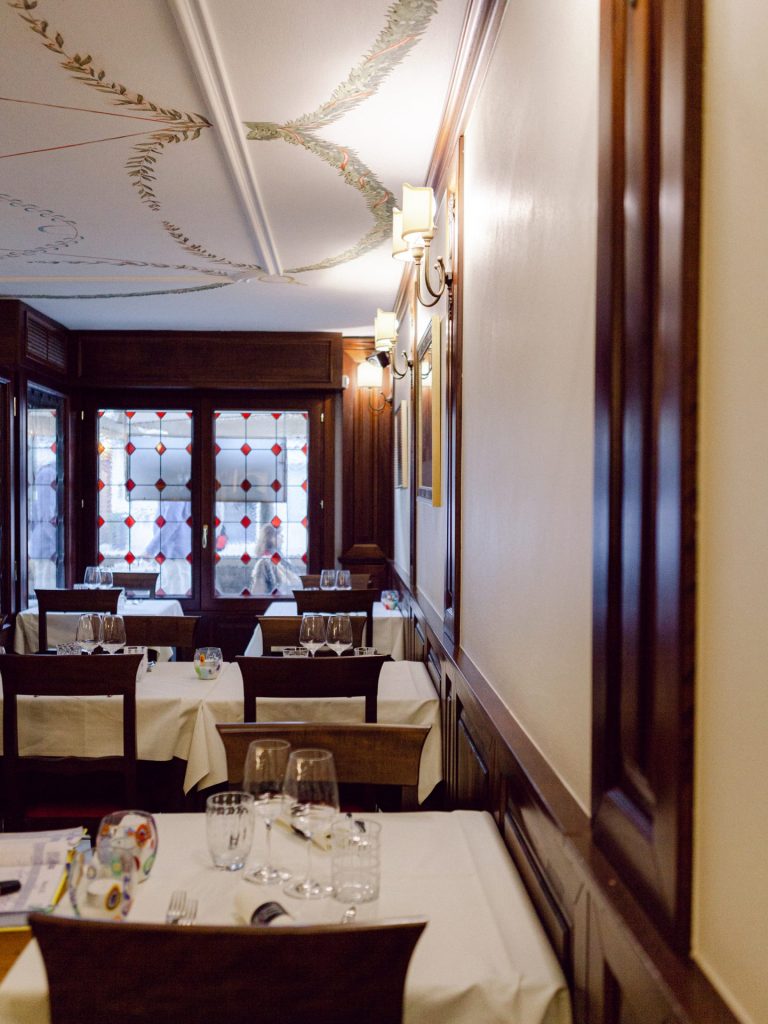

9. Gondolas, Water Taxis and Boats: Venice from the Water
In most places, a boat is how you get somewhere. In Venice it’s often the most cinematic setting in the city. At canal level, the palazzos rise straight out of the water beside you, and the light bouncing off the surface lifts your faces from below in a way that only happens here. The city goes quiet around you. Some of the most loved images in every Venice gallery I deliver were made on the water.
But not every boat does the same job, and choosing the wrong one for the hour is the most common way couples waste money here. This section explains how I think about it. Section 3 covers the everyday fares, including the vaporetto, the traghetto and airport transfers.
Choosing your boat
| Boat | Best for | Where it goes | Typical cost |
|---|---|---|---|
| Gondola, standard ride | A classic ride through the small canals | Narrow rii and the edges of the Grand Canal | €90 for 30 min by day, €110 in the evening, per boat (up to 5 people) |
| Gondola, arranged for your elopement | Portraits or a ceremony, on a route and at an hour chosen for the light | The quietest small canals, sometimes before the gondola stations open | Quoted to your route and time; I’ll give you real numbers for your date |
| Water taxi (transfer) | Getting from A to B beautifully, and arriving by water | Anywhere with a landing, including the islands | Per trip; short hops in the city from around €60–80 |
| Private motorboat by the hour | Golden hour on the basin, San Giorgio, Giudecca, the islands | The Grand Canal, the basin and the open lagoon | Roughly €100–200 an hour, depending on the boat |
| Classic wooden boat with skipper | The glamorous version: varnished mahogany, a toast on deck | The basin and the lagoon | Premium, quoted per boat and duration |
| Vintage yacht or traditional sailing boat | A full day on the lagoon, with lunch and a swim | The open lagoon and outer islands | Quoted per day |
The gondola, done properly
A standard gondola ride from a busy station at midday is a pleasant thirty minutes. A gondola arranged for your elopement is something else entirely.
The route matters most. I work with gondoliers I trust, and we plan together. We choose canals so narrow the houses almost touch overhead, in the quieter parts of San Polo, Dorsoduro and Cannaregio, where the only sound is the oar. We choose an hour when the light falls into those canals rather than past them. Sometimes that means going out before the gondola stations have even opened. The gondolier knows what we’re doing, moves at the pace the photographs need, and knows exactly where to pause.
Where I am while you’re on the water. For most of the ride I’m not in the gondola with you. I’m on the fondamenta and the bridges, moving ahead on foot, so I photograph you from above as you glide under a bridge, alongside at canal level, and framed by the palazzos. Being on land is what gives the gondola images their variety and their sense of place. It also means the two of you are alone in the boat, which is the whole point.
A few practical things. A gondola seats up to five passengers, and the gondolier will steady you as you step aboard. Take it slowly on the wet stone steps. A long train gathers into the boat beautifully. If you’d like music, a singer and accordion can follow in a second gondola for a serenade.
A ceremony on the water
A gondola ceremony is one of the most intimate settings Venice offers, and very few couples know it’s possible. Your officiant sits facing you. The canal closes around you, the gondolier moves in near-silence, and your vows take about fifteen minutes as you drift between bridges. I move ahead along the fondamenta, waiting for the moments.
Two things to know. A ceremony on the water is symbolic, because legal ceremonies can only take place in authorised venues (see section 4). It’s also arranged directly with the gondolier as part of your plan, never booked as a tourist ride. The same goes for a boat arrival: stepping off a gondola through a water gate straight into a palazzo courtyard or a hotel garden for your ceremony is an experience no land entrance can match.
Water taxis and private motorboats: the basin and the lagoon
Gondolas belong to the small canals. For everything bigger, you want a motorboat. That means the Grand Canal at a proper pace, San Giorgio Maggiore across the basin, Giudecca, and the islands.
The moment I’d build a whole day around is golden hour on the Bacino di San Marco. You cross the open water with San Giorgio behind you and the Doge’s Palace and the Salute ahead, turning amber, then pink. Book a private boat by the hour, and it simply becomes part of your day. It can collect you from your hotel’s own landing, wait while we photograph on San Giorgio, and carry you back into the city as the lamps come on. Unlike in the gondola, I ride with you on motorboats, so these images are close, relaxed and full of wind and light.
Classic boats and a day on the lagoon
For couples who want the glamorous version, Venice has a small fleet of restored classic boats. Classic Boats Venice keeps several with skippers, including:
- Jandona, a mahogany motor yacht built in 1968 by the Cantiere di Pisa to a design by architect Pier Luigi Spadolini, which takes up to eleven guests
- Riva runabouts, the most elegant little boats ever built in Italy
- a bragozzo, one of the lagoon’s traditional sailing boats
A full day aboard can include:
- the colours of Burano in the morning
- a walk through the Venissa vineyard on Mazzorbo
- the silence of Torcello
- a lunch prepared on board
- a swim off the boat somewhere quiet in the open lagoon
After that, you return across the water at golden hour. It’s the natural shape for the second day of a Custom 2-Day Experience, and one of the most joyful days I photograph anywhere.
What I plan around
- Tides. On very high tides, gondolas can’t pass under some of the lowest bridges. On very low tides, the smallest canals become too shallow. I check the tide forecast when I plan the route, and again on the morning itself.
- Wind and weather. The open lagoon can turn choppy in a strong wind, and gondoliers won’t go out in a storm. There’s always a sheltered alternative, and a boat moment can move to later in the day.
- Shoes. Many classic wooden boats ask for soft soles or bare feet on deck. It’s lovely in photographs, and worth knowing before you choose your shoes.
- Traffic. The Grand Canal is a working waterway, full of delivery barges, vaporetti and taxis. The magic happens in the side canals and on the open basin, so that’s where I take you.
- Booking. I arrange every boat through people I’ve worked with for years. A boat booked for tourists and a boat booked for an elopement look the same at the dock, but the route, the timing and the gondolier’s understanding of the day are completely different.

10. What a Venice Elopement Day Actually Looks Like, and How to Choose Your Collection
After years of photographing elopements in this city, here’s what I’ve learned: Venice rewards the couples who give it time. More hours do mean more photographs, but that isn’t the real reason. Venice works on you slowly. It takes a little while before you stop being visitors and start being present, before the city stops being a backdrop and becomes the place where something real is happening to you. Every day I design is built around that shift.
Your hours with me run continuously, from the first frame to the last. The walk between neighbourhoods, the gondola, the long lunch: none of it is a pause. It’s all part of the story. What changes from couple to couple is when those hours fall. In Venice, that’s decided by the light.
The four collections
The Mini Elopement Experience: 4 hours in one neighbourhood, from €3,800. One sestiere, explored on foot, at the best hour of the day. It’s perfect for a sunrise in an empty San Marco or golden hour along the Zattere, with your vows and portraits in one beautifully timed window. At least 400 hand-edited images.
The Half Day Elopement Experience: 8 continuous hours, from €6,200. The collection most of my couples choose. There’s time to get ready without rushing, move through two or three neighbourhoods, spend time on the water, and sit down to a proper Venetian lunch, all built around one of the city’s two great windows of light. At least 800 hand-edited images.
The Full Day Elopement Experience: 12 continuous hours, from €8,000. Your whole story, told from beginning to end. From late September to mid-March, it can run from the empty city at first light to the last blue hour of the evening. In summer, it tells one long half of the day in full. The whole day is blocked in my schedule, so we can move with the weather and the tides. At least 1,200 hand-edited images.
The Custom 2-Day Elopement Experience: 16 hours across two days, from €10,400. The version I recommend most for summer dates in Venice. It gives you both sunrise and sunset, a day in the city and a day on the lagoon, or a second day somewhere else entirely: the Prosecco hills, Verona, or the Dolomites. It’s also the best protection against a grey day. At least 1,600 hand-edited images.
Below is what each one can look like. Think of these as sketches rather than schedules. Every time is set against the real light for the month shown, and your own day will be drawn around the two of you.
The Mini · 4 hours · one neighbourhood
Four hours isn’t a compromise. It’s a complete, distilled experience: a ceremony, portraits in places that will stop your breath when you see the images, and the particular feeling of having had a part of Venice entirely to yourselves. The Mini stays in one sestiere on foot, so every minute goes into the light rather than into moving between places.
Option A: Sunrise in San Marco
Mid-September. First light 6:18, sunrise 6:48.
6:00 I arrive at your hotel near San Marco. You’re dressed and ready, and I photograph the details: the dress or suit, the flowers, the view from the window, then the two of you in the early light of the room.
6:20 We step out into a city that belongs to no one yet. The calle outside your door and the first bridge are still and blue.
6:40 Piazza San Marco as the sun rises. It’s completely empty: just the two of you and the Basilica turning gold from the east. I’ve photographed this square at sunrise more times than I can count, and I still watch couples walk into it and physically slow down. They reach for each other and stop talking. That’s the moment I’m waiting for.
7:30 The quiet calli behind the Basilica, the Canonica Bridge, the Bridge of Sighs, and the Riva degli Schiavoni with its row of gondolas and San Giorgio floating across the water.
8:15 Your ceremony on your hotel’s terrace, or in a quiet corner of the waterfront before the city arrives. The basin of San Marco lies below you, and the first boats of the day draw white lines across the water. Venice carries on around you, completely indifferent, and I find that one of the most beautiful things about marrying here. The city doesn’t stop for you. You stop for each other, inside it.
9:00 Portraits in the warmer light, then coffee at Caffè Florian as it opens. It’s gilded and mirrored and nearly three hundred years old.
10:00 We finish. The rest of the morning, and the rest of your life, is yours.
Option B: Golden hour in Dorsoduro
Mid-October. Sunset 18:25, blue hour ends 18:56.
15:00 I meet you where you’re staying in Dorsoduro for the final details and the first look.
15:30 The Rio di San Trovaso and its squero, where gondolas have been built and repaired for centuries. It’s weathered, quiet and deeply Venetian.
16:15 A slow walk along the Zattere, the long waterfront on the Giudecca Canal, as the light begins to turn.
17:15 Your ceremony at the tip of Punta della Dogana, with the Salute behind you and San Marco across the water, in the warm, low light. There’s nothing set up and nothing needed: just your vows and the city.
17:45 Champagne on a canal-side terrace nearby, then portraits back along the waterfront as the stone turns amber.
18:25 Sunset over the Giudecca Canal, then blue hour: the lamps come on and the canals become mirrors.
19:00 We finish, just in time for dinner.
The Half Day · 8 continuous hours · the collection most couples choose
Eight hours is a full, extraordinary day, but before you choose your start time, you should know one thing. Venice has two great windows of light, sunrise and golden hour. For most of the year they sit too far apart for eight hours to hold both. An 8-hour day gives you one of them, deeply and completely, and which one you choose shapes the whole character of your elopement.
The morning plan gives you the empty city, pink and gold light on the canals, and a ceremony in the late morning, with the whole afternoon still ahead of you. The evening plan gives you a slow start, with time for breakfast and no 4am alarm, and it ends with Venice turning gold and then deep blue around you. Both are extraordinary. They’re just different days.
Plan A: The sunrise day
Mid-April. First light 5:54, sunrise 6:26. Coverage 6:00–14:00.
6:00 I meet you at your hotel. The sky is already light, but the sun hasn’t cleared the rooftops yet. We start walking, and I’m making images before we reach the first bridge.
6:25 Piazza San Marco at sunrise. We take our time: the Piazzetta, the loggia of the Doge’s Palace, and San Giorgio in the early mist across the water.
7:15 Through the calli to the Rialto. At this hour the bridge is empty, and the market is setting up on a Tuesday to Saturday, with crates of spring artichokes and fish laid on ice under the Pescheria’s arches.
8:15 Across into Dorsoduro, where the light is softer and more open: Campo Santa Margherita waking up, and the squero at San Trovaso.
9:30 Your ceremony at the Scuola Grande dei Carmini, beneath the ceiling Tiepolo painted in the 1740s. It’s completely private, in a room that has held ceremonies for more than three hundred years.
10:30 Portraits in the campo, then a private gondola through the small canals of Dorsoduro and San Polo. I move ahead on foot, catching you from the bridges.
12:00 Lunch: cicchetti standing at a bacaro counter, or a long table at a trattoria. We eat properly, and you rest. It’s part of the day, not a break from it.
13:00 A last wander wherever the day has led us: a quiet campo, a canal we saw from the gondola, somewhere to simply sit together.
14:00 We finish. The afternoon is yours, and your preview images arrive within 48 hours.
Plan B: The golden-hour day
Mid-October. Sunset 18:25, blue hour ends 18:56. Coverage 11:00–19:00.
11:00 I meet you at your hotel after a slow morning. We begin in Cannaregio, the Venice where Venetians actually live: the Fondamenta della Misericordia, and the tall, quiet campo of the Ghetto.
12:30 Your ceremony on a private terrace above the Grand Canal, either your own rental or your hotel’s. The canal traffic moves below you, and your vows happen in the warm light of a Venetian noon.
13:30 Champagne, portraits, then a long Venetian lunch at a table I’ve chosen for you, with wine and no rushing.
15:00 A private water taxi across the basin to San Giorgio Maggiore, for the view back to the whole city and the bell tower above it all.
16:15 Back across the water to the Salute and Punta della Dogana as the light starts its long turn toward gold.
17:15 Golden hour along the Zattere and the Accademia waterfront, with warm, low light on every surface.
18:25 Sunset, then blue hour. The sky deepens to indigo and the lamps come on along the fondamenta.
19:00 We finish. Your dinner reservation is twenty minutes away.
The Full Day · 12 continuous hours · first light to blue hour
The Full Day is the whole story, beginning to end. From late September to mid-March, when sunrise and sunset sit less than twelve hours apart, it can run from the empty city at dawn to the last blue light of evening. In mid-October it fits almost exactly. In summer it becomes a long, unhurried half of the day, told completely: either the sunrise half with a ceremony and the lagoon, or a slow start that builds to the finest evening light of the year.
A Full Day in October
Mid-October. First light 6:56, sunrise 7:26, sunset 18:25, blue hour ends 18:56. Coverage 7:00–19:00.
7:00 Piazza San Marco as the sun rises. At this time of year it rises at a civilised hour, and the square is still empty.
8:00 The Rialto and the market in full morning life.
9:00 A private gondola through the quiet canals of San Polo, which I photograph from the bridges.
9:45 Your ceremony at the Scuola Grande dei Carmini, or on a private terrace above the water.
10:30 Champagne and your first portraits as a married couple.
11:30 A cicchetti lunch in Dorsoduro, standing at the counter of a bacaro opposite the gondola yard.
13:00 A water taxi to San Giorgio Maggiore and Giudecca, for the city seen from across the water.
14:30 Something just for the two of you, such as the Biennale (in 2027 it’s the Architecture edition, closed on Mondays) or Tintoretto’s great rooms at the Scuola Grande di San Rocco.
16:30 Dorsoduro: the Zattere and Campo San Barnaba as the afternoon softens.
17:30 Golden hour at Punta della Dogana, where October’s light is at its most beautiful.
18:25 Sunset, then blue hour on the water’s edge.
19:00 We finish, with twelve hours of Venice from first light to last.
The Custom 2-Day Experience · 16 hours · Venice, and beyond
Two days in Venice feel like two different cities: the pale, still, intimate Venice of early morning, and the warm, golden, lived-in Venice of late afternoon. You don’t have to choose between them. On the second morning you wake up already knowing where you are, and that changes how you move through the city. It shows in the images.
Your second day doesn’t have to stay in Venice at all. The city sits at the heart of one of the most beautiful regions in Italy:
- The lagoon: a classic wooden boat to Burano, the Venissa vineyard on Mazzorbo, the silence of Torcello, and a swim off the boat
- The Prosecco hills of Conegliano and Valdobbiadene, a UNESCO landscape of steep vineyard ridges, about an hour and a quarter by car, with Asolo close by
- A Palladian villa on the Brenta Riviera, reached by car or slowly by boat
- Verona, a little over an hour by high-speed train
- The Dolomites, about two hours north: a sunrise on the lagoon one day and a sunset at 2,000 metres the next. My Dolomites guide covers the mountain side in full.
A summer example
Mid-June. Sunrise 5:21, sunset 21:00, blue hour ends 21:39.
Day One: the wedding in Venice · 8 hours (13:00–21:00)
13:00 Getting ready in your hotel or palazzo rental, with frescoed ceilings, the canal outside and the light through the shutters.
14:15 The first look, in a quiet courtyard or a campo away from the crowds.
15:00 A gondola ceremony in a narrow canal of San Polo, with your officiant facing you and the city rising on both sides.
16:00 Champagne, then portraits through the backstreets while the tourist routes are at their busiest and the small canals are at their quietest.
17:30 Early dinner or aperitivo at a canal-side table.
19:00 A private boat across the basin of San Marco as the light turns gold, with San Giorgio behind you and the Doge’s Palace ahead.
21:00 Sunset from the water, then blue hour back in the city.
Day Two: the lagoon · 8 hours (8:00–16:00), a day or two later
8:00 A classic wooden boat collects you from your hotel’s landing.
9:00 Burano in the soft morning light, before the day visitors arrive.
10:30 Across the little bridge to Mazzorbo, for a walk through the walled Venissa vineyard.
11:30 Torcello: its ancient cathedral, the reeds, and complete silence.
13:00 Lunch on board, anchored somewhere quiet, and a swim in the open lagoon.
14:30 A slow drift home, with the city rising on the horizon.
16:00 We finish, sun-kissed and salty, with nothing left to wish for.
The two days don’t need to be consecutive. A free day in between is often the most relaxed rhythm. Two days also quietly solve Venice’s one real risk: if one day brings fog or rain, you still have the other.
Which collection is right for you?
- Choose the Mini if Venice is part of a longer trip and you want one perfect window of light: your vows, your portraits, and one neighbourhood explored on foot.
- Choose the Half Day if you want your elopement to feel like a real day, with getting ready, a ceremony, time on the water and a proper lunch, and you’re happy to choose between the morning and the evening. It’s the collection most couples choose, and for good reason.
- Choose the Full Day between late September and mid-March if you want both the empty city at dawn and Venice turning gold at dusk. In summer, choose it for a long, complete half of the day.
- Choose the Custom 2-Day Experience for a summer date if you don’t want to choose between sunrise and sunset, or if you’re dreaming of the lagoon, the Prosecco hills or the Dolomites as well as the city. It’s also the best protection against the weather.
→ Tell me about your dates and I’ll suggest the right shape for your day
→ See all elopement collections and pricing


11. Planning Your Venice Elopement: Timeline, Vendors and What I Take Care Of
The practical side is where most couples feel the most uncertain, and it’s where having someone local makes the biggest difference. You’re planning one of the most important days of your life in a foreign city, often in a foreign language, from thousands of kilometres away. Here’s the whole process in the order it actually happens, and who does what.
The countdown
Nine to twelve months out
For April, May, June, September and October, the months I consider the finest in Venice, this is when to start. It’s when the best dates, the best officiants and the best rooms are still available. Reach out before you’ve decided everything. Honestly, it’s better that way: I’d rather help you shape an idea than receive an inquiry three months out, when the options have already narrowed. If you’re marrying legally in Italy, start the paperwork now too (see section 4).
For July and August, six to nine months is usually enough, although hotels around Ferragosto (15 August) fill extremely early. For November to March, three to four months can work, except around Carnival, which you should treat like peak season.
Six months out
Your date, your collection and your hotel are confirmed. Together we choose the shape of the day, whether morning or evening light, one neighbourhood or three, city or lagoon, and I introduce you to your officiant. This is also when to book any rentable ceremony space, a palazzo apartment with a terrace, or a special boat.
Three to four months out
Your hair and makeup artist and florist are booked. Your officiant starts working with you on the ceremony itself, usually over a video call. I build your first full timeline around the season’s light and share a mood board for the day.
Four weeks out
We confirm everything: every boat, every reservation and every vendor’s arrival time. Your dinner table is booked, and if you’re adding a Biennale visit or an evening at the opera, those tickets are in hand.
The week before
I watch the weather and the tide forecast, and I check the city’s events calendar and the national transport-strike calendar. Italian strikes are announced well in advance. If your date falls on an access-fee day (see section 3), you’ll register for your free exemption QR code. Your hotel usually sends instructions. You send me your final outfit choices so I can fine-tune locations to them.
The day before
If you’d like to, we can meet and walk part of the route together. It’s the best cure for nerves I know, and it means that on the morning itself you’re following someone you’ve already met through streets you’ve already seen.
On the day
You wake up, get ready, and follow me. Everything else has already been decided.
Your small team
Most Venice elopements need only a handful of people besides the two of you and me.
An officiant. For a symbolic ceremony, the right officiant matters more than most couples expect. A good celebrant for a small, intimate ceremony is a different person from a good one for 150 guests. You want someone who can hold a quiet moment between two people by the water without it feeling thin or rushed. The celebrants I work with talk with you beforehand, learn your story, and help with your vows if you’d like support. Several of them also lead ceremonies in Italian, Spanish, French or German. Many couples also choose no officiant at all, and simply read their vows to each other.
Hair and makeup. Always use a professional in Venice. Summer humidity and a day spent walking bridges ask a lot of both hair and makeup, and an artist who works with brides here knows exactly how to make it last. The artists I recommend come to your room, so the getting-ready photographs happen in your own space, with the canal light through the shutters.
One thing to know before you choose a sunrise start: hair and makeup have to be finished before first light. In midsummer that can mean an appointment around 3:30am. In October, when the sun rises after 7:00, it’s closer to 5:00. Couples who’ve done it tell me that getting ready in the dark and stepping out into a sleeping city is one of their favourite memories of the day, but I’d rather you knew in advance.
Florals. Venice needs very little decoration. A single seasonal bouquet and a buttonhole usually say more than anything elaborate, with perhaps a few flowers for a terrace ceremony. The florists I work with understand natural light and editorial style, and they deliver straight to your hotel.
Film. If you’d like a film of your day as well as photographs, I’ll recommend videographers whose eye matches mine, so the two work together naturally rather than competing for the same moments.
Section 12 has real prices for each of these.
A note on accessibility
Venice has over 400 bridges, and most of them have steps. Many of the most beautiful hotels and apartments are in buildings without lifts. None of that is a failure of the city: it’s centuries of architecture built long before anyone thought about access. But it’s real, and knowing it in advance makes the planning better.
A Venice elopement is absolutely possible with limited mobility. In some ways the city’s water helps. The vaporetto network is designed for wheelchairs, with level boarding from floating pontoons, and wheelchair users and EU Disability Card holders travel for €1.50. The city’s own Venezia Città per Tutti service publishes accessible routes and maps, and says that most of the historic centre can be reached using public transport. People with disabilities and a companion are also exempt from the access fee.
Tell me about any mobility needs when we first speak. I’ll suggest a hotel with a lift, build the day around the water and the flat, wide fondamenta rather than the steepest bridges, and choose a ceremony spot that’s easy to reach and comfortable to be in.
What can change a Venice day, and how I plan for it
- Weather. Rain in Venice is rarely a disaster, and often it’s the opposite: wet stone, reflections everywhere, and an empty city. I always keep covered alternatives in reserve, such as arcades, sotoporteghi, a hotel interior or a boat with a canopy.
- Tides. High water mostly arrives from autumn to winter and is forecast days in advance. We simply move the lowest-lying parts of the route to a different hour (see section 3).
- Crowds and events. I check your date against Carnival, the Redentore, the Regata Storica, the Biennale and the city’s own calendar before anything is booked.
- Strikes. Transport strikes in Italy are announced well ahead. On the day they rarely matter, because most of your day is on foot or on a private boat, but they can affect trains and flights, so I check.
- The two of you. A long day of walking, emotion and early starts needs real food and real rest. I always build in a proper meal. Couples who’ve eaten well look and feel different in the afternoon photographs, and that’s simply physiology.
What’s already included when you book me
All of the above is my job. For an elopement, the full design of your day is built into every collection: choosing locations for your season, building the timeline around the light and the tides, booking the boats and reservations, introducing and coordinating your officiant, artists and florist, and keeping the day running so you never have to think about what comes next. You don’t need a separate planner for an elopement with me.
There’s one exception. If you want to marry legally in Italy, I’ll introduce you to a trusted local planner who specialises in the civil paperwork. If you’re planning a celebration with a larger group of guests, see section 14.
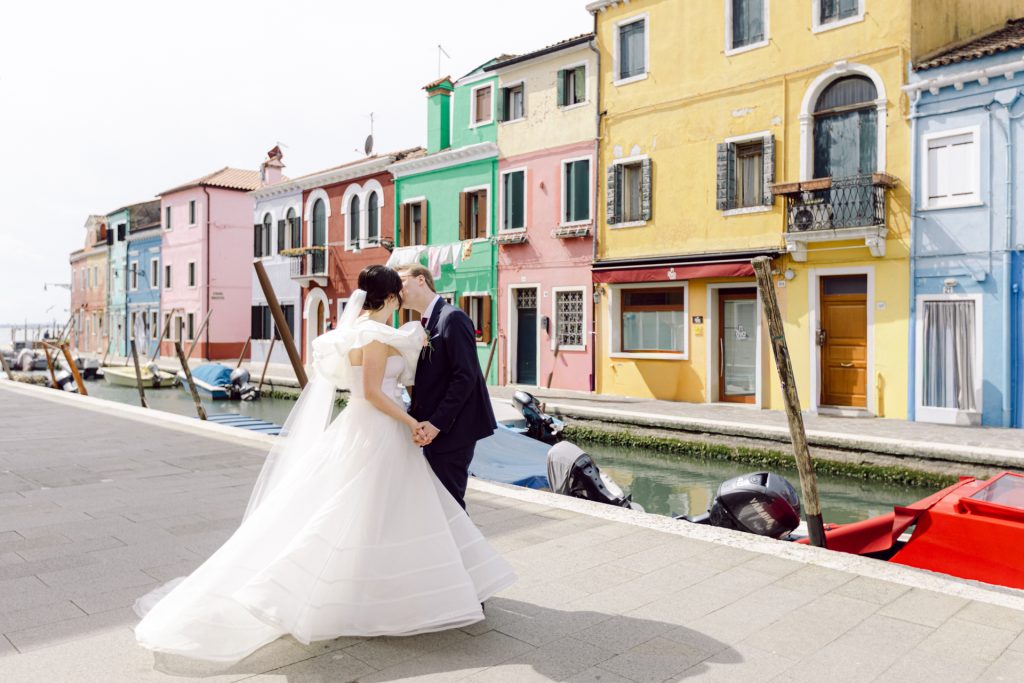
12. How Much Does a Venice Elopement Cost?
Here’s a real answer. It isn’t a range so wide it’s useless, a number designed to make Venice sound cheap, or a figure that leaves out half of what you’ll actually spend.
Venice isn’t an inexpensive city. Everything arrives by boat, beautiful rooms are in short supply, and the loveliest private spaces come at a premium. But an elopement puts your whole budget into the experience itself rather than into feeding a guest list. And in Venice, some of the most extraordinary settings cost nothing at all: an empty Piazza San Marco at dawn, a quiet fondamenta, a campo at blue hour.
As a broad guide, a thoughtfully planned Venice elopement for two costs between about €5,500 and €23,000 all-in. Here’s what that looks like in practice.
Three real examples
A sunrise in San Marco: around €5,700.
- The Mini Elopement Experience at sunrise: €3,800
- Two nights in a comfortable, well-placed hotel: about €600
- Hair and makeup: about €300
- A seasonal bouquet: about €150
- A celebrant: about €450
- Breakfast at Florian and a celebration dinner: about €250
- A water taxi from the airport: about €150
The ceremony location, Piazza San Marco in the first light, is free.
The Half Day, with a gondola: around €10,000. This is the day most of my couples choose.
- The Half Day Elopement Experience: €6,200
- Three nights in a boutique palazzo hotel: about €1,500
- A gondola arranged for your route and your light: about €300
- Water taxis through the day: about €300
- Hair and makeup: about €450
- Florals: about €300
- A celebrant: about €700
- Dinner at a canal-side table: about €350
The ceremony takes place on your hotel’s terrace.
Two days, with the lagoon: around €20,500, or €23,000 with a film.
- The Custom 2-Day Experience: €10,400
- Four nights at one of the city’s great hotels: about €5,200
- A classic wooden boat for the lagoon day: about €1,200
- A gondola: about €300
- Hair and makeup on both days: about €900
- Florals: about €500
- A celebrant: about €1,000
- Two celebration dinners, one of them starred: about €900
- A short film of your day, if you’d like one: about €2,500
This is the most complete version of a Venice elopement: the city on one day and the lagoon on the next.
Cost by cost (2026)
| Element | Typical range |
|---|---|
| Photography and full planning (my collections) | €3,800–€10,400 |
| Ceremony location | €0 in a public space with nothing set up; private rooms and terraces roughly €500–€2,000+ |
| Symbolic celebrant | €350–€800 for a simple ceremony; up to €1,500 fully personalised |
| Legal civil ceremony (municipal fee, non-EU couples) | €1,700–€3,600 at Palazzo Cavalli, depending on day and hour (see below) |
| Gondola, standard ride | €90 for 30 min by day, €110 in the evening, per boat |
| Gondola, arranged for your elopement | Quoted to your route and time |
| Water taxi | From around €60–€80 per trip in the city; around €140–€160 from the airport |
| Private motorboat | Roughly €100–€200 an hour |
| Classic boat, lagoon day | Around €600–€1,200+, depending on the boat and the hours |
| Hair and makeup (both, on the day) | €250–€600; a trial costs about €100 |
| Florals | From €150 for a bouquet; €300–€600 for a full elopement package |
| Videography | €1,500–€4,000 |
| Accommodation, per night | €150–€250 simple · €300–€800 palazzo apartment · €600–€2,000+ grand hotels |
| Dinner for two | €150–€300 at a serious restaurant with wine; starred tasting menus cost considerably more |
| City tourist tax | Up to about €5 per person per night, for a maximum of five nights, paid at your hotel |
These are guides for planning, not quotes. I confirm real prices for your date as part of planning.
If you’re marrying legally in Venice
A legal civil ceremony adds its own costs, so it’s worth knowing them upfront. At Palazzo Cavalli, the municipal fee for non-EU citizens depends on the day and the hour:
- €1,700 during office hours (Monday to Saturday, 8:45 to 13:00)
- €2,100 outside office hours on a weekday
- €2,400 on the day before a public holiday
- €3,600 on Sundays and public holidays
EU citizens pay €700–€1,700. An official interpreter adds €300 if either of you doesn’t speak Italian. Premium municipal rooms and authorised private venues cost more, with fees of up to €10,000 (see section 4). On top of that you’ll pay for your documents, which means translations, apostilles and consular fees depending on your nationality, plus a specialist planner to manage the paperwork. The least expensive legal ceremony is a weekday morning one. It also happens to fit Venice’s light perfectly.
What isn’t in these numbers
Flights, trains and travel insurance vary too much by origin to estimate, so they’re not included above. Travel within Italy is included in every collection. As overnight guests you won’t pay the day-visitor access fee (see section 3). In Italy, tips aren’t expected the way they are in the US. If a gondolier, a waiter or a boat captain makes your day, a small thank-you is always appreciated, but it’s never an obligation.
Where to spend, and where to save
Spend on time. More hours is what turns Venice from a backdrop into a day you actually lived, with room for the gondola, the long lunch, the crossing at golden hour, and the moment you didn’t plan. In summer especially, the 2-Day Experience is the best money you can spend, because it’s the only way to have both the dawn and the dusk.
Spend on where you wake up. For a sunrise start, staying in the historic centre isn’t a luxury. It’s what makes the morning possible. A room on the water also becomes part of your photographs.
Spend on one boat, done properly. A gondola arranged for your route and your hour is worth more than three tourist rides.
Save on the venue. Venice gives you its most beautiful settings for free, as long as you’re there at the right hour.
Save on flowers. The city is decoration enough. One seasonal bouquet is all the day needs.
Save by choosing the season. November, January and early March bring lower hotel rates, an emptier city, and a silvery light that summer never has.
What every collection includes
My collections begin at €3,800 for four hours and go up to €10,400 for two days. Every one of them includes the complete design of your day, not just the photography:
- locations chosen for your season, including the quiet corners most visitors never find
- a timeline built around the light and the tides
- activity ideas and a mood board
- unlimited planning calls
- booking and coordinating your boats, officiant, artists and florist
- guidance on paperwork if you’re marrying legally
- aerial photography wherever it’s permitted
- hand-edited images, with a preview gallery within 48 hours
- a complimentary album design
All travel within Italy is included, and there are no hidden fees.
Almost everything else on this page is over by morning. The flowers fade, the dress is packed away, and the boat returns to its mooring. The photographs are what stay: the part of the day you’ll hold in your hands in fifty years, and the only part your future family will ever see. Planning a Venice elopement was never about finding a beautiful city, because the whole city is beautiful. It’s about the hundred small decisions that make it yours, and that’s the part I’m here for.
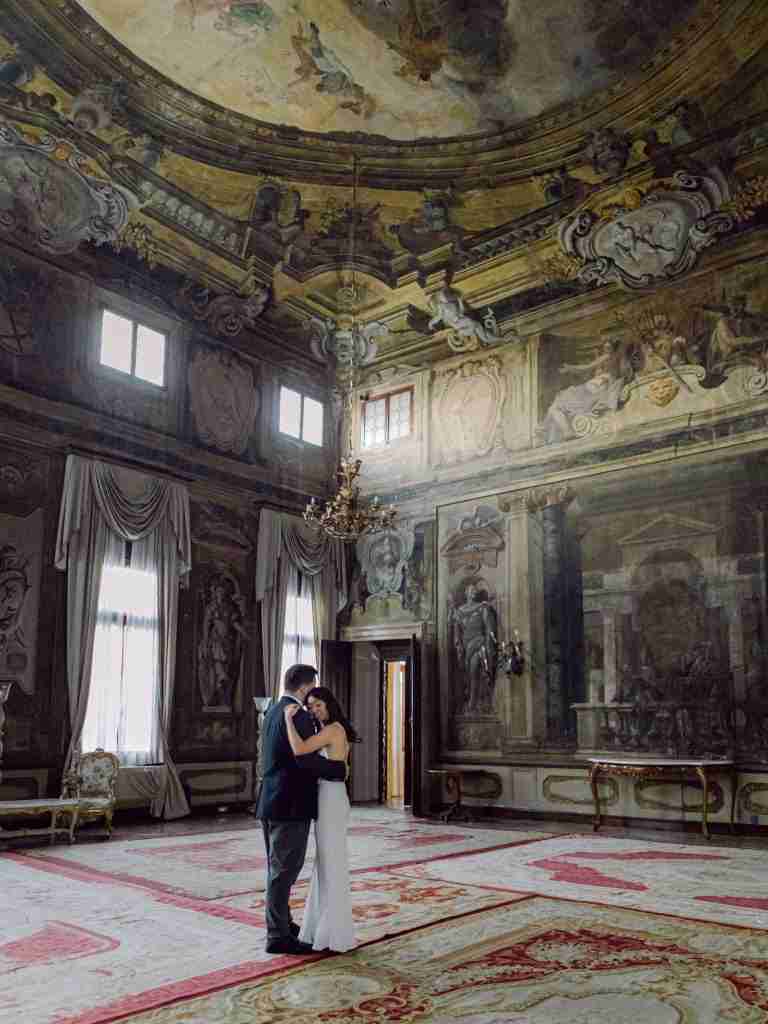
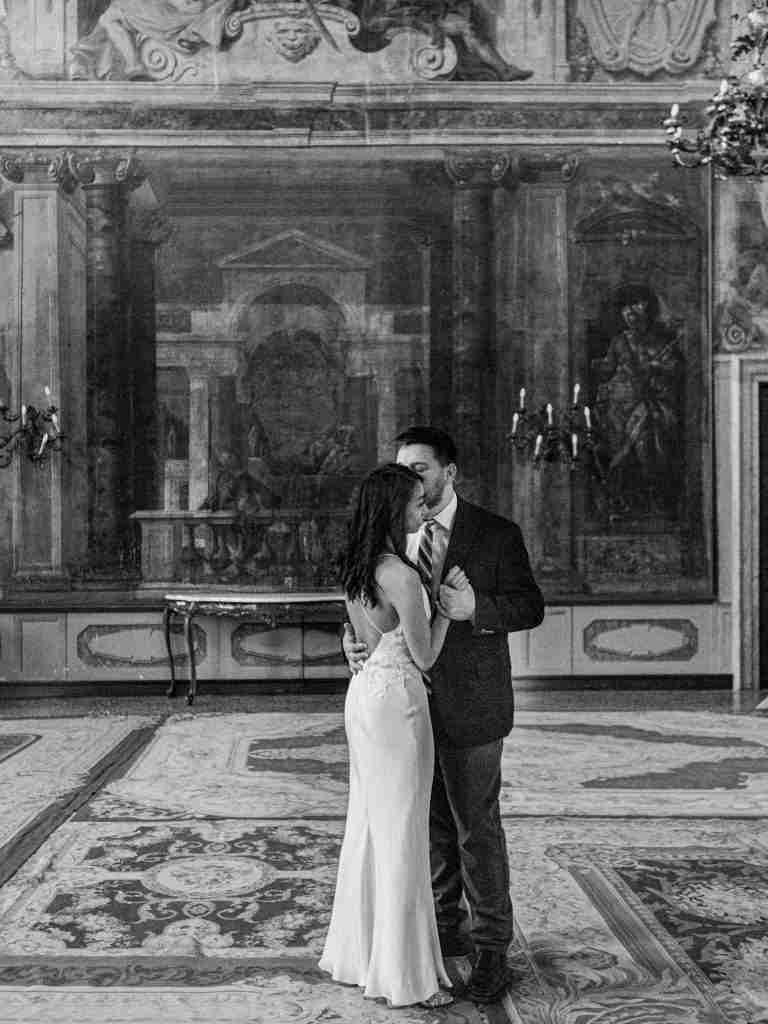
13. Is Venice Actually the Right Fit for You?
Most couples who write to me want Italy, and many haven’t yet decided where in Italy. So before you fall any further in love with Venice, here’s an honest picture of what this city asks of you, and what it gives back.
What Venice asks of you
An early alarm, at least once. The Venice you’ve imagined, with empty squares, mirror-still canals and the Rialto without a soul on it, exists at first light, and in high summer it’s gone by nine. The golden hour is almost as magical. But if your idea of your wedding morning is a long lie-in followed by an empty Piazza San Marco at noon, I’d rather tell you now that the two don’t go together.
Comfortable feet and a little patience with bridges. This is a city of stone steps and centuries-old paving. Almost every part of the day is walked or taken by boat, and even the gentlest route includes a few bridges.
A willingness to share the city. Venice is one of the most visited places on earth. I know exactly where and when to find it quiet, but it will never be as empty as a mountain pass or a private villa garden.
What Venice gives you back
Romance with real weight to it. It’s a thousand years of love stories, in a city built on water that’s still standing. Nowhere else in the world looks like this, and your photographs could never be mistaken for anywhere else.
A wedding day at walking pace. There are no cars, no traffic, no parking and no long drives between locations. Everything you want is a short walk or a boat ride away, so the day is spent living rather than travelling.
Grandeur for two. Frescoed palazzos, gilded ceilings, private terraces over the Grand Canal: settings that would cost a fortune for a hundred guests feel intimate, and surprisingly attainable, for two.
A city that changes by the hour. Sunrise, noon, golden hour and blue hour give you four different cities in a single day, and in winter fog it’s another city again.
If Venice isn’t quite it
Sometimes, reading a guide like this, a couple realises they love the idea of Venice but are dreaming of something else. That’s a good thing to discover now. Here’s where I’d point you:
- If you’re picturing an elegant villa, a garden by the water and a table under the stars, read my guide to eloping on Lake Como. It’s grand and green, and all about the water, the mountains and the villas.
- If you’re dreaming of rolling hills, cypress avenues, a vineyard and a long lunch in the sun, read my guide to eloping in Tuscany.
- If what you want is scale, silence and wild landscape, somewhere truly just the two of you, read my guide to eloping in the Dolomites.
- If you know you want Italy but have no idea which region yet, start with my complete guide to eloping in Italy, which compares them all.
Or choose both
You don’t always have to choose. Venice pairs beautifully with the rest of northern Italy. You could have the wedding day in the city and a second day among the vineyards of the Prosecco hills, or a sunrise on the lagoon and a sunset in the Dolomites two hours north. Lake Como is about three and a half hours away, so it works for a longer trip too. The Custom 2-Day Experience in section 10 is built exactly for this, and travel anywhere in Italy is always included.
Still not sure?
Tell me what you’re picturing: the mood, the season, water or mountains, a city or open landscape, dawn or dusk. I photograph and plan elopements all over Italy, and I’d always rather help you find the place that’s genuinely right for you than talk you into one that isn’t. Sometimes that conversation ends in Venice. Sometimes it ends somewhere you hadn’t even considered. Either way, you’ll know before you book anything.
14. Eloping in Venice with a Few Guests
Some couples want nobody but each other. Others can’t imagine the day without a mother in the front row, a best friend reading something, or the small handful of people who’ve been there all along. Both are elopements, and both are wonderful in Venice. But more than almost anywhere else, this city changes with every person you add. Here’s how.
How many is “a few” in Venice?
Just the two of you, plus two witnesses. If you’re marrying legally, two witnesses are required, and many couples bring their two closest people for exactly that reason. Nothing about the day changes: you can still have the empty city at sunrise, still move quickly, and still slip into the smallest canals.
Up to six people. This is the sweet spot. A small group can still walk the narrow calli together, fit into a single water taxi, and gather in a quiet campo without feeling like an event. It’s intimate and flexible, and the day stays genuinely yours.
Seven to fifteen people. This is still beautiful, but the day needs more shape. I’d plan a private space for the ceremony, several boats, and a real restaurant booking made months ahead. Venice’s streets and tables were built for small parties, and a group of twelve is already a small parade.
More than fifteen. At this point you’re planning an intimate wedding rather than an elopement, and that needs a different kind of planning. I photograph intimate weddings in Venice too, and they’re a joy, but I’ll introduce you to a planner to make it work.
The shape that works best
For couples bringing guests, one structure works better here than any other. The two of you first, then everyone. Start the day alone with me: sunrise in an empty San Marco, a gondola through the small canals, the portraits made while the city still belongs to you. Then your people join you for the ceremony later in the morning, with a long lunch or dinner afterwards.
This way you get both halves of what you want: the intimate, quiet, just-us Venice of the early hours, and the joy of having the people you love around you. Your guests also get to sleep in, which they’ll thank you for.
Where a small group fits
Once you’re more than a handful of people, the ceremony belongs on private ground, not in a public campo:
- a terrace or altana above the rooftops, perfect for up to eight or ten
- a palazzo apartment with a Grand Canal view, where the ceremony happens in the salon and the celebration flows onto the terrace
- a historic room, such as the Sala Capitolare of the Scuola Grande dei Carmini beneath Tiepolo’s ceiling
- a hotel garden or terrace, some of the loveliest spaces in the city (see section 15)
- a legal ceremony at Palazzo Cavalli or one of the authorised venues (see section 4), where your guests can stand with you as you marry
Moving everyone around
This is the part most couples don’t think about until it’s too late. Venice has no roads, so every move your group makes is on foot or by boat.
On foot, a group moves more slowly than a couple, especially over bridges and through narrow calli at busy hours. I build in more time between locations and choose routes with fewer steps, and I plan group photographs where there’s actually room, such as the Zattere, the Riva or a wide campo.
By water, a water taxi carries up to around ten people, so a larger group needs two boats, booked in advance for the right times. For something unforgettable, consider a small flotilla of gondolas, each carrying up to five, moving together through the canals to your ceremony or your dinner. Your guests will talk about it for years.
For the evening, a private boat bringing everyone to a waterside dinner, or back to the hotel after blue hour, turns a transfer into part of the celebration.
What your guests should know
- The access fee. Guests staying overnight anywhere in the Municipality of Venice, including Mestre, are exempt, although they still need a free exemption QR code on fee days. Guests coming just for the day on a fee day pay €5 each if they book at least four days ahead, or €10 after that. Attending a wedding doesn’t count as an exemption. Children under 14 don’t pay. It’s worth sending the details to your guests with your plans (see section 3).
- Where to stay. Guests who stay in the historic centre can walk to everything. Guests in Mestre are only minutes away by train or bus, but they’ll join you later in the day rather than at sunrise.
- Shoes. Tell your guests about the bridges. Elegant, comfortable shoes make the day for everyone.
- Children and pushchairs. Children are wonderful at a Venice wedding. A pushchair on the bridges is harder work, so a baby carrier is usually easier.
When you’ll want a planner
For the two of you, or a handful of guests, you don’t need one. The design and coordination of your day are already part of every collection. Beyond about ten to fifteen guests, or if you’re planning a welcome dinner, several days of events or guests arriving from different countries, a local planner is worth every euro. I work alongside some of the best in Venice and I’m happy to introduce you. I’ll still design the photography, the light and the moments, while they take care of your guests.
→ Tell me who’s coming, and I’ll suggest the right shape for your day
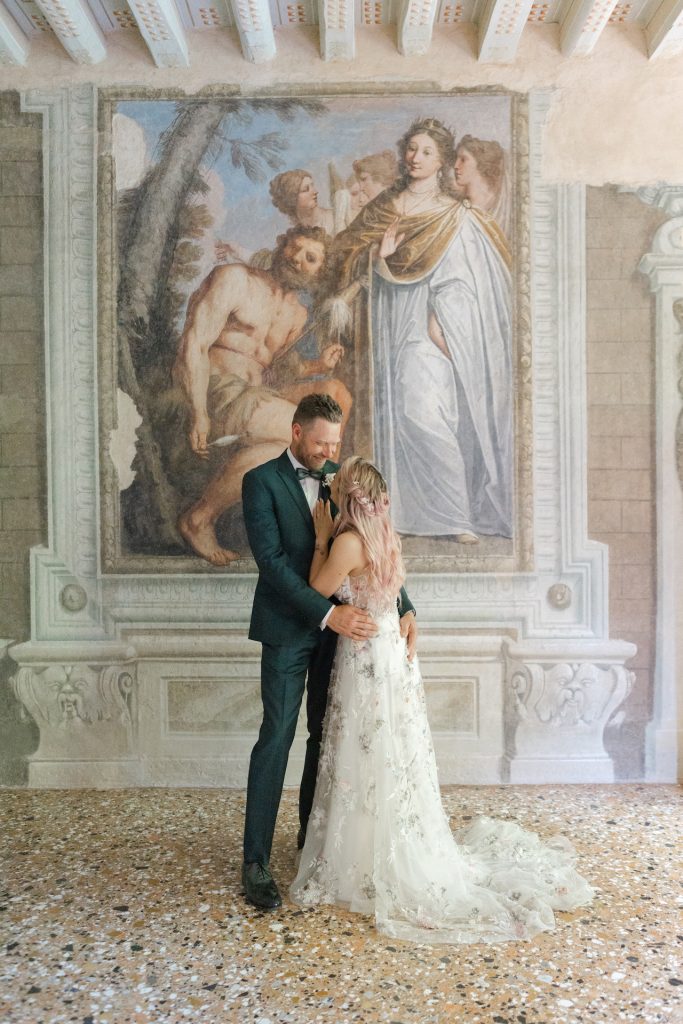
15. Where to stay for your Venice elopement: Hotel, Palazzos and Private Rentals
Where you sleep shapes your elopement day more than almost any other decision.
First, stay in the historic centre. For a sunrise start, it’s what makes the morning possible rather than a luxury. Mestre is only minutes away, but a 5am crossing from the mainland adds friction to a morning that should feel quiet and unhurried. Stay in Venice itself, and wake up with the canal already outside your window. It also keeps things simple on access-fee days, because overnight guests are exempt (see section 3).
Next, choose the neighbourhood by your light. San Marco, Castello and Dorsoduro put you closest to the most beautiful sunrise locations. San Polo and Santa Croce are central and quiet. Cannaregio is lovely to live in, but it’s a little further from the Piazza, and at 5:30am that matters.
Then remember that your hotel is part of your elopement. Venice’s great hotels weren’t built as hotels. They’re palazzos, orphanages and noble residences, inhabited for centuries before anyone ever checked in. Where you get dressed, where you drink your first coffee, and the light that falls through your window before we begin are all part of the story. Here are the places I’d send you to, from the grandest to the most intimate, plus one option no hotel can offer.
For ceremony-focused hotel spaces, such as terraces, gardens and rooms that can host a symbolic or civil ceremony, see my guide to the best wedding venues in Venice.
The Grand Five-Star Palazzos

The Gritti Palace (San Marco, Grand Canal)
Built in the 15th century by the Pisani family and completed in its current Gothic form in 1475, the Gritti Palace became the private residence of Doge Andrea Gritti in 1525. It has been a hotel ever since, and it has changed remarkably little. The Doge himself would recognise the décor, as would former guests such as W. Somerset Maugham and Ernest Hemingway, who wrote at a table on the canal terrace.
For elopement photography, the Gritti is exceptional for one reason above all others: its position. It sits directly on the Grand Canal, facing the Church of Santa Maria della Salute and the Punta della Dogana, with the Peggy Guggenheim Collection just across the water. The Gritti Terrace, the seasonal outdoor restaurant where tables sit literally inches from the Grand Canal, is one of the most beautiful places in the city to photograph a couple. Warm stone, Grand Canal light bouncing off the water and the Salute rising in the background create images that are impossible to make anywhere else in Venice.
Getting dressed in a Grand Canal suite, stepping straight onto the waterfront for the first images of the day, then arriving at San Marco on foot through the quiet morning streets: logistically and aesthetically, there’s no better way to begin a Venice elopement.
Why I recommend it for elopements: The terrace. The Grand Canal proximity. The quiet campo of Santa Maria del Giglio behind the hotel, one of the most beautiful and overlooked squares in San Marco. And Piazza San Marco is five minutes away on foot.

Hotel Danieli, A Four Seasons Hotel (Castello — Riva degli Schiavoni)
For more than three years, the most famous hotel facade in Venice was hidden behind scaffolding. On 30 July 2026, the legendary Hotel Danieli reopened as Danieli, Venezia, A Four Seasons Hotel, after a meticulous restoration led by French interior architect Pierre-Yves Rochon.
The Danieli’s central wing was built as Palazzo Dandolo at the end of the 14th century by one of the Dandolo families, among the most powerful dynasties in Venetian history, whose members included doges and crusade leaders. The palazzo hosted grand social events for centuries, and at one wedding celebration held here, Monteverdi’s Proserpina Rapita had its premiere. The hotel’s second life began in 1822, and it has since hosted Charles Dickens, Charlie Chaplin, John Ruskin and George Sand.
The gilded internal atrium, four floors of Gothic arches rising in pink marble and gold and lit by Murano glass chandeliers and stained-glass windows, is one of the most extraordinary architectural interiors in Venice. I’ve never made a bad photograph on that staircase. It’s theatrical in the way only a building that has hosted theatrical people for two centuries can be.
The restored rooftop Terrazza Danieli has a panoramic view over the lagoon, San Giorgio Maggiore, the Doge’s Palace and the Riva, and it’s extraordinary at both sunrise and blue hour. The hotel sits directly on the Riva degli Schiavoni, five minutes from San Marco, which makes it unbeatable for a sunrise session.
Why I recommend it for elopements: The atrium staircase for interior portraits. The rooftop terrace. The Riva and the water right outside the door, ready for a gondola or water taxi arrival. The lagoon views from the upper suites are some of the best in the city.
Aman Venice (San Polo, on the Grand Canal)
This is the most private and architecturally extraordinary hotel in Venice. Palazzo Papadopoli is a 16th-century Grand Canal palazzo still partly lived in by the family that owns it, in private apartments above the hotel. The leather wall coverings in some of the rooms have absorbed centuries of Venice’s scents, its musks, spices and salt, and entering certain rooms feels like breathing in time itself.
There are only 24 rooms and suites, many with protected frescoes and original reliefs, and a private garden that opens directly onto the Grand Canal, one of the very few in the city. The privacy is absolute, and the service anticipates rather than responds. For couples who want Venice to feel like it belongs only to them, nothing comes closer than Aman.
Why I recommend it for elopements: The private garden on the Grand Canal is one of the only places in Venice where you can stand among greenery with the canal and the city behind you. Twenty-four rooms mean real intimacy. The palazzo’s frescoed interiors make getting-ready images look like paintings.
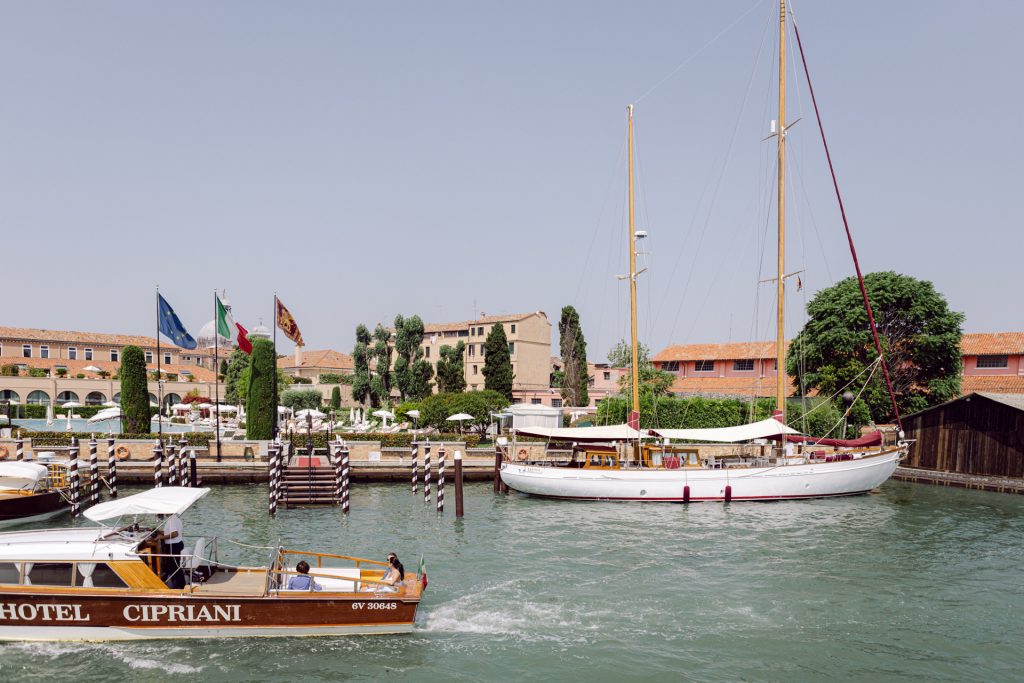
Belmond Hotel Cipriani (Giudecca) — spring to September only
Venice’s most famous hotel isn’t on the main island but on Giudecca, five minutes across the basin by the hotel’s private launch, which runs around the clock. Its founder, Giuseppe Cipriani, had already created Harry’s Bar in 1931, where Hemingway, F. Scott Fitzgerald, Noël Coward and Gertrude Stein all drank. The hotel opened in 1958 and has barely changed since, in the best possible way.
The Cipriani’s gift for elopement photography is its location. Every time you cross to Venice, you do it by private launch over open water. That arrival, with the San Marco skyline, the Campanile and the Doge’s Palace rising as you cross the basin, is the most beautiful entrance to Venice there is. Looking back from Giudecca at golden hour, with the whole city laid out across the water turning gold and amber, gives a view I’ll always want to photograph.
Palazzo Vendramin, a 15th-century aristocratic residence that now forms part of the hotel, offers suites with private butler service and direct views across the lagoon to Piazza San Marco. The Cipriani also has a heated Olympic-size saltwater pool, the largest pool in central Venice. It’s extraordinary in late spring, when the late-afternoon light falls across it.
One important note: the Cipriani is seasonal. In 2026 it closes on 30 September, so it’s a hotel for late-spring and summer elopements, not for October.
Why I recommend it for elopements: The boat crossing to Venice is a ceremony in itself. The gardens and pool give you private portraits on the island. Then there’s the view back to Venice at golden hour. For couples who want a resort feeling alongside the Venice experience, nowhere else offers it.
The Boutique Palazzos — Smaller, More Intimate, Equally Historic
Ca’ Sagredo (Cannaregio, Grand Canal at the Rialto)
A 15th-century palazzo on the Grand Canal, directly facing the Rialto market, Ca’ Sagredo is a listed national monument, and walking through it feels like walking through a museum where you happen to be allowed to sleep. Pietro Longhi’s vast fresco The Fall of the Giants, painted in 1734, covers the walls of the grand staircase. Breakfast is served in the Sala del Tiepolo, under a ceiling by Giambattista Tiepolo himself. Works by Sebastiano Ricci hang throughout, and the rooftop terrace is edged with a balustrade of Murano glass flowers.
I’ve photographed couples here, and it’s one of my favourite interiors in the whole city. The light through the Grand Canal windows falls onto centuries of stucco and gold, and the staircase alone could fill a gallery. Ca’ Sagredo is also one of the private venues authorised by the city for legal civil ceremonies (see section 4). You could get dressed, marry and take your first portraits as a married couple without ever leaving a frescoed palazzo.
Why I recommend it for elopements: The Longhi staircase. The Grand Canal rooms. The Rialto market waking up across the water at dawn. A legal ceremony under the same roof.
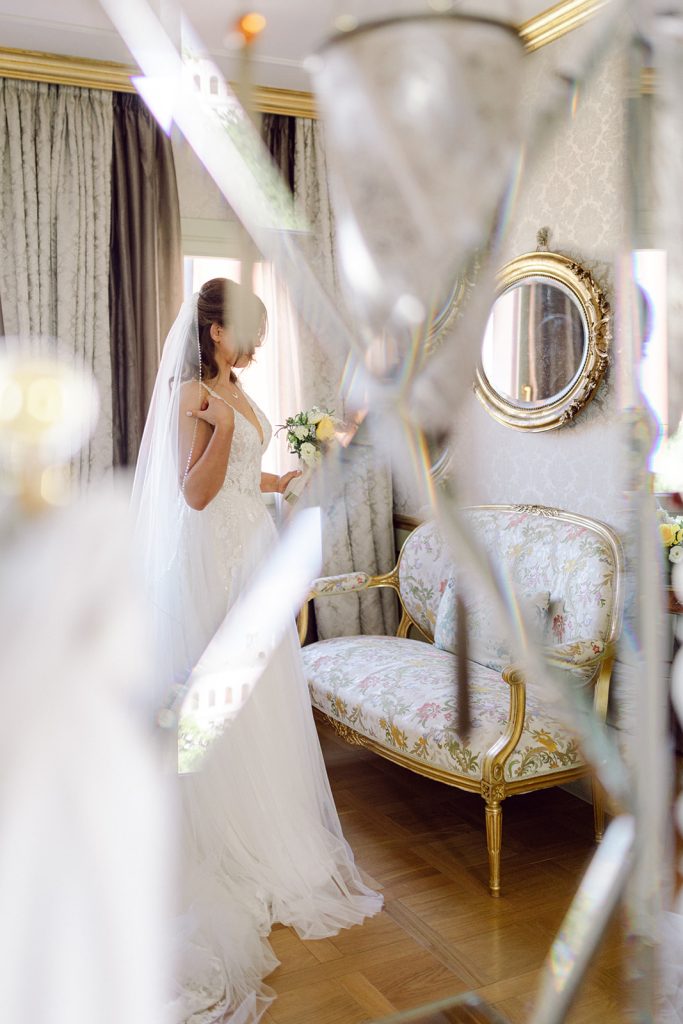
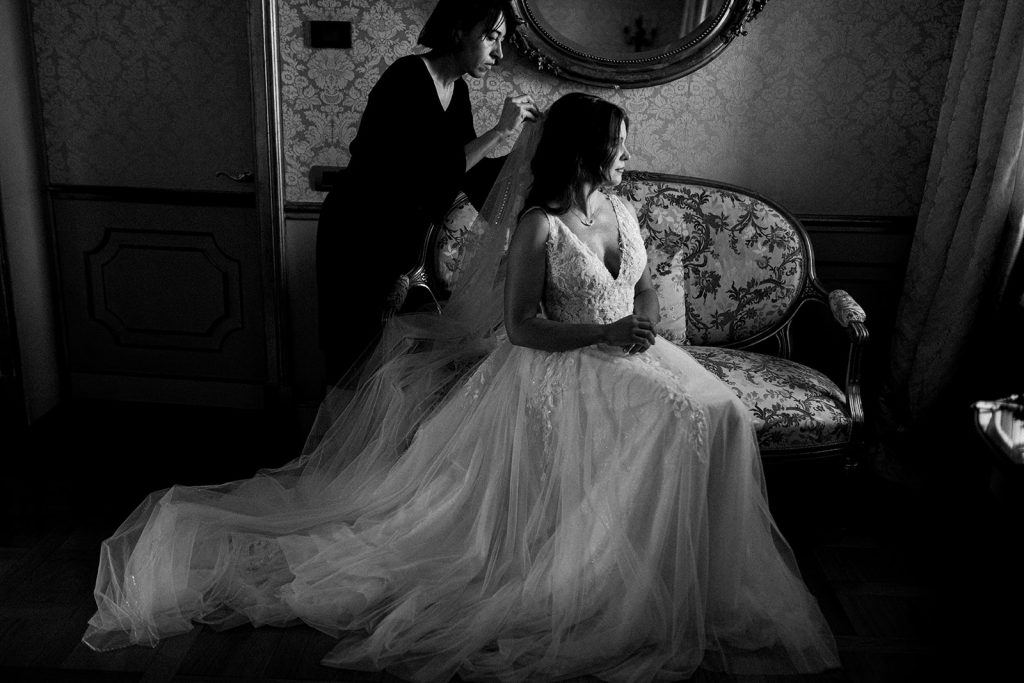
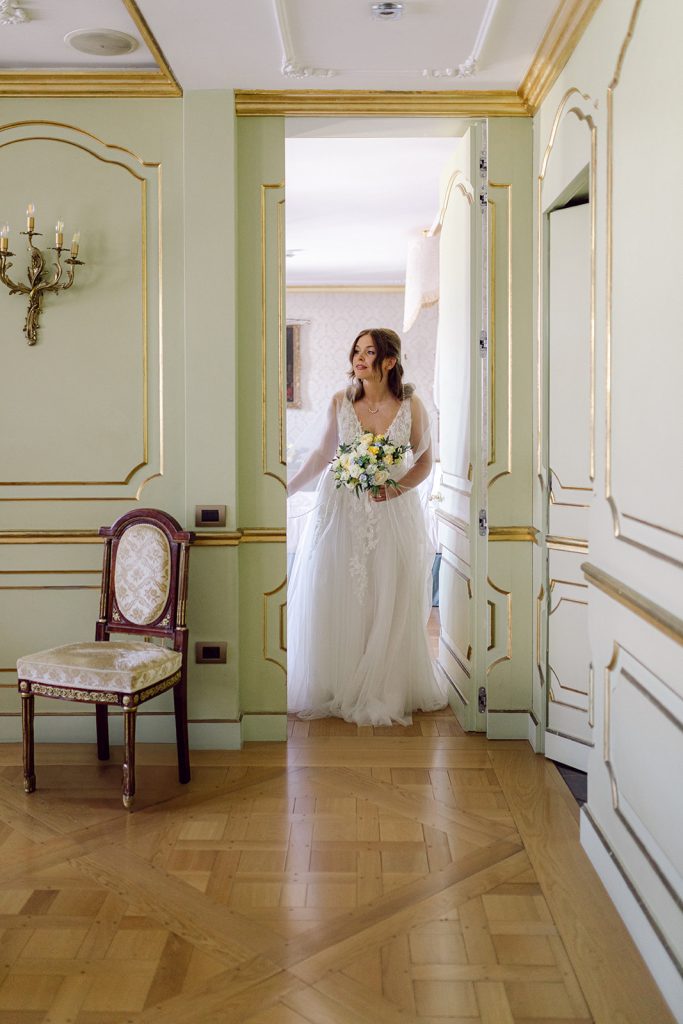
Baglioni Hotel Luna (San Marco, San Marco Basin)
If the Gritti Palace is Venice’s grandest hotel address, Baglioni Hotel Luna is its most ancient. The oldest hotel in Venice, it’s housed in a 12th-century palazzo a few steps from Piazza San Marco. The building began its life as a shelter for the Knights Templar on their way to the Crusades in 1118, and by 1574 it had become the Locanda della Luna, the Inn of the Moon. The walls you get dressed against on your elopement morning have been standing for nearly a thousand years.
The interiors are 18th-century Venetian grandeur: a marble lobby, crystal chandeliers, brocade fabrics and antique furnishings. Breakfast is served in the Salone Marco Polo, a frescoed ballroom decorated by pupils of Tiepolo. It’s one of the most beautiful breakfast rooms in Europe and an extraordinary location for getting-ready photography. The hotel has its own private jetty on the lagoon.
The San Giorgio Terrace Suite deserves special mention. It’s a two-bedroom apartment with its own private terrace of more than 100 square metres, overlooking the lagoon and San Giorgio Maggiore. That terrace, entirely private, panoramic and facing the water, is a ceremony location in its own right, and one of the most naturally beautiful ceremony settings in the city. I wouldn’t hesitate to photograph a symbolic ceremony there.
Why I recommend it for elopements: The San Giorgio Terrace Suite for a private ceremony with lagoon views. The Salone Marco Polo for frescoed getting-ready portraits. The history: nothing in Venice says you chose a city with a thousand years of love stories more clearly than this address.
Hotel Metropole (Castello, Riva degli Schiavoni)
Vivaldi taught music here. Thomas Mann stayed here while writing Death in Venice, and Sigmund Freud stayed here too. During the Second World War the building served as a military hospital. Since 1968 it has been owned by the Beggiato family, who have filled it with more than 2,000 antiques, one private collection per floor, each different and each extraordinary:
- trunks and suitcases
- fans and Belle Époque evening bags
- corkscrews and crucifixes
- 19th-century Thai armour
- Far Eastern rugs and red velvets
The hotel is a museum that also happens to offer rooms. The Oriental Bar & Bistrot is set in the very chapel where Vivaldi once taught the orphan girls of the Ospedale della Pietà, and it still has a speakeasy, incense-and-candlelight quality, like a scene from a Visconti film. The Giardino degli Agrumi, the citrus garden, is a rare and beautiful private outdoor space in this part of Venice.
For photography, the Metropole’s interiors are unlike any other hotel in the city: deeply layered, eccentric, and rich with texture, objects and atmosphere. Getting-ready images made here look like editorial fashion photography shot in a collector’s private home. It’s maximalist and intense, so it isn’t for everyone, but for the right couple it’s extraordinary.
Why I recommend it for elopements: The extraordinary interiors for getting-ready and ceremony portraits. The citrus garden. The chapel bar. The lagoon views from the suites. And its position directly on the Riva degli Schiavoni, five minutes from San Marco.
Palazzo Stern (Dorsoduro, Grand Canal)
Palazzo Stern is a Moorish-Gothic palazzo with roots in the 13th century. It was rebuilt in the early 20th century by the Stern family, renowned Venetian art collectors, who worked older materials and elements from the original building into the reconstruction. The result is a deeply photogenic building: Gothic arched windows, original mosaics and sculptures throughout, frescoes, Murano glass chandeliers and silk walls.
The waterside terrace overlooking the Grand Canal is the hotel’s defining feature. Breakfast and aperitivi are served at outdoor tables under a canopy at canal level, with gondolas gliding past at arm’s reach. It’s one of the most intimate Grand Canal experiences in Venice: not a grand terrace high above the water, but right at water level, close enough to feel the wake of passing boats. For photography it’s extraordinary, with warm stone, canal light, and the Grand Canal and Palazzo Grassi directly opposite.
The rooftop Jacuzzi terrace has panoramic views over the Venetian rooflines and the canal below. The hotel is in Dorsoduro, steps from the Accademia Bridge and Ca’ Rezzonico, perfectly placed for both San Marco sunrise sessions and Dorsoduro golden-hour work.
Why I recommend it for elopements: The water-level Grand Canal terrace is one of the most photogenic hotel spaces in Venice. The property is intimate, with only 24 rooms. And its Dorsoduro location is calmer and more local than San Marco.


Hotel Nani Mocenigo Palace (Dorsoduro, Rio di San Trovaso)
Palazzo Barbarigo Nani Mocenigo dates to the 15th century. It was built for the Barbarigo family, one of Venice’s most illustrious noble dynasties, which gave the city two doges. It later passed to the Nani and Mocenigo families (four more doges between them) and was enlarged and embellished with frescoes by Guarana, a collaborator of Tiepolo, and stuccoes by Alessandro Vittoria. In the 18th century it housed the Naniano Museum, a celebrated private collection of antiquities. Later it became part of Ca’ Foscari University, before its recent restoration as a hotel.
The palazzo sits on the Fondamenta Nani, overlooking the Rio di San Trovaso, one of the most beautiful and quiet canals in Dorsoduro, directly opposite the historic Squero di San Trovaso, one of the last working gondola yards in Venice. The Gothic facade, the small canal and the weathered gondola yard opposite make one of the most genuinely Venetian views in the city. It isn’t a famous view. It’s the kind of view that people who actually live in Venice love.
The hotel’s private garden, rare and beautiful in this part of Dorsoduro, is the heart of the property. Breakfast under the trees, morning light through the leaves, and the quiet of a neighbourhood that tourists barely reach: this is Dorsoduro at its most intimate.
Why I recommend it for elopements: The Rio di San Trovaso and the gondola yard opposite, one of my favourite views in all of Venice. The private garden for a ceremony or aperitivo portraits. The frescoed interiors. An atmosphere of genuine, lived-in nobility that many hotels claim and few achieve.
Ca’ Maria Adele (Dorsoduro, near Santa Maria della Salute)
This 16th-century palazzo has only fourteen rooms, each decorated individually. Some have Murano glass mosaic headboards, one has a canopied bed and damask walls, and others have frescoed ceilings or views over the Salute. It’s owned by two brothers, Alessio and Nicola Campa, who have filled the building with their own taste and personality: a mix of Venetian tradition, Moroccan textiles and African objects, with a sensibility that’s intimate, bold and unlike any other hotel in Venice.
It’s one of the most photogenic interiors in the city at any price point. It feels more like a jewel box than a palazzo: concentrated, warm and deeply personal. For getting-ready photography, the rooms here produce images that look as if a fashion editor had styled them.
Why I recommend it for elopements: Intimacy and character that no larger hotel can match. Rooms that are each genuinely different. And it’s so close to the Salute and the Dorsoduro waterfront that a morning session needs no transport at all.
The Venice Venice Hotel (Cannaregio, Grand Canal, at the Rialto bend)
This is the most singular hotel on this list, and arguably in Venice. That’s not only because of its service or its grand history, though both are extraordinary, but because of what it’s trying to do and why.
Ca’ da Mosto is a 13th-century palace in the Venetian-Byzantine style, often described as the oldest on the Grand Canal. It sits right where the canal bends to meet the Rialto Bridge, with uninterrupted views of the bridge. It’s the same panorama Canaletto painted, and his light-drenched views of this stretch of the canal match the palazzo’s own perspective almost exactly.
The palace takes its name from Marco da Mosto, who bought it in 1266. The explorer Alvise da Mosto, who worked for Prince Henry the Navigator of Portugal between 1454 and 1462, was born and died here. Between the 16th and 18th centuries the palazzo housed the Albergo Leon Bianco, the White Lion Hotel, one of Europe’s first hotels and a stop on the Grand Tour. In 1769 and 1775, the Holy Roman Emperor Joseph II stayed here during his visits to Venice. The palazzo then sat empty for decades, until a major restoration turned it into the Venice Venice Hotel, which opened in 2022.
The hotel was conceived by Alessandro Gallo and Francesca Rinaldo, the founders of Golden Goose, and it shows. Each room is named after, and contains works by, a specific artist. Yoko Ono’s Dream hangs in Room 72, which also has a terrace looking across the Grand Canal to the Rialto Bridge. The hotel’s concept, Postvenezianità (“the shape of Venice to come”), deliberately rejects nostalgic Venetian pastiche in favour of something genuinely contemporary, layered and alive. Architecture, contemporary art, fashion and the 800-year-old bones of the oldest building on the Grand Canal all share the same rooms.
A sotoportego, a passageway under the building, houses the hotel restaurant, Venice M’Art. On one side it has a terrace on the Grand Canal, and on the other a bar, shop and exhibition space. That terrace, directly below the Rialto bend with the bridge framed in the background, is one of the most extraordinary outdoor dining and photography positions in the city.
Why I recommend it for elopements: The Rialto view from the terrace and the upper suites, which is Canaletto’s view, available to you in real life. The contemporary art interiors, which produce images that look nothing like any other Venice hotel photography. The sotoportego as a ceremony setting: ancient stone, canal light, absolute drama. For couples who want Venice’s history with a contemporary, art-world sensibility rather than antique grandeur, this is the only hotel that offers it. And the irony isn’t lost on me: the oldest building on the Grand Canal is also the most forward-looking hotel in the city.
One practical note: The hotel is in Cannaregio, the furthest sestiere from San Marco on this list. For a sunrise session in the Piazza, allow a 15–20 minute walk. I think it’s completely worth it, but plan for it.
A Completely Different Option — Private Palazzo Rentals
Not every couple wants a hotel. Some want to feel they’re genuinely inhabiting Venice for a few days rather than being guests in it. Some want a space that’s entirely their own for a ceremony: a terrace over the Grand Canal, a piano nobile with frescoed ceilings, a private garden, or a water entrance where your gondola arrives right at the door.
Venice has a kind of rental that exists almost nowhere else in the world: private apartments inside historic palazzos, many directly on the Grand Canal, many with terraces or private water gates. Some are listed on Airbnb and others are managed privately. Several are, quite literally, rooms in buildings that have belonged to the same Venetian families for centuries.
What makes these extraordinary for elopements is total privacy combined with genuine architectural beauty. Picture a symbolic ceremony on a Grand Canal terrace at sunset, with just your officiant, your photographer and no one else, while the water moves below and the palazzos turn gold in the last light. It’s one of the most intimate experiences Venice can offer. There’s no hotel lobby, no other guests, and no schedule that isn’t yours.
The words to search with:
- Piano nobile is the principal floor of a Venetian palazzo, typically with the highest ceilings, the most elaborate details and the grandest windows. This is what you want.
- An altana is the traditional Venetian rooftop terrace, built of wood, often with views over the rooflines and canals. It’s extraordinary in summer and autumn, and cold in winter.
- Riva d’acqua or accesso dall’acqua means the property has a private water entrance directly onto a canal. Arriving at your ceremony by gondola and stepping through the portego from the water is an experience no hotel lobby can replicate.
- Affaccio sul Canal Grande means the property faces the Grand Canal. It’s the most sought-after position in Venice, and the one that produces the most extraordinary images.
Properties worth knowing: Palazzo Correr Contarini Ca’ dei Cuori on the Grand Canal has apartments with private terraces and a garden. Palazzo Vendramin Costa has a piano nobile apartment with a Grand Canal balcony. Palazzo Garzoni has a top-floor apartment with a private terrace and rooftop views over the Rialto. These and many similar properties appear on Airbnb. Search for piano nobile, Canal Grande view and private terrace.
Practical notes before you book:
- Check what the building actually permits. Some palazzos welcome ceremonies and outside vendors, while others have building rules that prohibit events. Always confirm with the owner before booking, before giving your officiant the address, and before planning a ceremony there.
- Consider the season carefully. An altana is magnificent in June or October, but in February it’s cold and often wet. A piano nobile with Grand Canal windows works in every season, although the light changes dramatically through the year, and I can advise on that once I know your dates.
- Think about the water entrance. It changes the emotional experience of the day entirely. Arriving at your ceremony by gondola, gliding down a narrow canal and stepping out through a gate from the water into a courtyard or androne is the Venice elopement experience that exists nowhere else, and that no hotel can replicate.
I can help you find the right property. Knowing which buildings have the right light at the right hour, which terraces face west for golden-hour ceremonies, which piano nobile apartments have ceilings worth photographing, and which hosts understand what an elopement photographer needs: this is part of what I mean by experience design. If you’re considering a rental for your Venice elopement, mention it when you inquire, and I’ll give you specific recommendations for your season and vision.
16. What to Wear for Your Venice Elopement
This is deeply personal, and I would never presume to dictate it. But I have some genuine recommendations, based on what works photographically and practically in Venice.
Choosing your outfit
For Venice’s colour palette. The city is warm-toned: terracotta, ochre, aged stone, dark water, deep wood. Colours that work beautifully against this palette include ivory and cream, deep burgundy and rust, soft olive, champagne, nude and sand tones, and navy. Pure brilliant white can be harsh in Venice’s light. Highly saturated colours, like vivid orange or electric blue, can compete with the city’s own palette rather than work with it.
For movement and elegance. Venice rewards flowing fabrics. A dress that moves when you walk, catches the slight breeze off the water, and photographs like the city itself (light, ancient and alive) will always look extraordinary here. Structured, stiff silhouettes are beautiful in a different way, and they work very well in the more architectural locations.
For suits. Venice is a city with a strong aesthetic. A well-cut suit in a warm tone, such as charcoal, navy, warm grey or even a subtle check, looks extraordinary here. If you want to be more casual, a linen suit in cream or ecru can look wonderful in summer and autumn. Dress for the city as much as for the photographs.
Navigating Venice in wedding clothes
This comes up in almost every planning conversation, and I want to be practical rather than just reassuring.
Venice is cobblestones, bridge steps, narrow doorways and occasional flooding. It’s one of the most beautiful cities in the world to elope in, and it asks for a kind of physical pragmatism that flat European capitals don’t.
Footwear. This is the most important decision you’ll make about what to wear. Stilettos on Venetian stone are genuinely dangerous, because the surface is uneven, often wet and unpredictable. Low block heels or elegant flats are far more practical and, in my opinion, far more beautiful for Venice. You’ll be walking, climbing bridge steps, and possibly stepping in and out of a gondola, and your shoes should let you do all of that without thinking about it. I often suggest bringing a second pair, comfortable shoes for the walking sections and dress shoes for the ceremony and formal portraits, and changing when we arrive at each location. If your day includes a classic wooden boat, remember that many of them ask for soft soles or bare feet on deck (see section 9).
Train length. A dramatic cathedral train is extraordinarily photogenic in the right setting, but genuinely difficult to manage in Venice’s narrow streets and on bridge steps. If a long train matters to you, we plan the route around it, or bring styling help: an extra set of hands, my assistant. Discuss it with me before your day and I’ll plan for it. A train does gather beautifully into a gondola, though. It’s one of the loveliest images of any Venice elopement.
Humidity and heat. In July and August, Venice is humid in a way worth taking seriously when you choose your dress. Natural fibres such as silk, linen and cotton blends breathe and move more comfortably in the heat than synthetics. For winter, think about what you’ll wear underneath: a thin layer under the dress, and a beautiful wrap or jacket for between locations. I always check the weather forecast for the week of your elopement with you during planning.
Acqua alta. If your elopement falls in autumn or winter and acqua alta (high water) is forecast, I’ll let you know in advance. Since 2020 the MOSE flood barriers have held back the highest tides, and the flooding that does still happen is mostly shallow, often only a few centimetres in the lowest-lying areas, and it passes within a few hours. We adapt the route and bring rubber boots for the walking sections if needed. In some cases acqua alta actually produces extraordinary photographs: the reflections, the raised walkways (passerelle), and the particular quality of a city quietly managing its relationship with the sea. Some of my most memorable Venice images were made on flooded mornings.
A few more things worth knowing
Veils and wind. Out on the open water, crossing the basin by boat or standing at Punta della Dogana, there’s almost always a breeze. A long veil flying in the wind can make a breathtaking photograph, and it can also wrap around your face at exactly the wrong moment. Bring a few extra pins, and for boat crossings consider a shorter veil or a hair accessory instead. We’ll bring the long veil out where the light and the wind are on our side.
Churches. If your day includes stepping inside one of Venice’s churches, such as the Frari, the Salute or the Basilica of San Marco, remember that shoulders and knees need to be covered. A light wrap or shawl in your bag solves it instantly, and it often photographs beautifully too.
Travelling with your outfit. Carry your dress or suit in a garment bag as hand luggage, never in the hold. When you arrive, let the heavy suitcases go with a porter (see section 3) while your wedding clothes travel with you. Ask your hotel to steam them on arrival. Most good hotels in Venice do this every day.
Carnival. If your elopement falls during Carnival, there’s another possibility: dressing for it. Venice has historic costume ateliers that hire out 18th-century gowns, capes and masks. Some couples choose full costume, others add only a mask and a cape over their wedding clothes for part of the day. Either way, the images are unlike anything else you’ll ever own.
Send me your choices
I ask all my couples to send me their outfit choices before the day, so I can plan locations, backgrounds and light around them. A dress with a long train changes which bridges we cross. A deep burgundy suit changes which walls we stand against at golden hour. The more I know, the more your photographs will look like you in Venice, and not just anyone.


17. How to find the right photographer for your Venice elopement
In most places, a photographer’s job starts when you arrive. In Venice it starts months before. Most of what makes a Venice elopement work happens before a single photograph is taken:
- the hour you step into Piazza San Marco
- which bridge you cross, and when
- whether the gondolier knows why you’re there
- whether the tide will let you through the canal you’ve chosen
- whether your date falls on a Regata or an access-fee Saturday
The person who photographs your day in Venice is, in practice, the person who designs it. So choosing them is really choosing how your day will unfold.
Here’s what I’d look for, whether or not you end up choosing me.
What to look for
Full galleries from Venice, and from your season. Anyone can post twenty beautiful images from a city this photogenic. Ask for a complete gallery, start to finish, ideally from the same season as your date. Venice in October and Venice in July are different cities, and you want to see how a photographer handles yours. Look at the whole day, not just the highlights: the walking moments, the in-between, the light in the hour after the ceremony.
Empty places, honestly earned. Look for San Marco, the Rialto and the Accademia Bridge without crowds. Then ask how it was done. The answer should be timing, not software. A photographer who knows when the city is empty gives you real images of a real morning. Heavy retouching to remove crowds gives you a postcard, and it shows.
Light literacy. Venice lives in three windows: first light, golden hour and blue hour. Ask what time they’d start your day, and why. A good answer names the month and the sunrise. A vague one (“we’ll go in the morning”) tells you they haven’t thought about it.
Real local knowledge. This covers the tides and the high-water forecast, the city’s events calendar, the access fee, which campo floods first, which gondoliers work well with photographers, and which hotel terraces allow a ceremony. None of it is in a guidebook, and all of it changes your day.
Planning, not just photography. Ask exactly what’s included before the day. Does the photographer design the route and timeline, book the boats, introduce the officiant and coordinate the vendors? Or do you need a separate planner for all of that? In Venice this makes a real difference to both your budget and your stress.
How they make you feel. Most people aren’t comfortable in front of a camera, and a crowded city can make that worse. Look for a photographer whose couples look at ease, not posed. Then have a video call and notice how you feel after it.
Questions worth asking
- How many Venice elopements have you photographed, and can I see a full gallery?
- What time would you start my day, and why?
- What’s your plan if it rains, or if acqua alta is forecast?
- Who arranges the gondola and boats?
- What’s included in the planning, and do I need anyone else?
- Do you edit every image yourself? When do the previews and the full gallery arrive?
- Can you fly a drone over Venice?
That last question is a good test. The honest answer is that the historic centre is a restricted zone, and aerials there need specific authorisation. A photographer who promises you drone shots over Piazza San Marco without mentioning that isn’t being straight with you.
A few red flags
- A portfolio of the same five spots at the same busy hour. That’s a route, not a design.
- A promise of an empty San Marco at noon, or any hour after mid-morning in season.
- A “gondola package” that’s really a standard tourist ride from the busiest station.
- Vague answers about what’s included, or about who handles the boats, the officiant and the timing.
- No clear delivery timeline for previews and the final gallery.
Why couples choose me
I’m Italian, and Venice is my home base. I photograph and plan elopements across Italy, but this is the city I know best: every season, every hour, and every kind of weather. I know which bridge catches the light at 7:10 in October, which campo is empty at noon when everything else is full, and which gondolier will pause in exactly the right place without being asked.
My background is in cinema. I’ve worked as a director of photography for years, and I read a place the way a film does, through its light, its movement, its rhythm and its story. That’s why my images feel editorial and full of light, but never stiff. I guide you when it helps and step back when the moment is yours, and I approach posing gently and intuitively, so it feels natural even for couples who don’t love being photographed.
In more than ten years I’ve photographed so many weddings, elopements and portrait sessions across Italy, and none of them followed the same route. I work with a limited number of couples each year, so you’ll always have my full attention. Planning is part of every collection: the route, the timeline, the boats, the officiant and the vendors are all designed and coordinated by me. I speak several languages, which helps when your day brings together people from different parts of the world. I edit every image myself, and your preview images arrive within 48 hours.
If you’d like to see what that looks like in practice, start with my portfolio, and follow @_venice_photographer for the city as I see it every day.
→ Tell me about your plans
→ See elopement collections and pricing
18. Frequently Asked Questions About Eloping in Venice
Can you legally get married in Venice as a foreigner?
Yes. Foreign couples can marry legally in Venice in a civil ceremony performed by a city official at an authorised venue, most often Palazzo Cavalli on the Grand Canal. You’ll need documents from home proving you’re free to marry, and the exact form depends on your nationality. Allow at least six months. Most of my couples choose a symbolic ceremony in Venice and complete the legal step at home. Section 4 explains both routes.
Do you need a permit to elope in Venice?
Not for a simple symbolic ceremony. A few quiet words between two people in a campo or on a fondamenta, with nothing set up, need no permission. Setting up chairs, an arch or musicians on public ground is different, because that counts as occupying public space. For that kind of ceremony, choose private ground instead: a terrace, a garden, a boat or a rented historic room. Section 4 has the details.
How much does it cost to elope in Venice?
A thoughtfully planned Venice elopement for two usually costs between about €5,500 and €23,000 all-in. That covers photography, accommodation, hair and makeup, flowers, a celebrant, boats and dinner. My collections run from €3,800 for four hours to €10,400 for two days, and full planning is included in every one. Section 12 breaks down every cost.
How much does a civil wedding at Palazzo Cavalli cost?
For non-EU citizens, the municipal fee in 2026 is €1,700 on a weekday or Saturday morning during office hours. Outside office hours it rises to €2,100 on a weekday, €2,400 on the day before a public holiday, and €3,600 on Sundays and public holidays. EU citizens pay €700–€1,700. An official interpreter adds €300 if you need one, and document translations and apostilles are extra. Section 4 lists every authorised venue and its fee.
What is the best month to elope in Venice?
October, in my opinion. It has the softest golden light of the year, thinning crowds and comfortable temperatures. It’s also one of the few months when a single 12-hour day can hold both sunrise and sunset. April into early May is a close second, and September is third. Section 5 goes through every season honestly.
How early do we need to start to have Venice to ourselves?
At first light. Piazza San Marco and the Rialto are genuinely empty only in the first hour or so after sunrise, and by around 8:30 in most seasons they’re filling up. That means about 5:00 in midsummer and about 7:00 in October. Golden hour and blue hour are quieter too. Section 5 has a month-by-month table of sunrise, sunset and blue hour.
Do we have to pay the Venice access fee?
Not if you’re staying overnight anywhere in the Municipality of Venice, including Mestre. You’re exempt, although on fee days you still need to register for a free exemption QR code. Guests coming just for the day on a fee day pay €5 if they book at least four days ahead, or €10 after that. In 2026 the fee applied on 60 days between April and July, from 8:30 to 16:00. The 2027 calendar hasn’t been confirmed yet. Section 3 has the full rules.
Can we have our wedding ceremony on a gondola?
Yes, as a symbolic ceremony. Your officiant sits facing you and your vows take around fifteen minutes as you drift through a quiet canal, while I photograph from the bridges and the fondamenta alongside. A gondola carries up to five passengers, and the ceremony is arranged privately with the gondolier, not booked as a tourist ride. Section 9 explains how it works.
How much is a gondola ride in Venice?
The official 2026 fare is €90 for thirty minutes during the day and €110 in the evening. The price is per boat, not per person, for up to five passengers. A gondola arranged for your elopement, with a chosen route, a chosen hour and a gondolier who works with photographers, is priced separately. Section 9 has more.
What happens if it rains or there’s acqua alta?
We adapt. Rain in Venice often brings wet stone, reflections and an empty city, and I always keep covered alternatives ready. High water (acqua alta) is forecast days in advance. Since 2020 the MOSE flood barriers have held back the highest tides, and smaller floods pass within a few hours. On a high-water morning we simply move the lowest-lying locations to a different hour. Sections 3 and 11 explain how I plan for both.
Can same-sex couples elope in Venice?
Absolutely. A symbolic ceremony has no restrictions of any kind. For legal recognition, Italy has offered civil unions to same-sex couples since 2016, and Venice celebrates them in the same rooms and at the same fees as marriages. How an Italian civil union is recognised back home depends on your own country’s law. Section 4 covers this in full.
Can we bring guests to our Venice elopement?
Yes. Up to about six guests, the day stays intimate and flexible. From seven to fifteen, you’ll want a private ceremony space, several boats and a restaurant booked well ahead. Beyond fifteen, you’re planning an intimate wedding, and a planner becomes worthwhile. Section 14 explains how each size changes the day.
Where should we stay for a Venice elopement?
In the historic centre, especially if you’re planning a sunrise start. San Marco, Castello and Dorsoduro put you closest to the best early-morning locations. Section 15 covers the hotels I recommend, from the Gritti Palace and the newly reopened Danieli to boutique palazzos and private rentals with Grand Canal terraces.
Is Venice accessible for someone with limited mobility?
Yes, with the right planning. Venice has more than 400 bridges, most with steps, but the vaporetto network is designed for wheelchairs, with level boarding, and wheelchair users travel for €1.50. A day built around the water and the flat waterfront promenades is beautiful and comfortable. Section 11 explains how I plan for it.
Do we need a wedding planner for a Venice elopement?
Not if you book with me. The full design of your day, including locations, timeline, boats, officiant and vendors, is included in every collection. You’ll want a specialist planner if you’re marrying legally in Italy, or if you’re hosting more than about ten to fifteen guests. Section 11 has more.
How far in advance should we book a Venice elopement?
Nine to twelve months ahead for April, May, June, September and October. Six to nine months is usually enough for July and August. Three to four months can work from November to March, except around Carnival, which you should treat like peak season. Section 11 has the full planning countdown.
Can we combine a Venice elopement with the Dolomites or Lake Como?
Yes, and it’s one of my favourite ways to elope. You could spend one day in Venice and the next among the Prosecco vineyards, in Verona, or in the Dolomites, about two hours north. The Custom 2-Day Experience is built for exactly this, and travel anywhere in Italy is included. See section 10, and my guides to the Dolomites and Lake Como.
Can you fly a drone in Venice?
Not freely. The historic centre is a restricted zone, and flying a drone there needs specific authorisation. I include aerial photography wherever it’s permitted, and I’ll always tell you honestly what’s possible at your locations. Section 17 explains why this is also a good question to ask any photographer.
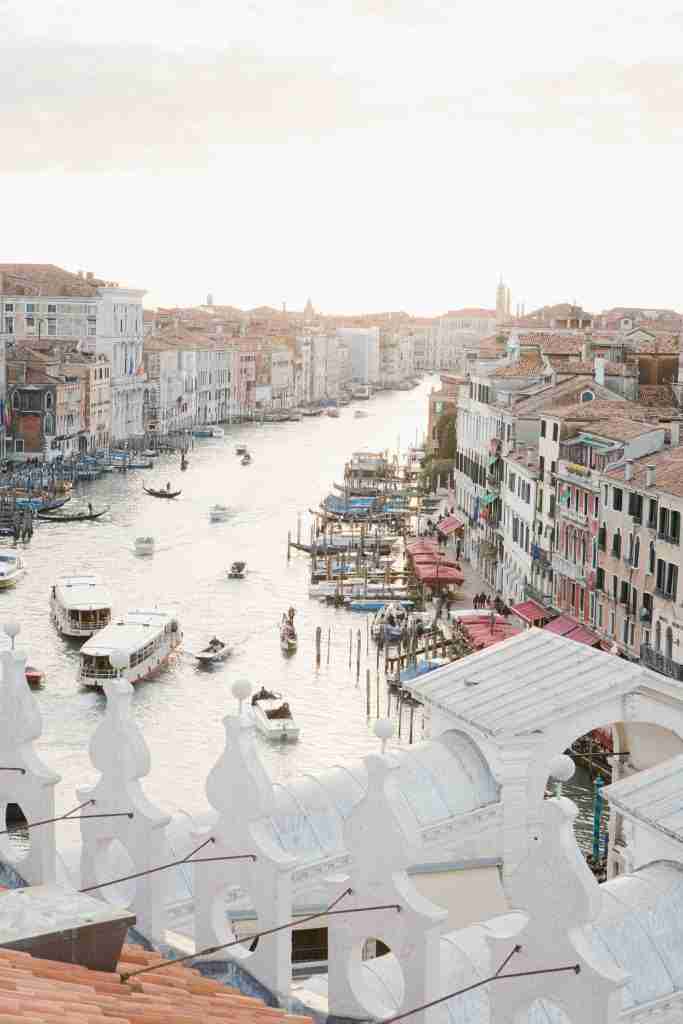
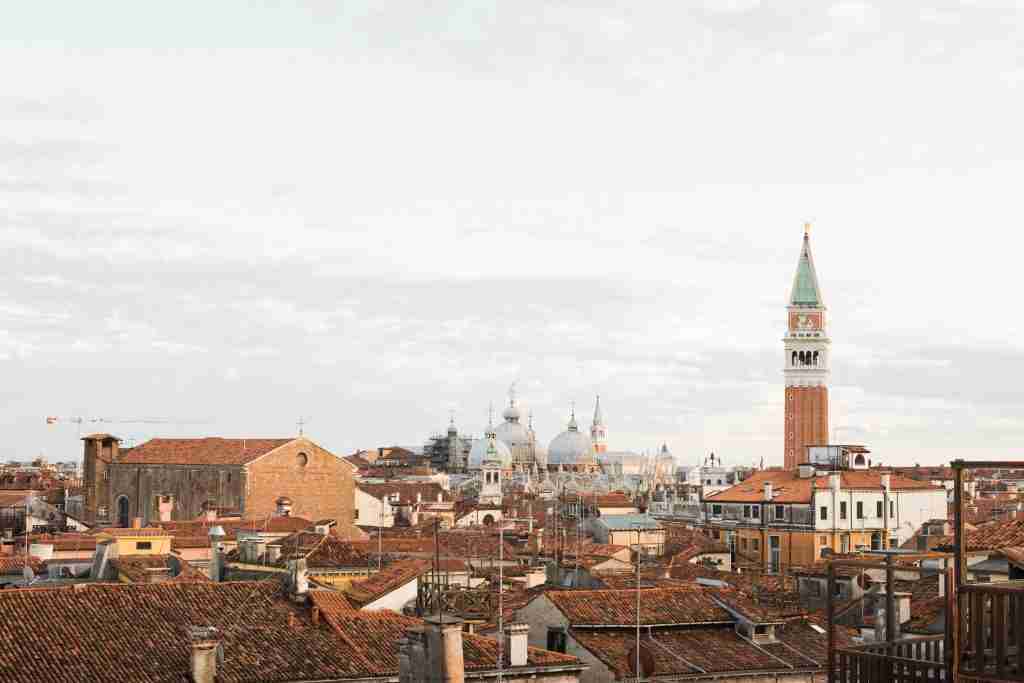
19. How to Get Started
If you’ve read this far, you’re probably already imagining your own version of it. Here’s how we get from that picture in your head to the real morning.
1. Tell me about the two of you
Write to me through my contact page. You don’t need to have decided anything yet, and honestly, it’s better if you haven’t. Tell me roughly when you’re thinking of coming, whether you’re picturing sunrise or golden hour, the city or the lagoon, just the two of you or a few people you love. Tell me whether you’re marrying legally or having a symbolic ceremony, if you know. Most of all, tell me what you’re imagining when you close your eyes. That’s the part I’m really listening for.
2. We talk
If it feels like a good fit, we’ll set up a video call. It’s relaxed and there’s no obligation. It’s simply a conversation about what you’re dreaming of and what’s possible. I’ll ask questions you might not expect: whether you’re morning people, whether you’d rather have silence or a little life around you, what you’d want to remember in fifty years. By the end of the call you’ll have a much clearer picture of your day, whether or not you book with me.
3. Your day takes shape
After we talk, I’ll suggest the collection and the shape of day that fit you best: which light, which neighbourhoods, what time on the water, and whether a second day in the lagoon, the Prosecco hills or the Dolomites makes sense. If Venice turns out not to be the right place for what you’re imagining, I’ll tell you that too, and point you somewhere better.
4. We make it official
When you’re ready, a simple agreement reserves your date. From that moment your day is blocked in my calendar, and the planning begins.
5. We plan it together
This is where everything in this guide becomes yours. I’ll build your route and timeline around the season’s light and tides, and book the boats and reservations. I’ll also introduce you to your officiant, hair and makeup artist and florist, and share a mood board for the day. Section 11 walks through the full countdown. You’ll always know what happens next, and you’ll never have to work any of it out alone.
6. The day itself
You wake up in Venice, get ready, and follow me. Everything else has already been decided. All that’s left for you is to be there, with each other, in one of the most beautiful places on earth.
7. Afterwards
Your first preview images arrive within 48 hours, often while you’re still in Italy. Your full gallery follows, hand-edited image by image, along with a complimentary album design, so your story can become a book you’ll hold for the rest of your lives.
Venice has been the backdrop to love stories for a thousand years. I’d love to help you write yours, somewhere quiet, at the right hour, in exactly the right light.
→ Start the conversation
→ See elopement collections and pricing
Want to see what a real Venice elopement looks like from start to finish? Read Patrycja and Tomasz’s summer sunrise elopement and Giorgia and Alessandro’s Carnival elopement.
With love from Venice,
Camilla
Keep planning
- Venice Elopement Locations: The Complete Guide
- Best Photo Spots in Venice: A Photographer’s Guide
- The Most Romantic Restaurants in Venice
- The Best Wedding Venues in Venice
- How to Elope in Italy: The Complete Guide
If you’ve read this far, you’re probably already picturing your day. Here’s what happens next, from your first message to your gallery.
Camilla is an Italian wedding and elopement photographer based in Venice, covering Italy from the Dolomites to the Amalfi Coast. She specialises in intimate, editorial documentation of elopements and destination weddings for couples who want a day — and images — that feel entirely their own.
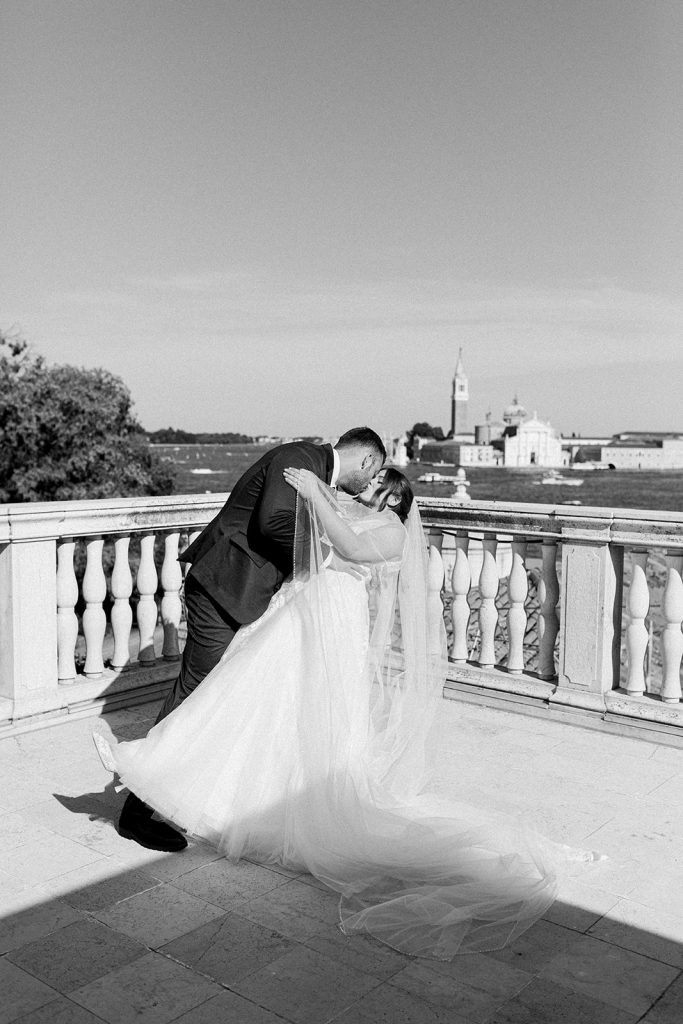



Leave a Comment
Your email address will not be published. Required fields marked *