


Ready to start planning your dream elopement in Italy?
By Camilla M — Amalfi Coast Elopement Photographer & Experience Designer
You already know the view. Everyone does: Positano poured down the cliff in pastel, the majolica dome catching the sun, the sea an impossible blue beneath it.
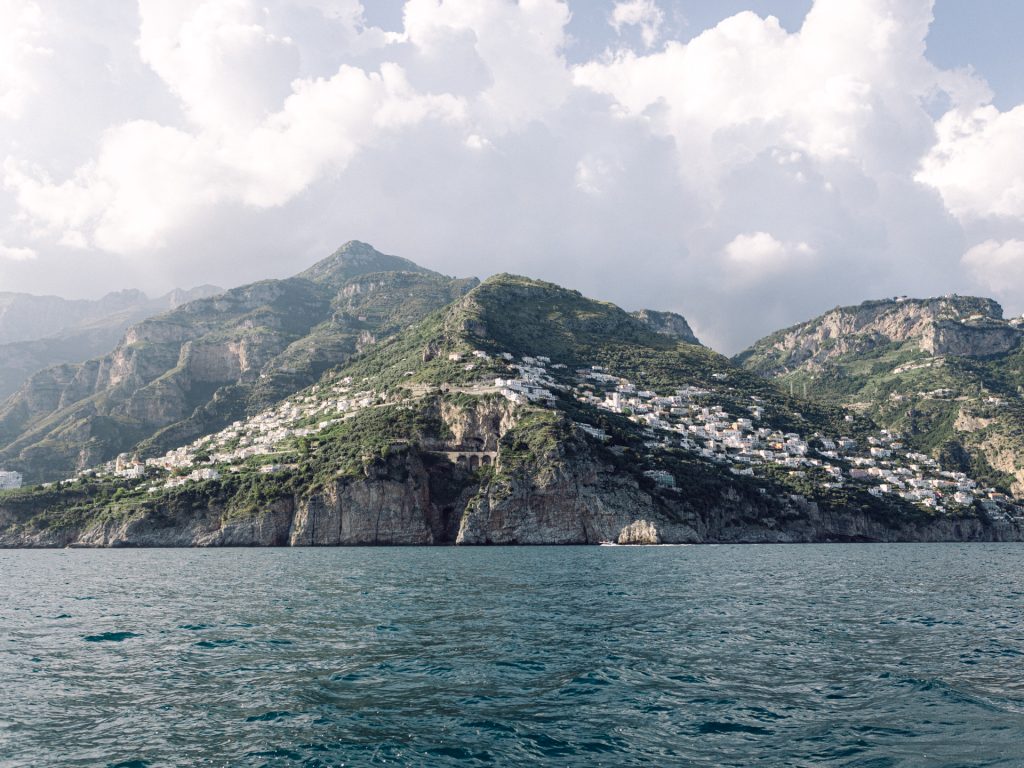
The version of the coast I’d build an elopement around sits just outside that famous frame. When I photographed a couple on a private boat ride here, the coast looked completely different from the water. The towns became small clusters of colour stacked against the rock, the cliffs rose straight out of the sea, and the whole coastline opened up in a way no terrace or viewpoint can show you.
This guide is everything I’d want a couple to know before planning theirs: which town suits the feeling you want, how to move between them by water, where you can actually say your vows, and how to time the day so the coast feels like yours.
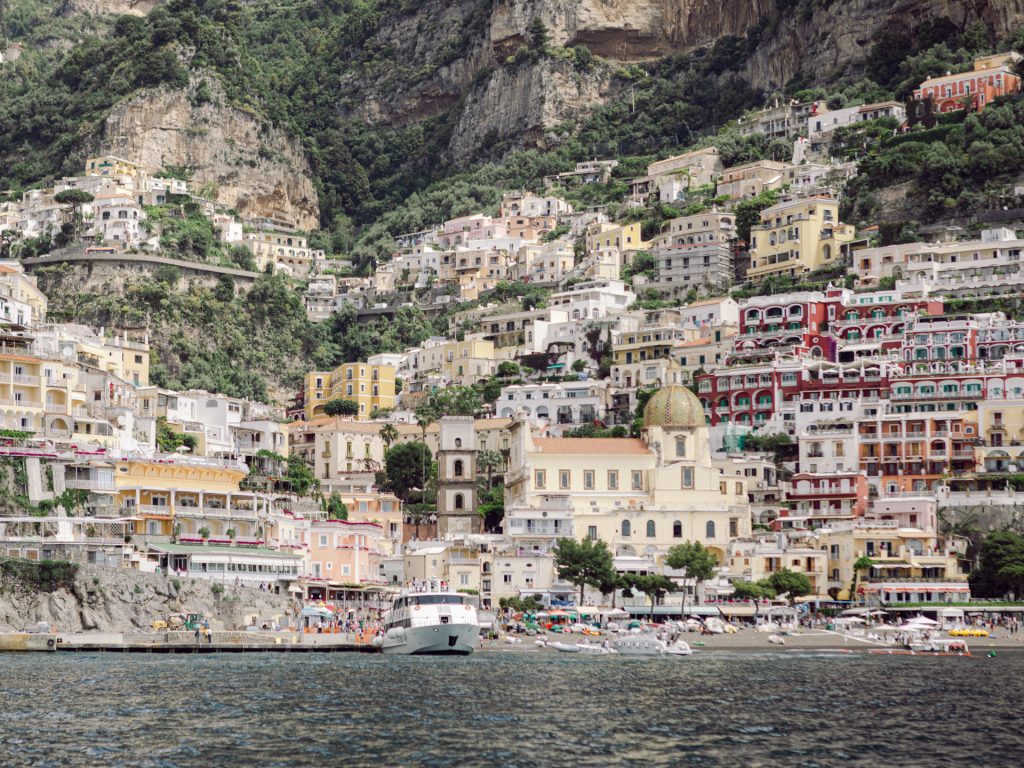
The famous view of Positano when you arrive from the water
1. Why Elope on the Amalfi Coast
The Amalfi Coast is built vertically. For around fifty kilometres, from Positano to Vietri sul Mare, the Lattari Mountains drop almost straight into the Tyrrhenian Sea, and every town has had to climb the rock to exist. Houses stack on top of one another, churches sit on narrow ledges, and lemon groves grow on terraces held up by dry-stone walls. It has been a UNESCO World Heritage Site since 1997, and it’s easy to see why the moment you arrive.
For an elopement, that verticality means the sea is in almost every frame. On a terrace in Ravello, a church step in Praiano or a hotel balcony in Positano, the horizon is right there behind you.
It also shapes the light. The coast faces south over the Gulf of Salerno, so the towns hold the sun for most of the day. In summer, the mountains behind Positano and Ravello start to cast shade across the towns in the early evening, while the sky and the sea are still bright. That window is the one I’d build a ceremony around: soft, even light on your faces, with colour still in the water behind you.
The water is also what connects everything here. From a single private boat you can pass the Fiordo di Furore, where the cliffs close into a narrow inlet, the Emerald Grotto near Conca dei Marini, and the Li Galli islets off Positano. On the way, you see the towns from the one angle the coast road never gives you.
And for all its fame, the coast has quiet corners. Most visitors arrive in July and August and head straight for Positano and Amalfi town. Ravello, 365 metres above the sea, keeps a calmer pace. Praiano, a few minutes along the coast from Positano, is noticeably quieter, and the smallest towns, like Atrani, Furore and Cetara, are quieter still. Choose the right town and the right hour, and your elopement can feel private in a place the whole world wants to see.
2. The Towns of the Amalfi Coast, West to East
“Amalfi Coast” is the name of a coastline rather than a single place. It’s a string of more than a dozen towns along one road, the SS163, and each is its own comune, with its own town hall and its own traffic rules. The town you choose shapes almost everything about your day: the light you’ll have, how you’ll move around and how many people you’ll share it with. Here they are in the order you’d meet them travelling east from Positano.
Positano
The town most people picture when they imagine this coast: pastel houses cascading down the hillside to Spiaggia Grande, with the majolica dome of Santa Maria Assunta at its heart. It’s the most visited town on the coast and the most iconic backdrop Italy has to offer. For photographs, early morning is the time to treasure here. The light is soft, the stone steps are quiet, and the beach is yours before the day begins.

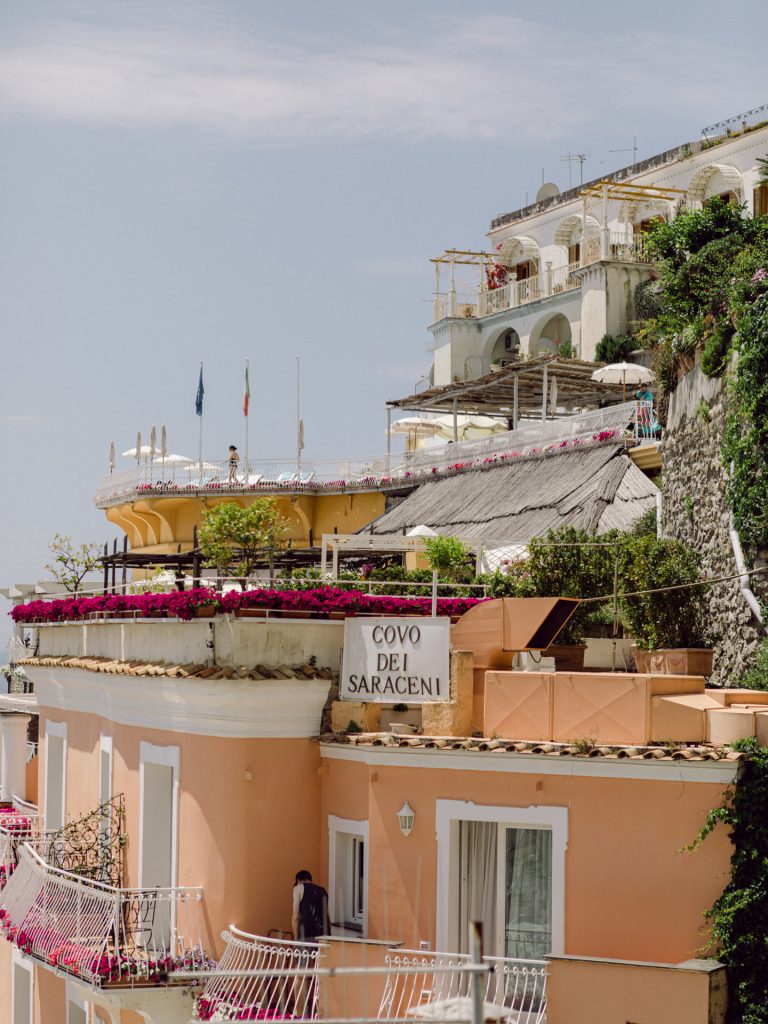

Postcard views of Positano on a sunny spring day
Praiano
A few minutes east of Positano, with the same dramatic cliffs and wide views along the coast in both directions, at a gentler pace. Down at sea level, Marina di Praia is a tiny cove of colourful fishing boats tucked between the rocks. It’s a beautiful choice for couples who want the Positano look with more space around them.
Furore and Conca dei Marini
Furore is known in Italy as il paese che non c’è, “the town that doesn’t exist,” because its houses are scattered up the mountainside rather than gathered around a centre. At sea level it hides the Fiordo di Furore, a narrow inlet where the cliffs close in on either side. Conca dei Marini, just beyond, is home to the Emerald Grotto and to the Monastero Santa Rosa on its clifftop, where the sfogliatella Santa Rosa pastry was first created.

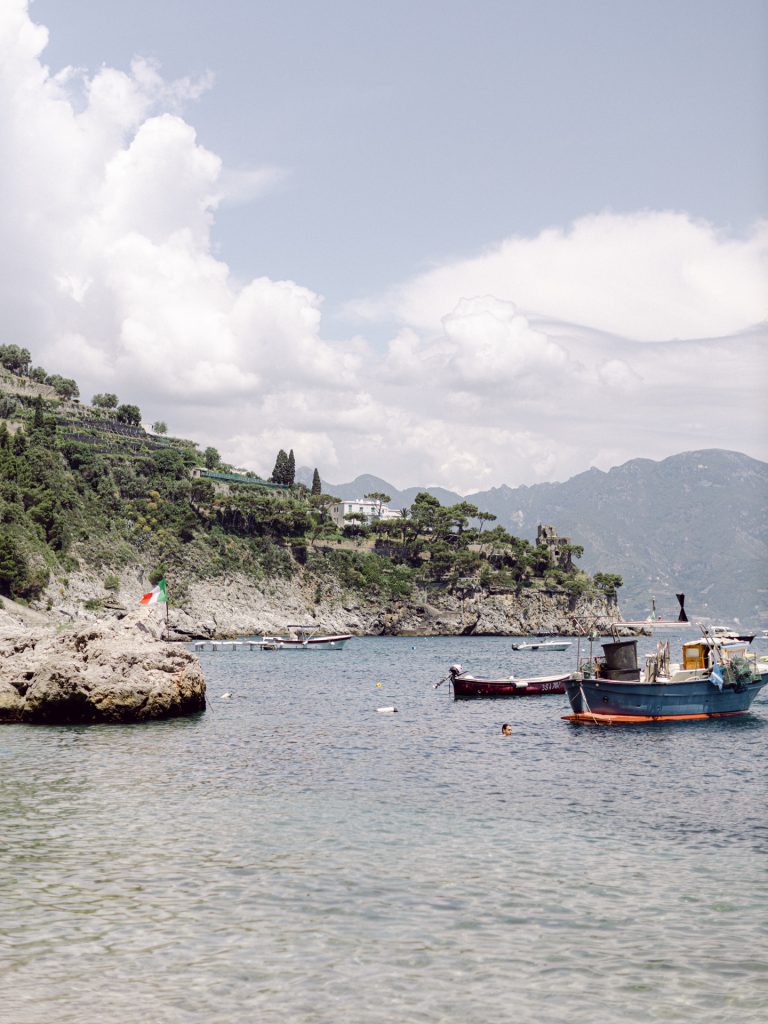

Boats resting on turquoise water and the sea stretching out beneath the cliffs: a sunny day at La Tonnarella in Conca dei Marini, one of the quietest corners of the Amalfi Coast.
Amalfi and Atrani
Amalfi gave the coast its name. In the 10th and 11th centuries it was the capital of a powerful maritime republic, and it still has the grandest monument on the coast: the Cathedral of Sant’Andrea, rising above Piazza del Duomo at the top of its famous staircase. It’s also the coast’s main ferry port, which makes it the most practical base for a day spent on the water. Atrani sits just around the headland, a few minutes’ walk away. It’s a tiny town with a single piazza that opens straight onto its own small beach.

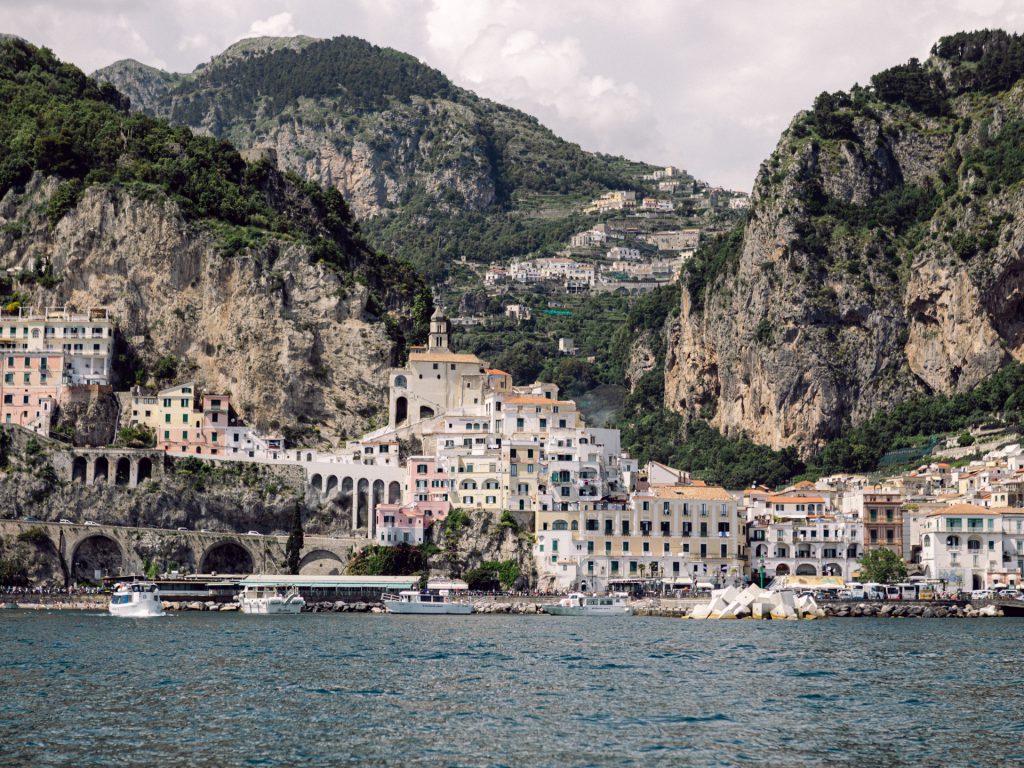
Two sides of Amalfi: the lively square at the heart of town on an ordinary day, and the view that greets you as you arrive by sea.
Ravello and Scala
High in the hills above Amalfi, at 365 metres, Ravello feels like a different world from the coast below. Its stone lanes are calm, and it is home to the gardens of Villa Rufolo and Villa Cimbrone, two of the most celebrated in Italy. With the whole coastline spread out beneath it, Ravello is where I’d look first for a ceremony. You reach it by road rather than by boat. Across the valley, Scala is often described as the oldest town on the coast, and it’s even quieter.
Minori, Maiori, Cetara and Vietri sul Mare
The eastern end of the coast, towards Salerno, has a more local rhythm. Minori has the remains of a Roman villa near its waterfront and a long pastry tradition. Maiori has the longest beach on the coast. Cetara is a working fishing village, famous across Italy for its anchovies and colatura di alici, the anchovy sauce made there. Vietri sul Mare is the home of the hand-painted majolica ceramics you’ll see everywhere along the coast.
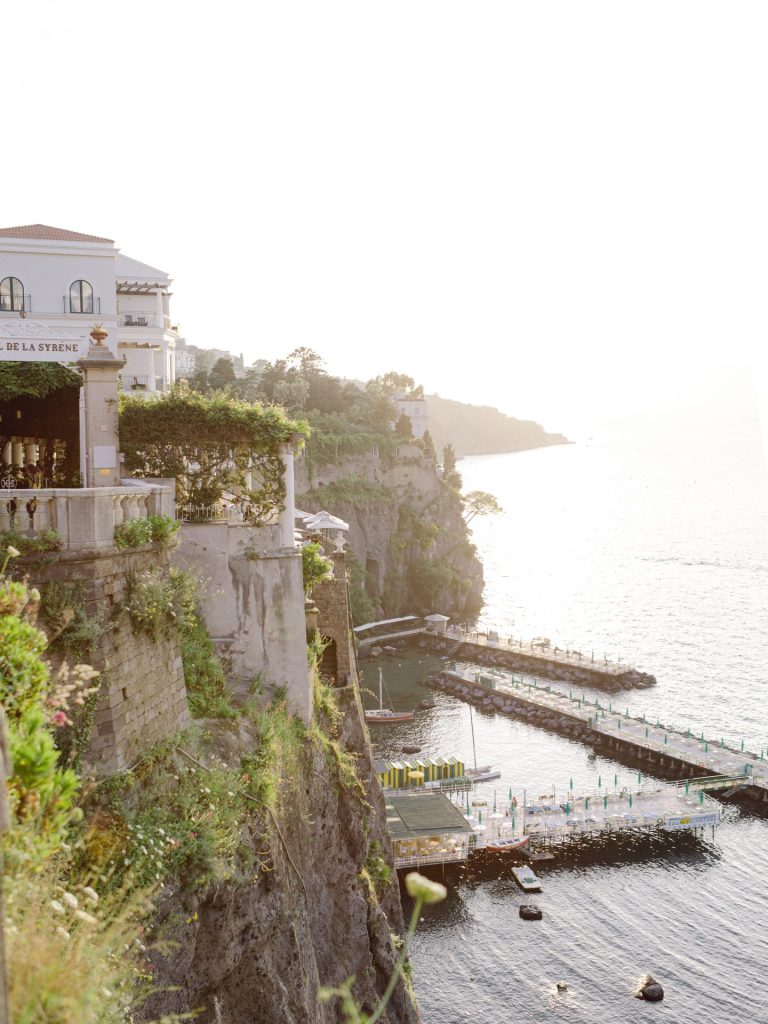

Sorrento from the water’s edge: cliffs rising straight out of the sea, and a quiet beach platform with closed umbrellas and small boats resting on the blue.
A note on Sorrento and Capri
Sorrento and Capri are often grouped with the Amalfi Coast, but neither is technically part of it. Sorrento faces the Bay of Naples on the other side of the peninsula, and Capri is an island off its tip. Both are easy to reach by boat, and either works beautifully as part of an elopement day or as an extra day on your trip.
Choosing your town, in short: Positano for the iconic image, Ravello for gardens and calm above the sea, Praiano for the same coastline with more room, Amalfi for an easy base on the water, and Atrani or Cetara for something small and local.
3. Getting Around: Road, Ferry and Private Boat
Of every destination I cover in Italy, the Amalfi Coast is the most complex when it comes to transport. There’s no railway along the coast, only one road carved into the cliff, and a ferry service that runs for part of the year and depends on the sea. Towns that look a few minutes apart on a map can take far longer to reach by car in peak season.
This is exactly why the planning matters so much here. Every town is linked by that one road and by the sea, and a beautiful day comes down to knowing which one to use, when, and what to switch to if the plan changes. That’s the part I take care of, so on the day itself all you’ll notice is the view.
The road
The SS163, the Amalfitana, is one of the most spectacular drives in Europe: about 40 kilometres of hairpin bends, tunnels and viaducts cut into the cliff, with the sea below you the entire way. It’s a narrow two-lane road with no alternative route, shared by coaches, scooters and local traffic. Each town sets its own rules for access, and the historic centres of Positano and Amalfi are restricted traffic zones monitored by cameras. Parking near both towns is limited and fills early in the day during the warmer months.
For your elopement day, I’d recommend leaving the driving to someone who does it every day. It gives you the view from the passenger seat, and it spares you the hunt for parking in your wedding clothes.
The sea
From spring to autumn, the water is the most beautiful and most relaxed way to move along the coast. Ferries and hydrofoils connect Amalfi, Positano, Salerno and Capri between April and October. Arriving in a town by sea, with the houses rising up in front of you, is how this coast was meant to be seen.
For an elopement, a private boat is the natural next step. It collects you from the nearest pier to your hotel, follows the timeline we build around the light, and turns every transfer into part of the photographs rather than a pause between them. Section 9 covers boat types and prices.
One thing worth knowing: ferries can be cancelled when the sea is rough, and private boats follow the same judgement from their skippers. That’s why every water-based plan I design comes with a land alternative ready.
The bus
The SITA Sud bus runs the full length of the coast road all year round, stopping in every town. It’s inexpensive and scenic, and it’s the only public transport on the coast outside ferry season. Tickets are bought in advance at a tabaccheria or newsagent, not on board. In summer the afternoon return from Positano is the busiest stretch, and buses often arrive already full, so the ferry is the easier choice at that hour. The bus is lovely for a relaxed day of exploring before or after your elopement, while the day itself deserves something more flexible.
A private driver
For everything the sea can’t reach, such as Ravello, hillside hotels and the transfer from the airport, a private driver who knows the coast road is the comfortable choice. Expect roughly €200–350 for a full day with the car included. The driver handles the parking and waits while you take your time.
How I’d plan it: the water for the coast, a driver for the hills. Ravello in the morning by car, the afternoon and golden hour by boat, with a driver on standby in case the sea has other plans.
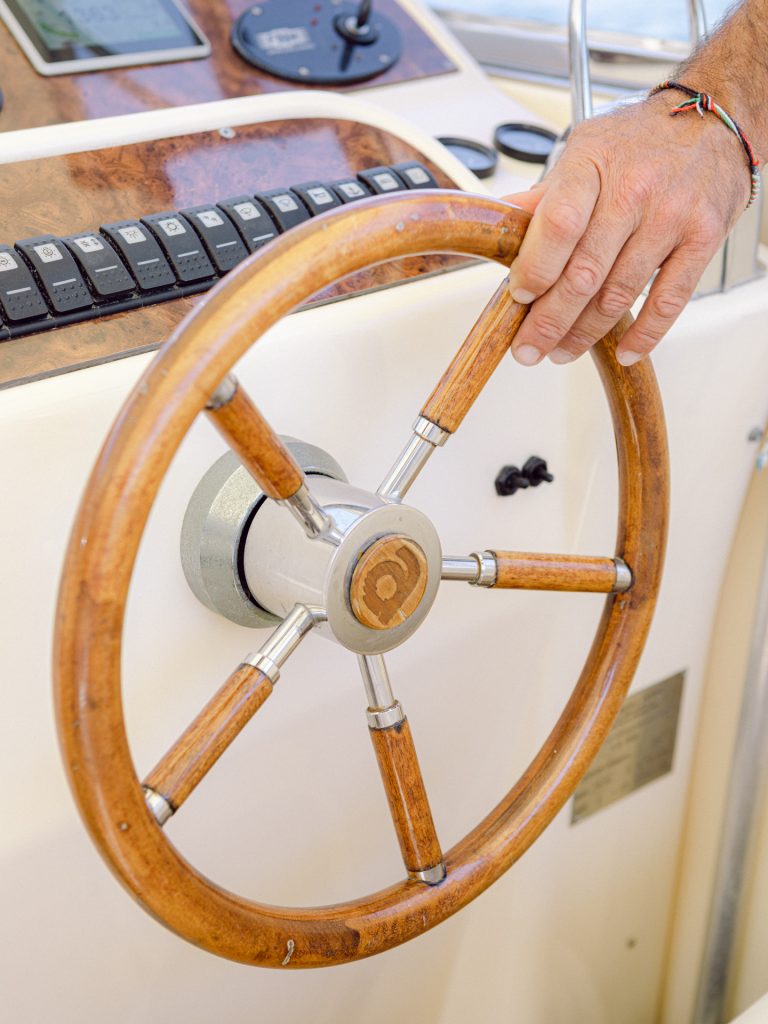

Wood, rope, salt and sea: the small details of a day spent along the coast by boat.
4. Symbolic or Legal: Getting Married on the Amalfi Coast
You can do either here, and on this coast each has its own kind of beauty.
A legal civil ceremony
Even the legal version of a wedding comes with a view on the Amalfi Coast. There’s no single registry office for the whole coast. Each town performs civil ceremonies through its own comune, each in its own setting.
Positano holds civil ceremonies on the sea-view terrace of its town hall, high on the hillside above the town. The terrace is intimate in size, which makes it best suited to a couple on their own or a small group of guests. It’s available any day of the week, weekends included.
Ravello holds them at its town hall, set in the calm, elevated town above the coast.
Amalfi holds them in the Salone Morelli, the ceremonial hall of the town hall, a few steps from the cathedral and Piazza del Duomo.
The ceremony is performed by the mayor or a civil registrar and takes around twenty minutes. You can personalise it with readings and your own vows. Once the marriage certificate is issued and legalised, your marriage is recognised internationally.
What you’ll need. There’s no residency requirement, but there is paperwork, and the exact documents depend on your nationality. In general you’ll need:
- a certificate of no impediment (Nulla Osta), translated and legalised
- a declaration signed at the town hall in the days before the wedding
- two adult witnesses with valid identification
- an official interpreter if you don’t speak Italian (a witness can’t also act as the interpreter)
Some of these documents are only valid for about six months, so the timing needs care. I’ve covered the full process in my guide to marriage requirements for getting married in Italy.
A symbolic ceremony
Most international couples choose this route. They take care of the legal side at home, before or after the trip, and exchange vows on the coast wherever they choose: a hotel terrace above the sea, a garden in Ravello, a quiet stretch of coastline reached by boat. There’s no Italian paperwork, no fixed venue and no fixed time. You can work with an officiant, or simply read your vows to each other.
How to choose
If a legal marriage in Italy matters to you, this coast has some of the most beautiful civil ceremony settings in the country. Give yourselves time: start six months to a year ahead, with a local planner who specialises in the paperwork. If what matters most is the setting and the meaning, a symbolic ceremony gives you complete freedom over both. You can also do both: a short civil ceremony at the town hall, and your own vows somewhere else later that day.
5. When to Elope on the Amalfi Coast: Season and Hour
The short answer: May, and September into October. In those months the coast is fully open, the sea is warm enough to swim in, and the days are long and golden without the full intensity of summer. Here’s how the rest of the year unfolds.
Spring: April to early June
The coast wakes up around Easter. Hotels and restaurants reopen, the ferries start running again, and the lemon groves come into blossom against hillsides that are still green. April brings warm days with the occasional shower, so it suits a flexible plan. May is one of the loveliest months of the year: everything is open, temperatures sit around 20°C, and the sea is already swimmable for the brave. Early June stays relaxed until the Italian school holidays begin in the middle of the month. Easter week itself is lively and festive, with religious celebrations drawing crowds to the towns.
Summer: mid-June to August
The longest, warmest evenings of the year, the sea at its most inviting, and the coast at its most alive. These are also the busiest and hottest months, with the heaviest traffic on the coast road, reaching a peak around Ferragosto in mid-August. A summer elopement works beautifully when it’s built around the edges of the day: early morning in the towns, a long break through the midday heat, and golden hour out on the water. A weekday date makes a real difference in these months.
Autumn: September and October
September has the sea still warm from summer, while the crowds thin from the middle of the month and prices begin to ease. The light turns warmer and lower. October is calmer still and lovely for walking, including the Path of the Gods. Ferry schedules begin to wind down towards the end of the season, so it’s worth checking services for your exact dates.
Winter: November to March
The quietest season, when the coast belongs mostly to the people who live here. You’ll find empty cathedral steps, mild days and a softer, more atmospheric version of the same views. Many hotels, restaurants and ferries close after October, and winter brings most of the year’s rain. A winter elopement needs a flexible plan and a driver rather than a boat. In return you get the coast almost to yourselves. On 30 November, Amalfi celebrates the feast of Sant’Andrea, its patron saint and the town’s most important religious festival. It’s a beautiful moment to be there for a late-autumn date. And the festive season around Christmas and New Year adds its own warmth to the towns.
The hour matters as much as the month
On this coast, time of day shapes the photographs as much as the season does. Sunrise is peaceful and golden in Positano and Amalfi, before the towns fill. Late afternoon is the finest light in Ravello and out on the sea. And as the evening approaches, the mountains begin to shade the towns while the sky and water are still bright. So the natural shape of an Amalfi elopement is the towns in the morning and the water or Ravello’s gardens later in the day, with the ceremony timed to that last soft light.
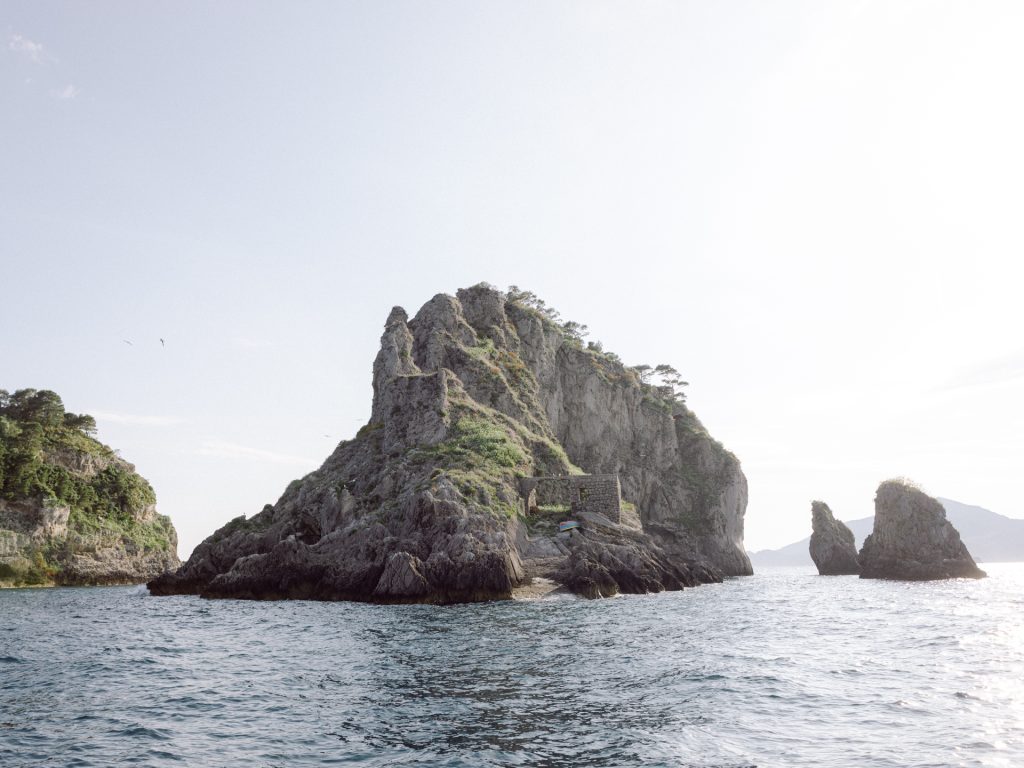
The soft sunshine of a late afternoon in May is incredible for pictures
6. Where to Say Your Vows: Ceremony Locations on the Amalfi Coast
On a coast this vertical, choosing where to say your vows is really choosing a height: high in the gardens of Ravello, on a terrace on the cliffs of Positano, or down at sea level with the water at your feet. Each creates a different feeling, and different photographs.
One thing sets this coast apart from the rest of Italy: very often, the place you stay and the place you marry are the same. Many of the most beautiful ceremony settings here are hotel terraces and private villas, so it’s worth confirming that a property can host your ceremony before you book your room. The prices below are reference figures. Always confirm current rates, as they change from season to season.
High above the sea: Ravello and Scala
Villa Rufolo, Ravello. In the heart of Ravello, a few steps from Piazza Duomo. Villa Rufolo was built by one of the great merchant families of the medieval Republic of Amalfi. Its 13th-century Moorish cloister, with its interlaced arches, and its tall Norman tower lead out to gardens that cascade down the clifftop in terraces of pines, palms and roses above the sea. Richard Wagner visited in 1880 and saw in them the enchanted garden of his opera Parsifal. Private photography sessions here cost far less than at Villa Cimbrone, which makes Rufolo a beautiful and accessible choice for an elopement. From July to September the Ravello Festival builds its stage on the villa’s belvedere, which can close part of the gardens, so check the calendar for your date.
Villa Cimbrone, Ravello. A ten-minute walk from the centre of Ravello along quiet pedestrian lanes. It’s home to the most famous view on the coast: the Terrace of Infinity, a belvedere on the cliff edge lined with classical busts, looking out over the sea. The estate also has a rose garden, a tea garden, a small hotel and the Michelin-starred restaurant Il Flauto di Pan.For a couple on their own, Cimbrone offers two possibilities. The first is a private photography session in the gardens, currently €1,800 plus taxes, and I take care of the booking. The second is an intimate ceremony: the villa has hosted elopements in its gardens and crypt, followed by dinner for two, with fees and conditions set by the villa on request. Its full weddings are a different scale altogether, built around exclusive use of the whole property.
Belmond Hotel Caruso, Ravello. Set in an 11th-century palazzo high in Ravello, Caruso is known for an infinity pool that seems to melt into the sea below, and for gardens of lemon and olive trees looking out over the Lattari Mountains and the Tyrrhenian Sea. It hosts symbolic ceremonies in its grounds, and couples have eloped here on their own. They exchanged vows in the gardens, then dined on a private terrace within them as the sun went down. The hotel is open from spring to early November. For a legal ceremony, Ravello’s civil wedding settings are a short walk away.
Villa Eva, Ravello. A Liberty-style villa set in 3,000 square metres of park, on the path from Ravello’s main square towards Villa Cimbrone. It’s purely an event venue, with no hotel guests, so on the day the gardens belong entirely to you. Symbolic ceremonies take place in the gardens, including at the panoramic edge of the park above the sea. Villa Eva usually hosts weddings with guests, so for a couple on their own it’s best arranged through a local planner. Its sister hotels, Villa Maria and Hotel Giordano, are a few steps away and make an easy base.
La Rondinaia, Ravello. Built around 1930 on the very edge of the cliff, and originally part of the Villa Cimbrone estate. Its name means “the swallow’s nest,” after that position on the edge of the cliff. The American writer Gore Vidal made it his home for more than three decades. Today it’s rented as an exclusive villa, with six bedrooms for up to twelve guests, terraced gardens and a pool. Symbolic ceremonies are held on its terraces, and one of its suite terraces is perfect for a couple on their own. It’s best suited to an elopement with your closest family staying alongside you.
Palazzo Avino, Ravello. Ravello’s “Pink Palace,” once the 12th-century home of a noble family, is intimate and ultra-luxurious. It’s home to the Michelin-starred Rossellinis, whose terrace looks along the coast as far as Minori and beyond. It hosts weddings, so ask about a ceremony for two if you’re staying.
The ruins of the Basilica of Sant’Eustachio, Scala. On a rocky promontory in Pontone, a hamlet of Scala, stand the ruins of what was once one of the finest churches of the medieval Republic of Amalfi. The noble D’Afflitto family built it and dedicated it to Saint Eustace. Today its three apses still rise high above the plateau, open to the sky, with terraces of lemons and olives all around. From the ruins you look out over Atrani and Minori to the hill of Ravello, where the gardens of Villa Cimbrone are clearly visible across the valley.
The basilica is reached only on foot, along stone paths that wind through vineyards and country houses, and that walk is part of what makes it so special for an elopement. Everything for the ceremony, from the chairs to the flowers, traditionally arrives by donkey. It hosts symbolic ceremonies. The site is cared for by a local association, and visitors’ donations support its restoration.
On the cliffs of Positano and Praiano
Hotel Marincanto, Positano. Built around an 18th-century villa, Marincanto sits a short walk from the centre of Positano yet feels quiet, with terraces stepping down the cliff, an infinity pool and its own beach club. It’s one of the few hotels on the coast with a package made specifically for couples eloping on their own: the honeymoon suite, a symbolic ceremony on a private terrace, and a private dinner there afterwards with cake and champagne. For a small group, the terrace of its private villa, Villa Incanto, holds around 20 to 25 guests.
Villa Oliviero, Positano. A family-run private villa on a rocky ridge above Positano, on the side of the bay that catches the very last of the sunset, with views over the beach and out to the Li Galli islets. It sleeps up to twelve guests in six bedrooms, and its terraces can host both symbolic and civil ceremonies. It’s rented as a whole villa, usually by the week, with shorter stays possible in spring and autumn. That makes it a beautiful choice for an elopement with your closest people around you.
Le Sirenuse and Il San Pietro, Positano. Two of the coast’s most legendary hotels. Le Sirenuse, at the heart of Positano, is home to La Sponda, a dining room that opens onto a panoramic terrace in fine weather. Il San Pietro sits on a headland just outside the town, overlooking Positano from a distance. It holds three Michelin Keys, the Guide’s highest award for hotels, and its restaurant, Zass, has a Michelin star. Il San Pietro opens from April to October only, so it suits a spring, summer or early-autumn date.
Casa Angelina, Praiano. Calm and contemporary, set on the cliffs of Praiano, with the Michelin-starred restaurant Un Piano nel Cielo.
Villa Bideri, Praiano. A 16th-century villa among terraced lemon groves on the cliffs of Praiano, with six rooms and two suites, available for exclusive use. It’s a natural fit for an elopement where family and friends stay together.
In Amalfi and Conca dei Marini
Hotel Santa Caterina, Amalfi. A family-owned five-star hotel a short walk from the centre of Amalfi. Its terraced gardens of lemons and oranges tumble down the cliff, and lifts carry you through the rock to a beach club at the water’s edge. Couples elope here with symbolic ceremonies on the garden terraces, the coastline stretching behind them, and dinner at the Michelin-starred restaurant, Glicine, is the natural close to the day. The hotel generally hosts ceremonies together with a celebration on site, so plan your dinner here too.
Monastero Santa Rosa, Conca dei Marini. A 17th-century monastery on its own quiet clifftop, now a small hotel, home to the Michelin-starred restaurant Il Refettorio. It’s one of the most serene settings on the coast.
Borgo Santandrea, Conca dei Marini. A few minutes along the coast from Amalfi, Borgo Santandrea sits 90 metres above the sea, looking down over the old fishing village of Conca dei Marini. It opened in 2021 as the first new luxury hotel on the Amalfi Coast in fifteen years. The building is a 1960s modernist structure, reimagined with handmade tiles, local stone and mid-century furniture from the owners’ own collection. The Michelin Guide awards it two Keys, and its terrace restaurant, Alici, holds a Michelin star. For an elopement, it puts the whole vertical coast inside a single property. You can say your vows on garden terraces planted with lemon, olive and pomegranate trees and jasmine. Lifts descend through the cliff to a private pebble beach and pier at sea level, where a boat can be waiting to take you along the coast after the ceremony. Symbolic ceremonies are held on the garden terraces, overlooking the water, or on the private beach, and they work for a couple on their own or up to around fifty guests. The hotel sets its own schedule for ceremonies, so confirm the start time early, especially in autumn, when the light goes quickly in the evening.
At sea level
Hotel Marmorata, Ravello. Below Ravello, in the small seaside hamlet of Marmorata, this four-star hotel was once an old paper mill, built right above the water. It’s one of the most relaxed choices on the coast. It offers symbolic ceremonies and private dinners on the rocks beside the sea, and a private landing so you can arrive by boat. Its boat transfers reach the town halls and churches of Amalfi, Minori and Maiori, which makes it easy to pair a legal ceremony in town with your own vows by the water.
Giardini del Fuenti, between Cetara and Vietri sul Mare. A garden estate on the cliffs at the eastern end of the coast, with a terrace of roses and a lemon grove above the sea, a beach club below and a Michelin-starred restaurant. It’s licensed to host civil ceremonies on site, as well as symbolic and non-Catholic religious ones. It’s also fully accessible by lift, which is rare on a coast built on stairs. It’s designed for larger celebrations and has no rooms of its own, so ask directly about their elopement options.
On the water. A symbolic ceremony on a private boat is one of the most distinctive ways to marry on this coast. Anchored beneath the cliffs with Positano behind you, or inside the Fiordo di Furore where the rock closes in on either side, the boat becomes the venue. Several operators on the coast offer charters for weddings. How much space you’ll have for an officiant or guests depends on the boat. Because plans on the water depend on the sea, I always keep a ceremony location ready on land.
A B&B or small guesthouse as your base
Some of the most characterful places to stay on this coast are small, family-run B&Bs, especially in Praiano, Ravello and the quieter towns. Most don’t host ceremonies themselves, but they make a lovely, personal base for getting ready, with your vows in a garden, on a boat or at one of the settings above.
In the towns and along the trail
Positano’s Spiaggia Grande at sunrise, the stepped lane of Via Cristoforo Colombo above it, and a stretch of the Path of the Gods high above the coast are all extraordinary places for portraits, and for a ceremony if you’re adventurous. For a ceremony in a public place, local permission may be needed, which I check as part of planning.
For a legal ceremony, the civil settings in Positano, Ravello and Amalfi are covered in section 4.

Borgo Santandrea from the water, where the cliff, the terraces and the sea all become part of the day.
7. Things to Do on the Amalfi Coast On Your Elopement Day
An elopement here doesn’t have to be only a ceremony and portraits. The best days on this coast weave in a few experiences that belong to this place and nowhere else, chosen around what the two of you love. Here are the ones worth considering.
On the water
A private boat along the coast. The most beautiful way to spend part of your day. Pass beneath the cliffs to the Fiordo di Furore, anchor for a swim in a quiet cove, and circle the Li Galli islets off Positano. Many boats can also pull up at a seaside restaurant for lunch, so you step straight from the deck to the table. Boat types and prices are in section 9.
The Emerald Grotto. Near Conca dei Marini, this sea cave glows green when sunlight filters in through an underwater opening. You explore it by small rowing boat, past stalactites and stalagmites, and a ceramic nativity scene lies on the seabed beneath you. It can be reached by boat or by a lift down from the coast road.
Sea kayaking from Positano. For adventurous couples, a morning kayak brings you closer to the water than any boat can, into small caves and coves you can’t reach from land. Guided tours start from Positano’s Spiaggia Grande and include a short lesson, so no experience is needed.
A detour to Capri. Technically not part of the Amalfi Coast, but close enough by boat to fold into a longer day or a second day.
On foot
The Path of the Gods. The coast’s most famous walk, the Sentiero degli Dei, runs about 7 kilometres along the mountainside from Bomerano, above Agerola, to Nocelle, high above Positano. It’s mostly downhill in that direction, with Positano and Capri ahead of you the whole way, and takes around three hours. From Nocelle, a long stone staircase or a short bus ride brings you down into Positano. Some stretches are narrow and exposed, so it suits couples who are comfortable with heights. Spring and autumn are the loveliest seasons for it, and in summer an early start is essential. For a hiking elopement, a quiet stretch of the trail makes an unforgettable place for your vows.
The Lemon Path. A gentler walk through the terraced lemon groves between Minori and Maiori. Along the way, local farms open their doors to offer limoncello or fresh lemonade.
The Valle delle Ferriere. Behind Amalfi, a green and shaded valley of waterfalls, rare giant ferns and the ruins of old paper mills. It’s a surprising, cool contrast to the bright coast below. The lower trail ends right in the centre of Amalfi. The inner nature reserve is protected, so it’s best explored with a local guide.
Lemons, wine and a long lunch
A lemon grove visit and cooking class. The coast’s famous sfusato amalfitano lemons are large, fragrant and grown on terraces above the sea. At the edge of Amalfi, the Aceto family has farmed its lemon groves for six generations and welcomes visitors to walk the terraces, taste their limoncello, and join a cooking class. You can learn to make scialatielli, the coast’s own fresh pasta, then sit down under the lemon trees to eat what you’ve cooked together.
A winery on the cliffs. In Furore, the Marisa Cuomo winery grows its grapes on terraces clinging to the rock above the Fiordo di Furore and ages its wines in a cellar carved into the cliff. Guided tours and tastings are available by reservation, and they make a beautiful, unexpected addition to a day on this coast.
Something sweet. Pasticceria Sal De Riso on the seafront in Minori and the historic Pasticceria Pansa on Piazza Duomo in Amalfi, founded in 1830, are both local institutions. Their delizia al limone, a soft sponge filled with lemon cream, is a lovely way to celebrate right after your vows.
History and craft
The Duomo of Amalfi and the Cloister of Paradise. The cathedral rises above Piazza del Duomo at the top of its grand staircase. Its Arab-Norman cloister, just beside it, is one of the quietest spaces in town if you arrive early in the morning.
The Paper Museum. In the Valle dei Mulini, about a fifteen-minute walk above Piazza Duomo, a 13th-century paper mill still holds its original presses and water-powered machinery, all restored to working order. Amalfi was once one of Europe’s great centres of handmade paper, and during the visit you can make a sheet yourself. The museum shop sells Amalfi paper, which makes it a lovely idea for your vow books: written on paper from the town where you say them.
Ceramics in Vietri sul Mare. The home of the hand-painted majolica you’ll see across the coast. The Solimene ceramics factory is a sight in itself: a building covered in terracotta tiles, designed by the architect Paolo Soleri in the 1950s, where you can watch the potters shape and paint by hand.
The gardens of Ravello. Villa Rufolo and Villa Cimbrone (section 6) are as rewarding to wander as they are to marry in.
As the day ends
An aperitivo on a terrace facing the sunset. A slow walk through Atrani or Praiano once the evening has quietened. The last light on the water from the deck of a boat. You don’t need to fill the whole day: choose two or three things you love and leave room for everything else to happen on its own. Section 10 shows how these fit into a real timeline.
8. Where to Eat on the Amalfi Coast: Restaurants for Your Elopement Dinner
On this coast, dinner is often the last scene of your day. The light fades while you eat, the towns begin to glow across the water, and the ceremony becomes something you’re already remembering together. The right table depends on the kind of evening you want. Book it as soon as your date is confirmed: the best tables here fill early in the season, and many restaurants close for the winter.
A starred dinner above the sea
The Amalfi Coast has one of the densest concentrations of Michelin-starred restaurants in Italy. Many of them sit inside the hotels described in section 6, which makes it easy to marry, dine and sleep in the same beautiful place.
In Positano: Zass at Il San Pietro, with its terrace framed in majolica tiles.
In Praiano: Un Piano nel Cielo at Casa Angelina, whose name means “a floor in the sky.”
In Conca dei Marini: Il Refettorio, set inside the old monastery of Santa Rosa, and Alici on the panoramic terrace of Borgo Santandrea.
In Amalfi: Glicine at Hotel Santa Caterina, and La Caravella dal 1959, a family restaurant that has shaped the coast’s food culture for generations. Save room for its famous lemon soufflé.
In Ravello: Rossellinis at Palazzo Avino, and Il Flauto di Pan inside Villa Cimbrone.
A romantic table without the formality
La Sponda, Le Sirenuse, Positano. The hotel’s panoramic restaurant, with lemon trees and vines overhead and all of Positano below. It’s one of the most romantic dining rooms on the coast.
Trattoria da Gemma, Amalfi. One of Amalfi’s oldest restaurants, serving guests since 1872 from a terrace that looks over the cathedral and the main square. Order the fish soup or the paccheri alla Genovese, and finish with melanzane al cioccolato, the coast’s surprising chocolate-and-aubergine dessert.
Il Pirata, Praiano. Tables on a low terrace right above the water at Marina di Praia, reached along a path cut into the cliff. Dinner here is lit by lanterns, with the sea a few steps from your chair.
Lunch you arrive at by boat
Some of the most memorable meals on this coast can only really be reached from the water, and they fit beautifully into a boat afternoon.
Da Adolfo, near Positano. A simple beach restaurant reached by its own little boat from Positano’s main jetty. You swim, then eat mozzarella grilled on lemon leaves with a carafe of cold white wine.
Lo Scoglio da Tommaso, Marina del Cantone. Around the headland from the Amalfi Coast, on the Sorrento side, a wooden deck built over the bay where the same family has cooked since the 1950s. It’s the place for spaghetti alla Nerano, made with courgettes and Provolone del Monaco cheese. The same small bay is home to Taverna del Capitano (one Michelin star) and Quattro Passi, the only three-star restaurant in the region.
La Tonnarella, Conca dei Marini. On the beach of the little bay of Conca dei Marini, between an old Saracen tower and the promontory of the villa that once belonged to Sophia Loren and Carlo Ponti, La Tonnarella has been serving seafood since the 1960s. It began as the storehouse where local fishermen kept their tonnara, the nets used for tuna fishing. Today its tables sit under a pergola a few steps from the water. The dish to order is the house speciality, spaghetti alla Jacqueline. Arrive by sea if you can: boats moor at buoys in the bay, and the restaurant’s own boat brings you ashore. It can also collect you from Amalfi if you ask when you book. It’s one of the places on this coast I’ve photographed, on a bright day with the boats resting in the bay.
Aperitivo at golden hour
Franco’s Bar, Positano. An elegant open-air bar beside Le Sirenuse on Via Cristoforo Colombo, named after the hotel’s late style-maker Franco Sersale. The cocktails are built around local ingredients, and the view falls across the whole of Positano. It’s a perfect first toast as a married couple before dinner.
For something sweet, the historic pastry shops in section 7 are worth a stop.


Lunch by the sea at La Tonnarella in Conca dei Marini: a historic beach restaurant, and a plate of spaghetti with fresh anchovies and tomato.
9. Your Day on the Water: Choosing a Boat and a Driver
For an elopement on this coast, the boat is not just transport. It’s where you’ll see Positano rise out of the sea, swim in a cove with no one else around, and toast each other with the cliffs behind you. It’s usually where some of your favourite photographs happen too. Here’s what to know to choose the right one.
Gozzo or speedboat?
The gozzo is the traditional wooden boat of the Amalfi Coast and the most beautiful choice for an elopement. It has a wide sunbathing deck at the bow and a shaded seating area at the stern, and larger models have a small cabin below deck with a bathroom. A gozzo is slower than a speedboat but more stable when the sea is choppy, which matters when you’re in your wedding clothes.
A speedboat covers the same distances faster, so it suits a day with many stops squeezed into a few hours. For a bigger celebration with guests, a yacht adds space, cabins and crew.
How long, and what it costs
Private boats here are priced per boat, not per person. Reference prices for 2026:
- A two-hour sunset cruise: from around €500
- A half day (about four hours) on a private gozzo: from around €750
- A full day (seven to eight hours) on a private gozzo: typically €800–1,200
- A luxury yacht for the day: from around €2,000 to over €10,000, depending on the vessel
Four hours is enough to explore the coast by sea, with swim stops. If you’d like to add Capri, or a long lunch ashore, plan for a full day.
Usually included: the skipper, fuel, soft drinks, towels and snorkelling gear. Some boats add prosecco.
Usually not included: lunch ashore, entry to the Emerald Grotto, harbour fees on Capri, and a tip for the crew, where €5–10 per person is customary but never expected.
Where the boat collects you
Most operators pick up from the main harbours along the coast: Positano, Praiano, Amalfi, Maiori, Cetara and Vietri sul Mare, with other piers on request. Several hotels, such as Borgo Santandrea and Hotel Marmorata (section 6), have their own landing, so the boat can meet you at the bottom of the hotel. Choose a departure point you can walk to. The coast road is slow in summer, and a pier near your hotel keeps the whole day relaxed.
Making the boat part of your elopement
Ask for a gozzo with a cabin and bathroom. It gives you a private place to change, freshen up or store your things between locations.
Choose the hour for the light. Mornings are usually calmer on the water, while late afternoon brings the warmest light. Your timeline decides which part of the day belongs on the boat, and section 10 shows how the two fit together.
Plan for wind and spray. Bring flat shoes for climbing aboard, something warm for the evening crossing, and a dry bag for your vows and rings.
Keep a plan on land. Skippers decide on the morning whether the sea is right. Good operators will reschedule or refund if the weather turns, and I always keep a land-based version of the day ready (section 3).
When you work with me, the boat is part of the planning: choosing the operator, the route and the timing so the light is right when you arrive at each place. For ideas on where the coast photographs most beautifully from the water, from the colourful fishing boats of Marina di Praia to the harbour in Amalfi, see my Amalfi Coast photoshoot guide.
On land: a private driver
For everything the boat can’t reach, like Ravello, hillside hotels and the airport, book a private driver with a licensed car (NCC, or noleggio con conducente, in Italian). Expect roughly €200–350 for a full day with the car included. Why I recommend a driver over renting a car is covered in section 3.

10. Amalfi Coast Elopement Timelines, Hour by Hour
On this coast, the day follows the light. Mornings are soft and quiet in the towns, and afternoons belong to the water. In the early evening, the mountains draw shade across the villages while the sea and sky are still glowing. That is the softest light of the day, and the one I build every ceremony around.
When you book a collection with me, your hours are continuous. The long lunch, the boat ride and the walk between places are all part of your story, and they’re photographed as part of it. After the ceremony and your portraits, many days here end down at the water, with golden hour on the sea and a swim as the sun goes down, in swimwear or just as you are.
Below are four examples, one for each of my collections. They’re here to inspire you: your own day will be designed entirely around the two of you.
The Mini Elopement · 4 hours · Borgo Santandrea, Conca dei Marini
One extraordinary place, from its gardens to the sea. A June evening.
5:00 PM · Getting ready. The last touches in your suite, with the doors open to the sea below.
5:45 PM · First look. On the garden terraces, among lemon trees and jasmine.
6:30 PM · Your ceremony. Vows on a terrace overlooking the fishing village of Conca dei Marini, with the coast stretching away on either side.
7:00 PM · Down to the sea. A lift carries you through the cliff to the hotel’s private beach and pier. Portraits at the water’s edge as the evening light turns warm.
8:00 PM · Golden hour on the terraces. A glass of champagne as the sun lowers over the coast.
8:30 PM · Sunset, and dinner begins at Alici on the panoramic terrace, while I capture the last quiet frames.
Coverage: 5:00–9:00 PM.
The Half Day Elopement · 8 hours · Positano and the sea
A June afternoon: vows as the light softens, then the sea at sunset.
1:00 PM · A slow start. A long, light lunch together on your hotel terrace in Positano.
2:30 PM · Getting ready. Hair, makeup and the last details, with the doors open to the view.
4:30 PM · First look on a terrace above the town.
5:15 PM · Your ceremony on a private terrace, as the mountains begin to shade the houses and the light turns soft.
6:00 PM · Portraits through Positano’s lanes, climbing Via Cristoforo Colombo for the view over the whole town.
7:00 PM · Onto the water. A private gozzo waits at Spiaggia Grande, and Positano rises behind you as you head out.
7:30 PM · Golden hour at sea, cruising west along the cliffs towards the Li Galli islets.
8:00 PM · A swim in a quiet cove as the sun goes down.
8:30 PM · Sunset on deck, wrapped in towels, with a glass of prosecco.
Coverage: 1:00–9:00 PM, back at Spiaggia Grande just as the town lights up for dinner.
The Full Day Elopement · 12 hours · Ravello to the sea
The whole story: Ravello in the morning, vows in the afternoon, the sea at sunset. A September day.
8:30 AM · Coverage begins over breakfast on your hotel terrace in Ravello.
9:15 AM · A slow walk through Ravello before the day begins in earnest, with coffee in Piazza Duomo.
11:00 AM · An early, light lunch on the hotel terrace.
12:30 PM · Getting ready. Hair, makeup, the dress or suit, and the rings.
2:30 PM · First look in the hotel gardens, high above the coast.
3:15 PM · Your ceremony in the gardens, with the Gulf of Salerno spread out below you.
4:00 PM · Champagne and portraits through Ravello’s stone lanes and Piazza Duomo.
4:45 PM · Villa Cimbrone. The gardens and the Terrace of Infinity in the late-afternoon light.
5:45 PM · Down to the sea with a private driver, to a boat waiting in Amalfi’s harbour.
6:15 PM · Golden hour on the water, cruising west past Conca dei Marini towards the Fiordo di Furore.
6:45 PM · A swim in a quiet cove as the sun drops towards the horizon.
7:05 PM · Sunset from the deck, wrapped in towels, with a glass of prosecco.
8:00 PM · Back in Amalfi as the harbour lights come on, for the last frames of the day.
Coverage: 8:30 AM–8:30 PM.
The Custom 2-Day Elopement · 16 hours · Positano, Sorrento and Capri
Two days, two moods: your vows and the sea on the first, the sky and the island on the second. June.
Day 1 · 7 hours · Positano: your ceremony and the sea
2:00 PM · Getting ready in your suite at Hotel Marincanto, with the whole of Positano outside your window.
4:30 PM · First look on the hotel’s terraces, stepping down the cliff.
5:15 PM · Your ceremony on a private terrace above the sea, as the mountains begin to shade the town and the light turns soft.
6:00 PM · Portraits through Positano’s lanes, up Via Cristoforo Colombo for the view over the whole town.
7:00 PM · Onto the water. A private gozzo waits at Spiaggia Grande.
7:30 PM · Golden hour at sea, heading east along the cliffs past Il San Pietro, with Positano glowing behind you.
8:00 PM · A swim in a quiet cove near Arienzo, as the sun goes down.
8:30 PM · Sunset on deck, wrapped in towels, with a glass of prosecco.
Coverage: 2:00–9:00 PM. A private dinner on your terrace is yours to enjoy afterwards.
Day 2 · 9 hours · Sorrento and Capri: the sky, the mountain and an island evening
A driver brings you from Positano to Sorrento in the morning. Tonight you’ll sleep on Capri.
11:30 AM · Sorrento. A second look, and a slow walk through the historic centre to the 14th-century cloister of San Francesco and the terrace of the Villa Comunale, looking across the Gulf of Naples to Vesuvius.
12:30 PM · A long lunch in the heart of Sorrento.
2:30 PM · The helicopter. Take-off from Sorrento for a private panoramic flight along the Amalfi Coast. From the air you see Positano, where you married yesterday, and the cliffs you sailed beneath at sunset, before crossing to Capri and landing at the Damecuta heliport in Anacapri.
3:45 PM · Up Monte Solaro. A chairlift of single wooden seats carries you for thirteen minutes over gardens and terraces to the highest point of the island.
4:00 PM · Portraits at the summit, with the Faraglioni far below and the Gulf of Naples, Ischia and Vesuvius on the horizon, then a drink at the little bar on the top.
5:15 PM · Back down the mountain, and an open-top taxi along the cliff road to Capri town.
6:15 PM · The Piazzetta and Capri’s elegant little lanes.
7:00 PM · Via Tragara, a quiet walk to the Belvedere of Punta Tragara as golden hour lights up the Faraglioni.
8:00 PM · Aperitivo on a terrace facing the Faraglioni as the sun goes down.
8:30 PM · The Piazzetta by night, as the day visitors leave and the island becomes yours, for the last frames of your two days.
Coverage: 11:30 AM–8:30 PM.
Would you like your marriage to be legal in Italy? In Sorrento, civil ceremonies are held in the cloister of San Francesco, one of the most beautiful civil settings in the region. Legal ceremonies are covered in section 4.
Choosing your collection
Each of the days above is built on one of my four elopement collections:
The Mini Elopement Experience · up to 4 hours · one location · €3,800
One extraordinary place at sunrise or sunset: your ceremony, your portraits, and time to simply be together.
The Half Day Elopement Experience · up to 8 hours · €6,200 · most chosen
Two or three places and the most beautiful light of the day. This is the collection most of my couples choose.
The Full Day Elopement Experience · up to 12 hours · €8,000
The whole story from morning to night, with time for the gardens, the sea and a long lunch in between.
The Custom 2-Day Elopement Experience · 16 hours across two days · €10,400
Split the hours however you like, for two completely different days: your vows on the coast, then Sorrento, Capri or another corner of Italy.
Every collection includes:
- full experience design and location scouting, including the quiet corners most visitors never find
- a light-driven timeline, a mood board and curated activity ideas
- unlimited planning consultations
- ceremony and officiant coordination
- recommendations for trusted local vendors, and guidance on permits and legal requirements
- drone photography where it’s permitted
- hand-crafted personal editing, with a preview gallery within 48 hours
- a complimentary album design
- my travel, with no hidden fees
You’ll find everything in detail on my elopement collections page. If you’re not sure which one fits the day you’re imagining, tell me about it and we’ll shape it together.

11. Planning Your Amalfi Coast Elopement: Travel, Timing and Your Team
Getting here
Naples (NAP) is the main gateway to the coast, about 60 kilometres from Positano. With a private driver, the journey takes around an hour and a half, and closer to two hours on summer weekends.
Salerno Costa d’Amalfi (QSR), at the eastern end of the coast, reopened to commercial flights in 2024 and now connects to cities across Italy and Europe. It’s especially convenient if you’re staying in Amalfi, Ravello or the quieter eastern towns. By private transfer, Amalfi is about an hour and a quarter away and Positano about an hour and a half.
If you’re planning a November 2026 date, check which airport your flights use: Naples airport is scheduled to close temporarily that month, and many routes are moving to Salerno.
A note on arrival: cars can only reach part of each town, especially Positano. Your driver will bring you to the closest point permitted, and most hotels arrange porters to carry your luggage from there. Soft-sided bags are much easier on a coast built on stairs. For getting around once you’re here, see section 3.
When to start planning
For a date between late May and September, begin six to twelve months ahead. Hotels with ceremony terraces, the best boats and the most sought-after dinner tables are all booked early in the season. April and October are more flexible. If you’d like a legal ceremony in Italy, allow six months to a year for the paperwork (section 4).
The small team around your day
An elopement here needs only a few people, each chosen with care:
- An officiant, if you’d like one. English-speaking celebrants lead symbolic ceremonies across the coast, and many couples simply read their vows to each other.
- Hair and makeup. Artists come to you on the morning of your day, wherever you’re getting ready. Book early for summer weekends.
- Flowers. A bouquet and a buttonhole are often all you need. The coast’s own colours, lemons and bougainvillea against the blue, do a lot of the work.
- Your skipper and your driver, for the boat (section 9) and the land between.
- Your dinner table, reserved as soon as your date is set (section 8).
What I take care of
Planning is included in every one of my collections. That covers:
- choosing your locations, and building a timeline around the light and the sea
- guidance on permits and legal requirements
- coordinating your ceremony and officiant
- recommending the right local vendors for your day
- booking the boat, the driver and the dinner, so they arrive exactly when the light is right
You bring the two of you, and I’ll take care of the rest. Everything included is on my elopement collections page.
If you’re still at the very beginning, my free Italy Elopement Planning Guide walks you through every step, from choosing your region to the paperwork. For the legal side in detail, see my guide to marriage requirements for getting married in Italy.
For an intimate wedding with a larger group of guests, see section 14.

12. How Much Does an Amalfi Coast Elopement Cost?
The Amalfi Coast is one of the most sought-after places in the world to marry, and its prices reflect that. The good news is that an elopement here is completely flexible. You’re paying for the experiences that matter to the two of you, not for a guest list, and you can shape the budget around what you care about most.
What each part of the day costs (2026)
| Typical investment | |
|---|---|
| Photography and planning (my collections, section 10) | €3,800–€10,400 |
| Ceremony setting | Free in public places (with permission) to €10,000+ for exclusive private venues |
| Private photography session at Villa Cimbrone | €1,800 + taxes |
| Celebrant for a symbolic ceremony | from around €300 to €800+ |
| Hair and makeup | €400–€900+ |
| Bouquet and buttonhole | €200–€500+ |
| Private boat | from €500 (two-hour sunset) to €800–€1,200 (full-day gozzo); yachts from €2,000 |
| Private driver | €200–€350 per day |
| Hotel | €250–€1,000+ per night, and more at the coast’s most famous addresses |
| Celebration dinner | €100–€150 per person in a private dining room, around €150–€250 per person for a Michelin-starred tasting menu, wine extra |
| Helicopter flight (optional) | from €3,100 |
Three example budgets
These are estimates for two people, excluding flights.
A simple, beautiful day: around €7,000–€9,000
The Mini Elopement Experience, vows on your hotel’s terrace, a celebrant, hair and makeup, a bouquet, a two-hour sunset boat, three nights in a boutique hotel, and dinner for two.
The classic Amalfi day: around €11,000–€14,000
The Half Day Elopement Experience, a hotel ceremony, a half-day private gozzo with a swim at sunset, a driver, three nights in a hotel with a view, and a celebration dinner.
Two days without compromise: from €25,000
The Custom 2-Day Elopement Experience, a session at Villa Cimbrone, a full day on the water, a helicopter flight over the coast to Capri, four nights at one of the coast’s finest hotels, and two starred dinners.
Where your budget goes further
- Choose the quieter towns. Praiano, Minori and Maiori offer the same coastline, with hotels and restaurants that are often considerably more accessible than in Positano or Ravello.
- Marry where you stay. A ceremony on your hotel’s terrace often means no separate venue fee at all.
- Travel in spring or autumn. May, late September and October bring lower hotel rates, calmer seas and softer light.
- Pick a weekday. Boats, terraces and the best dinner tables are easier to secure, and often gentler on the budget, from Monday to Thursday.
- Dine privately. Private dining rooms in Ravello and Praiano host an elopement dinner from around €100–€150 per person, with no venue fee.
Every one of my collections includes full planning, with no hidden fees and travel anywhere in Italy included. Once you know the day you’re imagining, I’ll help you build the budget around it. You’ll find all the details on my elopement collections page. And if you’re still comparing regions, my free Italy Elopement Planning Guide walks you through costs across the country.
13. Is the Amalfi Coast Right for You?
Many of the couples who write to me know they want to marry in Italy, but haven’t yet decided where. The Amalfi Coast is often the first place they imagine. Here’s how to know whether it’s truly yours.
The Amalfi Coast is made for you if…
You’re drawn to the sea. Cliffs dropping into the water, a boat instead of a car, a swim as the sun goes down: here the Mediterranean is in almost every frame.
You love colour and life. Pastel towns, bougainvillea, lemon groves and elegant terraces make this a coast with energy and style, not a quiet retreat.
You’d like your day to move. A garden in the morning, a boat in the afternoon, a terrace at sunset: few places let you pass through so many settings in a single day.
You’re happy to plan around the coast’s rhythm. Early starts in summer, the water instead of the road, a date booked well ahead. Those are the small trade-offs for one of the most beautiful coastlines in the world.
If your dream looks a little different
Italy has other places that might fit you even better:
For slow days and open countryside, Tuscany. Rolling hills, cypress avenues, vineyards and golden light, with easy roads between places and accommodation that’s often gentler on the budget.
For villas and gardens on the water, Lake Como. Historic villa gardens and a lake framed by mountains, for a classic, elegant elopement.
For mountains and adventure, the Dolomites. Alpine meadows, dramatic peaks and sunrise hikes, for couples who want their vows somewhere wild.
For a city elopement, Venice. Quiet canals at dawn, hidden courtyards and centuries of art, in the city I call home.
Still deciding? My guide to how to elope in Italy compares every region I work in, and includes my free Italy Elopement Planning Guide.
14. Bringing Your Closest People: Small-Group Elopements on the Amalfi Coast
Some couples dream of the intimacy of an elopement with the people who matter most right there beside them: parents, siblings, a best friend or two. The Amalfi Coast is beautifully suited to that. Many of its most beautiful settings are small by nature, and a group of ten feels just as at home on a hotel terrace as a couple on their own.
Settings sized for a small group
Keep everyone under one roof. A private villa such as La Rondinaia in Ravello or Villa Oliviero in Positano sleeps up to twelve guests. Your people share the house, the terraces and the view, and the ceremony happens right where you’re staying. Villa Bideri in Praiano, with six rooms and two suites, is available for exclusive use for a slightly larger group.
Marry on a hotel terrace. At Hotel Marincanto in Positano, the terrace of its private Villa Incanto holds around twenty to twenty-five guests. Borgo Santandrea hosts ceremonies on its garden terraces or overlooking the sea for up to around fifty.
Choose a legal ceremony with a view. The civil ceremony terrace at Positano’s town hall is intimate in size, and ideal for a small group of guests.
All of these are described in section 6.
Thinking about everyone’s comfort
Stairs are part of life on this coast. Positano and Ravello are built on steps, and some of the most beautiful places, like the ruins of Sant’Eustachio in Scala, are reached only on foot. If grandparents or anyone less steady on their feet are joining you, choose settings that are easy to reach:
- Giardini del Fuenti, which is fully accessible by lift
- Borgo Santandrea, where lifts run from the terraces down to the sea
- Hotel Marmorata, where guests can arrive by boat at its private landing
Plan the water for everyone. A larger gozzo or a small yacht can bring the whole group on the boat part of your day. Check its capacity when you book (section 9).
Gather around one table. A private dining room in Ravello or Praiano gives your group the whole room to itself for the celebration dinner, from around €100–€150 per person with no venue fee (section 8).
Help your guests arrive easily. Share the travel basics from section 11 early, including which airport to fly into and how to reach the coast, so everyone lands relaxed and on time.
How I work with small groups
For an elopement with a handful of your closest people, everything works just as it would for the two of you. Experience design, the timeline and day-of coordination are all included in my collections. For an intimate wedding with a larger guest list, I focus on the experience and the photographs, and recommend bringing in a local planner to take care of catering, guest logistics and the details of hosting. That way you can simply be present with the people you love.
15. Where to Stay on the Amalfi Coast, and for How Long
How many nights
Plan for at least three nights: one to arrive and rest after the journey, one for your elopement, and one to spare. The extra night gives you flexibility if the sea asks you to move your boat day, and time to simply enjoy being married. For the Custom 2-Day Elopement, four or five nights feel right. If Capri is part of your plans, spend a night on the island (section 10).
Many couples combine the coast with another part of Italy before or after, such as a few days in Venice or the hills of Tuscany.
Choosing your base
Where you sleep shapes your whole day: the light from your window, how you reach the boat, and how far you are from your ceremony.
Ravello, for gardens and calm. High above the sea, with quiet evenings and the gardens of Villa Rufolo and Villa Cimbrone a short walk away. If your ceremony is in Ravello, stay here. Boats leave from Amalfi, a short drive below.
Positano, for the icon. You wake up in the heart of the coast’s most photographed town, close to its legendary hotels, its lanes and Spiaggia Grande, where the boats leave from the beach. Evenings here are lively and glamorous. Book early for a summer date.
Praiano, for the same view with more space. Between Positano and Amalfi, with the same cliffs and wide views, a gentler pace, and some of the loveliest sunsets on the coast. Boats collect you from Marina di Praia.
Amalfi and Conca dei Marini, for easy days on the water. Amalfi is the coast’s main port, so everything along the coast is within reach by boat. Just outside it, Conca dei Marini offers quiet clifftop hotels such as Borgo Santandrea and Monastero Santa Rosa.
Minori, Maiori and Cetara, for a local rhythm. The eastern towns feel more lived-in and less busy, with more accessible prices and the Salerno airport close by.
Sorrento or Capri, for a second day. Just beyond the Amalfi Coast, and a natural base if your elopement continues across the water (section 10).
What kind of place
A hotel with a ceremony terrace, so you can marry, dine and sleep in the same beautiful place (section 6).
A private villa, if your closest people are joining you (section 14).
A small, family-run B&B, a characterful and personal base for getting ready, with your vows somewhere else on the coast.
Good to know before you book
Most hotels here are seasonal. Many open from spring to autumn and close for the winter. Il San Pietro, for example, opens from April to October, and Belmond Hotel Caruso from March to early November. Check the opening dates against your own.
Ask about the steps. Cars reach only part of each town, and hotels arrange porters to carry luggage from the road (section 11). If anyone in your group finds stairs difficult, ask how many there are between the road and the rooms.
Rates on the coast run from around €250 to over €1,000 per night, and more at the most famous addresses. They’re gentler in May, late September and October.
16. What to Wear for an Amalfi Coast Elopement
The coast is already full of colour: deep blue sea, pastel houses, lemon yellow, bougainvillea pink. Clothes that work with that palette photograph beautifully here. Think soft whites and ivories, warm neutrals, terracotta, blush and sage, or one confident colour that stands out against the blue. Pieces with movement come alive in the sea breeze.
Fabrics for the heat
Summer days here reach the low thirties, so choose fabrics that breathe: linen, silk, chiffon, crepe and light cotton. Evenings on the water turn cooler, especially after sunset, so bring a light layer for the boat ride home.
If you’re wearing a dress
A flowing, lightweight dress moves beautifully on a clifftop terrace and in the wind at sea. A shorter train, or one you can bustle, makes stairs and boat decks much easier. If you’re wearing a veil, secure it well or choose a shorter one, because the sea breeze loves to carry veils away. A light wrap is useful for the evening, and for any church you visit, since Italian churches ask for covered shoulders.
If you’re wearing a suit
Linen or a light wool-and-cotton blend in sand, stone, pale blue or olive looks effortless on this coast. An unlined jacket stays comfortable in the heat, and loafers are lovely with it.
Shoes for a coast built on stairs
Positano and Ravello are made of steps, and the old stone can be smooth underfoot. Block heels, flat sandals or espadrilles are the most comfortable choice. Bring a second pair for walking between places and keep your favourites for the ceremony. On the boat, ask your skipper about shoes on deck (section 9).
For the swim at the end of your day
If your day ends in the sea (section 10), pack swimwear and a towel on the boat. Then decide together whether you’ll change in the cabin, or jump in just as you are.
A second look
For a full day or a two-day elopement, a second outfit gives your story a new chapter: something lighter for Capri, or a dress or suit for dinner that feels different from the ceremony.
In your bag
Sunscreen, sunglasses for between the photos, a small dry bag for your vows and rings on the boat, and anything you’ll want for touch-ups through the day.
Styling suggestions are part of the mood board I create for every couple, so we’ll choose colours, fabrics and details together, around your locations and your light. Everything included is on my elopement collections page.
17. Choosing Your Amalfi Coast Elopement Photographer
Your photographer is the person you’ll spend almost your whole day with, and on this coast, often the person who helps you plan it. Here’s what matters when you choose.
What to look for
Someone who plans the day as well as photographing it. On the Amalfi Coast, the photographs depend on decisions made weeks earlier: which town, which hour, whether you arrive by road or by sea, where the light will be when you say your vows. Look for someone who designs that with you, not just someone who arrives on the day.
A plan for the sea and the weather. Ask what happens if the boat can’t go out, or if a storm rolls in on the morning of your ceremony. The answer should be specific, not “we’ll figure it out.”
Complete galleries, not just highlights. A full gallery shows how someone tells an entire day: the quiet getting-ready moments, harsh midday light, the colours at dusk. Ask to see one or two from beginning to end.
Someone you feel at ease with. You’ll spend hours together on one of the most personal days of your life. When you’re relaxed with the person behind the camera, you stop posing and start living the day, and that’s when the most honest photographs happen.
Questions worth asking
- Is planning included, or is it only photography?
- Are travel, drone photography and editing included, or extra?
- How do you guide couples who feel awkward in front of the camera?
- How many images will we receive, and how soon?
Why couples choose me
I’m Italian and I live in Italy, so I plan every elopement with a local’s understanding of how the country works: its seasons, its towns, its paperwork and its small unwritten rules. I speak English, Spanish and Italian, and conversational French and Portuguese, so nothing gets lost in translation, with you or with anyone we work with on the day.
Before photography, I spent more than fifteen years in cinema as a director of photography. It taught me to read light, to plan a day like a story, and to find the frame before the moment happens. I’ve photographed on this coast, including a couple’s private boat day along the cliffs, and at Borgo Santandrea. Every Amalfi elopement I design starts with detailed research into your locations, the light at your hour, the sea and the logistics that connect them.
My approach to posing is gentle and introvert-friendly. I guide you when it helps, then step back so you can simply be together. Planning is included in every collection, from the first idea to the last frame. You can see everything that’s included on my elopement collections page.
— Louise & Tim
“Camilla really listened to us and understood what we were trying to achieve rather than just stick to a typical routine. She was extremely helpful with suggestions and made the whole experience really enjoyable. We 100% recommend her.”
18. Frequently Asked Questions About Eloping on the Amalfi Coast
Can we elope on the Amalfi Coast if we’re not Italian?
Yes. Most international couples choose a symbolic ceremony, which needs no Italian paperwork, and take care of the legal side at home. A legal civil ceremony in Italy is also possible with the right documents, prepared in advance (section 4).
Where is the best place to elope on the Amalfi Coast?
It depends on the feeling you want. Ravello for gardens and calm high above the sea, Positano for the iconic view, Praiano for the same coastline with more space, and Amalfi for easy days on the water (section 2).
Can we get legally married on the Amalfi Coast?
Yes. Civil ceremonies are held on the sea-view terrace of Positano’s town hall, and at the town halls of Ravello and Amalfi. Just beyond the coast, Sorrento holds them in the 14th-century cloister of San Francesco. My guide to marriage requirements in Italy walks you through the paperwork.
Can we get married on a boat?
Yes, with a symbolic ceremony. Anchored beneath the cliffs or inside the Fiordo di Furore, the boat itself becomes your venue. Legal ceremonies take place at town halls and authorised venues, so many couples do both: a short civil ceremony on land, and their own vows at sea (section 6).
How much does an Amalfi Coast elopement cost?
Most elopements here cost between around €7,000 and €25,000+, excluding flights, depending on your hotel, the boat and the experiences you choose. My collections start at €3,800 and include full planning (section 12).
Is the Amalfi Coast more expensive than Lake Como or Tuscany?
Often, especially for hotels in Positano and Ravello. The quieter towns, such as Praiano, Minori and Maiori, offer the same coastline at more accessible prices, and spring and autumn dates are gentler on the budget too.
What’s the best time of year to elope on the Amalfi Coast?
May, and September into October. The coast is fully open, the sea is warm enough to swim, and the light is golden without the full heat of summer (section 5).
Which airport should we fly into?
Naples is the main gateway, about an hour and a half from Positano by private transfer. Salerno Costa d’Amalfi airport is closer to Amalfi and Ravello, and has welcomed commercial flights since 2024 (section 11).
How many nights should we stay?
At least three: one to arrive and rest, one for your elopement, and one to spare in case the sea asks you to move your boat day. Four or five nights suit a two-day elopement (section 15).
Can we include Capri or a helicopter flight?
Yes. A two-day elopement can include a day on Capri. A private helicopter flight over the coast starts from around €3,100 and is a beautiful way to arrive on the island (section 10).
Do we need a wedding planner?
For an elopement, no. Experience design, the timeline and day-of coordination are included in every one of my collections. For an intimate wedding with a larger guest list, I recommend adding a local planner for catering and guest logistics (section 14).
Can our families join us, including older relatives?
Yes. Many of the coast’s most beautiful settings are sized for small groups. Because the towns are built on stairs, I help you choose places that are easy for everyone to reach, including venues with lifts and settings you can arrive at by boat (section 14).
You’re based near Venice. Do you travel to the Amalfi Coast?
Yes. I work across all of Italy, and travel anywhere in the country is included in every collection, with no hidden fees (collections).
19. How to Begin
You already know the view. Now it’s time to find the version of this coast that belongs to the two of you: the town, the hour, the stretch of sea and the terrace where your story will happen.
Tell me about the day you’re imagining. The town that caught your eye, the season, whether you picture gardens or open water, and who, if anyone, will be there with you. The more you share, the more personal the ideas I can bring you.
Let’s talk it through. By email, or on a video or phone call, we’ll shape your first ideas together, including the locations, the light and the pace of your day. You’ll have direct access to me throughout the planning, with as many consultations as you need.
Secure your date. Summer dates, the best boats and the terraces with a view are reserved early in the season. If you already have a date in mind, reach out soon.
Then leave the details to me. Locations, timeline, boat, driver, dinner: I design every part of it around you and the light. All that’s left for you is to arrive, and be there for every moment.
Tell me about your Amalfi Coast elopement →
Not quite ready? My free Italy Elopement Planning Guide walks you through everything, from choosing your region to the paperwork, so you can start dreaming with a plan.
Camilla is an Italian elopement photographer and experience designer based near Venice, creating intimate elopements across all of Italy: the Amalfi Coast, Lake Como, Tuscany, the Dolomites, Venice and Sicily. Crafting unique, intimate elopements in Italy where every moment feels quietly extraordinary. Travel anywhere in Italy is included in every collection.
→ View my elopement collections
Keep reading: How to Elope on Lake Como · How to Elope in Tuscany · How to Elope in the Dolomites · How to Elope in Venice


Leave a Comment
Your email address will not be published. Required fields marked *